No biological threat in the history of modern apiculture rivals the destructive impact of the ectoparasitic mesostigmatid mite Varroa destructor. Originally an evolutionary parasite of the Eastern honey bee (Apis cerana) in Southeast Asia—where it reproduced exclusively in seasonal drone brood without killing host colonies—Varroa jumped species to the Western honey bee (Apis mellifera) in the mid-20th century, reaching Europe in the 1970s, North America in 1987, New Zealand in 2000, and mainland Australia in 2022. Because Apis mellifera lacks coevolved strict limits on worker-brood parasitism, an unmanaged mite population doubles every 21 to 28 days while brood is present, collapsing the colony within 12 to 24 months.
Crucially, for nearly half a century entomologists mistakenly believed that Varroa mites fed passively on honey bee hemolymph (blood) like ticks. Landmark research published in PNAS by Dr. Samuel Ramsey (2019) proved that Varroa destructor actually liquefies and consumes the honey bee Fat Body tissue—the vital organ analogous to the mammalian liver and immune system—while injecting lethal loads of Deformed Wing Virus (DWV-A and DWV-B).
Why Fat Body Consumption Destroys Winter Survival and Immunity
The honey bee fat body is a thin sheet of metabolic tissue lining the interior ventral and dorsal body wall of the abdomen. It performs nine essential physiological functions for the bee:
- Vitellogenin Synthesis: Synthesizes vitellogenin ($Vg$), a glycolipoprotein that acts as a powerful antioxidant, extends worker lifespan from 6 weeks (summer bee) to 6+ months (winter diutinus bee), and allows nurse bees to produce royal jelly even when fresh pollen is scarce.
- Humoral Immune Peptide Production: Synthesizes antimicrobial peptides (apidaecin, abaecin, defensin-1, hymenoptaecin) that defend the bee against bacterial and viral pathogens.
- Pesticide Detoxification & Water Regulation: Houses cytochrome P450 monooxygenases that detoxify agricultural neonicotinoids, fungicides, and miticides, while synthesizing cuticular hydrocarbons that prevent adult bees from dehydrating.
When an adult female Varroa mite wedges herself beneath the overlapping abdominal sternites (preferentially between the 3rd and 4th ventral segments on the left side of the abdomen) during her dispersal phase, she pierces the intersegmental membrane with her chelicerae, injects salivary digestive enzymes that dissolve the fat body cells via extra-oral digestion, and sucks out the nutrient-rich tissue. A pupa or adult bee whose fat body has been ravaged emerges underweight, immunodeficient, incapable of detoxifying agrochemicals, and utterly unable to survive the winter cluster.
A foundress female mite enters an uncapped brood cell roughly 15–20 hours before capping (Day 8). Sixty hours after capping, she lays an unfertilized haploid male egg, followed every 30 hours by fertilized female eggs. Because worker brood remains capped for 12 days (21 days total), a foundress produces 1.2 to 1.5 mature mated daughters per worker cell. Because drone brood remains capped for 14.5 days (24 days total), she produces 2.2 to 2.6 mature daughters per drone cell—which is why culling capped green drone comb frames removes mites mechanically!
Integrated Pest Management (IPM): Alcohol Wash Thresholds and Treatment Matrix
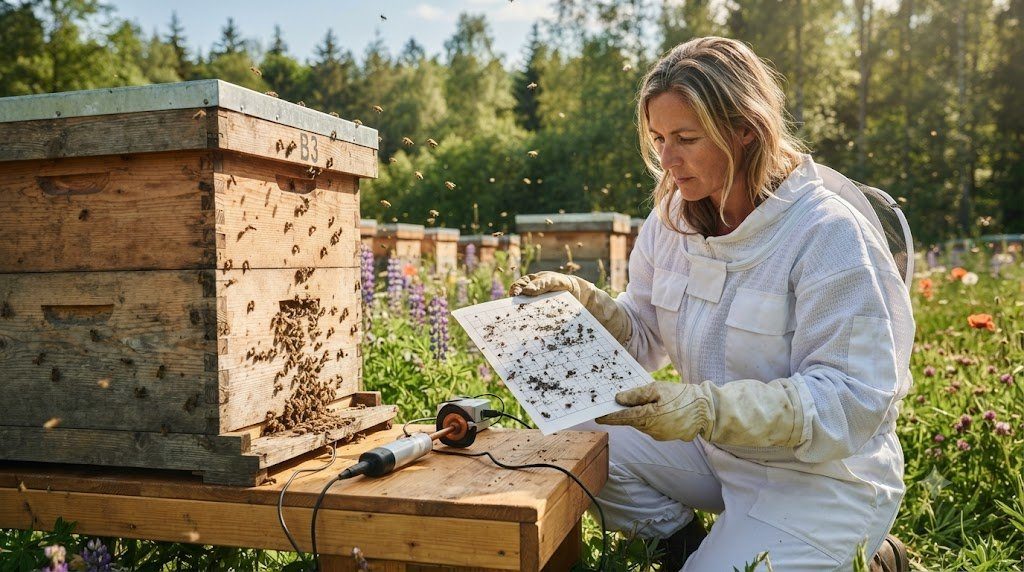
Never guess your mite load by looking for mites on the backs of adult bees! Because over 80% of disperser mites cling tightly to the underside of the bee’s abdomen where they are invisible from above, by the time you casually spot mites walking on thorax tops or see bees with shriveled deformed wings crawling in the grass, your infestation already exceeds 10% to 15% and the colony is in terminal viral collapse. Perform a monthly Alcohol Wash (or soapy water wash) of 300 nurse bees (1/2 level cup shaken from a frame of open/emerging brood after verifying the queen is safe) from April through October.
| Approved Varroa Treatment | Active Ingredient & Class | Safe Ambient Temp Window | Penetrates Capped Brood? | Allowed With Honey Supers On? | Typical Efficacy & Best Season |
|---|---|---|---|---|---|
| Formic Pro / MAQS | Formic Acid (Organic Acid) | 10°C to 29.5°C (50°F–85°F) | YES! (Kills mites under cappings) | YES (Naturally occurring in honey) | 85%–95%; Best in Summer / Early Autumn |
| Oxalic Acid Vapor / Dribble | Oxalic Acid Dihydrate | Above 2°C (>35°F for dribble) | NO (Kills phoretic mites only) | YES (Wait till after harvest or follow label) | 95%+ when broodless (Late Nov/Dec or splits) |
| Apiguard / Thymovar | Thymol (Botanical Terpene) | 15°C to 30°C (60°F–86°F) | NO (Vapors act over 28 days) | NO (Taints honey with thyme odor!) | 80%–90%; Late summer after pulling supers |
| HopGuard III | Potassium Salts of Hop Beta Acids | 10°C to 35°C (50°F–95°F) | NO (Contact strip; best w/ brood break) | YES (Food-grade hop extracts) | 70%–85% (Higher in broodless packages/splits) |
| Apivar Strips | Amitraz (Synthetic Formamidine) | Not temperature dependent | NO (Requires 42–56 day exposure) | NO (Remove strips 14 days before supering) | 90%–95% (Watch for emerging resistance) |
| Capped Drone Frame Culling | Biotechnical Mechanical Trap | Active Spring Drone Season | 100% (Entire capped frame frozen) | YES (Zero chemical input) | Removes 15%–25% of spring mite build-up |
Organic Acid Mechanics: Formic Acid vs. Oxalic Acid Protocols
Modern sustainable Varroa management relies heavily on rotating organic acids and botanical thymol with mechanical brood breaks so mites can never evolve single-site genetic target resistance (as occurred rapidly with early pyrethroids like fluvalinate and organophosphates like coumaphos):
Formic Acid: The Only Miticide That Penetrates Wax Cappings
Because 65% to 80% of the total Varroa population inside a summer colony is hidden underneath sealed wax brood cappings at any given moment, contact strips and oxalic vapor cannot reach them in a single dose. Formic acid (formulated in polysaccharide gel strips such as Formic Pro) releases a controlled low-molecular-weight vapor that diffuses directly through porous brood cappings, killing both phoretic mites and reproducing mother and male mites inside the cells! However, strict adherence to the 29.5°C (85°F) maximum daytime high temperature ceiling during the first 3 days of application is mandatory to prevent flash evaporation from burning young open larvae or causing queen supersedure.
Oxalic Acid Dihydrate: Broodless Winter Clean-Up and Extended Release
Oxalic acid ($C_2H_2O_4 \cdot 2H_2O$) kills phoretic mites on contact by acidifying and damaging their soft membranous ambulacra (foot pads) and mouthparts. Applied as a single trickle/dribble (5 mL per bee seam of a 3.2% oxalic acid in 1:1 sugar water solution) or sublimated via a heated vaporizer pan (using an NIOSH-approved organic acid respirator!) during the natural broodless period of late November or December—or 18 days after making a walk-away spring split when all brood has emerged and new brood is not yet capped—a single oxalic treatment wipes out 95% to 98% of the mites, sending your colonies into spring virtually mite-free.
The Critical August Deadline: Protecting Your Winter Bee Cohort
The single most common mistake in beekeeping is waiting until late October to treat for Varroa. In temperate climates, the colony rears its final generations of long-lived winter diutinus bees between August 15 and September 30. Even if you achieve a 99% mite kill in November, if your mite wash exceeded 2% to 3% (6 to 9 mites per 300 bees) in August, the winter bees were already parasitized as pupae and infected with high titers of Deformed Wing Virus. Test every hive on August 1st, intervene immediately if counts reach 2%, and perform a follow-up wash 14 days after treatment ends to verify efficacy.
Deformed Wing Virus (DWV-A vs. DWV-B) and Phoretic Vector Epidemiology
Prior to the arrival of Varroa destructor, Deformed Wing Virus (DWV) existed in Western honey bee populations as a rare, benign, low-titer virus transmitted horizontally via royal jelly and vertically via drone semen, almost never causing visible pathology. How did Varroa turn a harmless background virus into a global colony killer?
By changing the route of transmission from oral digestion (where the honey bee gut lining and peritrophic membrane block massive viral replication) to direct hypodermic hemocoel/fat-body injection during the fragile white-eyed pupal stage! Worse still, recent molecular epidemiology has documented the global sweep of recombinant DWV Master Variant B (DWV-B, formerly Varroa destructor Virus-1), which actively replicates inside the salivary glands and synganglion of the Varroa mite itself, driving viral loads to $10^{10}$ to $10^{12}$ viral genome copies per bee.
Recognizing Parasitic Mite Syndrome (PMS) Before Total Collapse
When a colony’s August/September alcohol wash exceeds 5% to 8% (15 to 24 mites per 300 bees), the brood nest begins exhibiting clinical Parasitic Mite Syndrome (PMS)—a multi-pathogen collapse frequently mistaken by beginners for European or American Foulbrood:
- Capped Pupae Chewed Open (‘Bald Brood’ / Cannibalism): Nurse bees uncap infested white-to-purple-eyed pupae whose heads are chewed off or partially cannibalized due to extreme viral and mite stress.
- Slumped, Melted White Larvae/Prepupae That Do NOT Rope: Unlike EFB (which twists yellowish in open early instars) or AFB (which ropes 2 inches in dark caramel scales), PMS larvae slump into odorless pearly-white puddles at the cell margins with white guanine mite fecal crystals visible on the upper interior cell roof!
- Crippled Emerging Bees With Stubby Shriveled Wings: For every 1 adult bee you see crawling in front of the hive with shriveled wings, at least 50 other bees in the colony are asymptomatically infected with shortened lifespans and cognitive navigation failure.
Clinical Diagnostic Inspection Workflow and Lab Sampling Protocols
Translating honey bee pathobiology, endocrinology, and pheromone chemistry into thriving colonies requires a systematic, repeatable Clinical Brood-Nest Inspection Protocol. Rather than pulling frames randomly from the middle of the hive (which risks rolling the queen between tight combs), always start by removing the outermost honey/pollen frame (#1 or #10) to create a wide working gap, then inspect frames sequentially toward the center while auditing five biological biomarkers.
| Biological Biomarker | Healthy Colony Baseline | Subclinical Warning Sign | Acute Pathological Crisis | Immediate Corrective Intervention |
|---|---|---|---|---|
| Egg & Young Larval Ring | Single upright eggs centered on floor; rich pool of white jelly | Dry larvae with minimal jelly (Nutritional stress) | Multiple eggs plastered on cell walls (Laying workers) | Feed 1:1 syrup + polyfloral pollen patty; unite laying workers w/ queenright nuc |
| Capped Brood Symmetry | >90% contiguous convex tan caps; 5–8% heater shafts | 15–25% spotty empty cells; occasional chewed pupae | Sunken greasy perforated caps; ropy brown scales (AFB) | Run alcohol mite wash & matchstick rope test; isolate hive tool |
| Varroa Mite Load (300 Bees) | < 1% (<3 mites/300 bees) in spring & autumn | 2% to 3% (6–9 mites/300 bees) in summer | > 4% (12+ mites) + bees with shriveled wings (DWV) | Apply temperature-matched IPM (Formic Pro, Thymol, or Oxalic + brood break) |
| Adult Bee Gut & Demography | Plump fuzzy nurses; clean entrance; active pollen loads | Slow spring buildup; high forager mortality | Dysentery streaking; crawling bees w/ K-wings (Nosema/CBPV) | Check 400x wet mount for Nosema spores; requeen & rotate dark comb |
| Acoustic & Pheromonal Tone | Calm low 180–220 Hz hum; cohesive frame carpet | Elevated roaring pitch when smoked; empty cups | High-pitched queenless roar; fanning without homing | Insert test frame of young eggs/larvae from healthy hive to verify queen status |
The ‘Test Frame of Eggs’ Assay: Definitive Queenlessness Diagnosis
What should you do when you open a hive in mid-summer, see zero eggs and zero young C-shaped larvae, hear a loud roaring hum, yet cannot tell whether the colony is truly queenless OR whether a slim, unmated virgin queen is hiding somewhere on the combs? Never blindly drop a $45 mated queen cage into a hive that might harbor a hidden virgin queen—the resident virgin will immediately sting the caged queen through the mesh!
Instead, perform the foolproof Test Frame Biological Assay:
- Go to a healthy, booming queenright colony in your yard, select a frame containing hundreds of fresh upright eggs and newly hatched 24-hour-old larvae, brush 100% of the adhering bees back into their parent hive, and mark the top bar of this test frame with a thumbtack.
- Insert this frame of fresh eggs right into the center of the suspect colony’s brood nest and close the hive.
- Read the Result Exactly 72 Hours Later: If the colony was truly queenless, the desperate nurse bees will have pulled 5 to 15 unmistakable emergency queen cells directly over the young larvae on your test frame! You can now either let them finish one prime cell OR pinch the emergency cells and introduce a mated queen with 100% confidence. Conversely, if zero queen cells are pulled on the test frame after 72 hours, a virgin (or newly mated queen about to start laying) is already present inside the hive!
In the United States and Canada, state apiary programs and the USDA-ARS Bee Research Laboratory (Beltsville, Maryland) provide free clinical microscopy and molecular diagnostics for suspected brood and adult bee diseases! To submit a suspicious brood sample, cut a 4×4-inch square of affected comb containing dead larvae/scales, wrap it in a dry paper towel or porous newspaper inside a cardboard box (NEVER wrap comb in plastic bags or aluminum foil, which causes saprophytic mold growth that ruins lab analysis!), and mail with your apiary contact form.
Frequently Asked Questions: Pheromones, Mites, and Brood Pathology
Does an alcohol wash kill the 300 nurse bees—and is a powdered sugar roll just as accurate?
While an alcohol wash (or Dawn ultra-dish-soap water wash) sacrifices ~300 nurse bees out of a colony of 45,000 bees (where the queen lays 1,500 new eggs every single day—meaning those 300 bees represent just 4.8 hours of the queen’s daily egg output!), comparative field validations by Dr. Randy Oliver show that agitated alcohol/soapy-water washes recover 98% to 100% of phoretic mites consistently. In contrast, a powdered sugar roll frequently undercounts mites by 30% to 50% on humid days or when performed with coarse sugar, giving beekeepers a false sense of security that can cost the entire colony of 45,000 bees in winter.
How can I tell the difference between laying worker drone brood and a drone-laying queen?
Both produce raised, bullet-shaped drone cappings inside worker-sized cells, but their egg-laying patterns are completely different! A failing or unmated drone-laying queen has a long abdomen that reaches the bottom of the cell, so she still lays 1 single unfertilized egg centered neatly on the cell floor in a cohesive patch. In contrast, laying workers have short abdomens that cannot reach the bottom of a deep comb cell; they lay 5 to 15 eggs chaoticly plastered along the vertical side walls of each cell, often depositing eggs right on top of stored bee bread (pollen) cells!
Why do bees throw white pupae out on the landing board after a cold spring night?
If a fast-expanding colony stretches its brood nest across 7 frames during warm April days and a sudden -3°C (26°F) freeze strikes overnight, the cluster must contract tightly toward the center to keep the core at 34.5°C. The outermost ring of brood left outside the contracted cluster mantle suffers Chilled Brood. Unlike infectious bacterial foulbrood, chilled brood affects a neat concentric outer ring of all ages simultaneously, turns gray-black without ropiness or foul odor, and hygienic house bees rapidly uncap and drag the dead white/gray pupae out onto the front porch within 48 hours as weather warms.