As a holometabolous insect (undergoing complete four-stage metamorphosis: Egg $\rightarrow$ Larva $\rightarrow$ Pupa $\rightarrow$ Adult Imago), the honey bee performs one of the fastest developmental growth sprints in the animal kingdom. Over just 6 days of open larval feeding, a newly hatched worker larva increases its body mass by an astonishing 1,500-fold—going from a 0.1-milligram translucent comma to a plump, pearly-white 150-milligram fifth-instar larva coiled tightly across the floor of its hexagonal wax cell.
Memorizing the exact ontogenetic timeline of Queens (16 days), Workers (21 days), and Drones (24 days), understanding the microbiology of fermented bee bread, and recognizing how the hormonal balance between Vitellogenin ($Vg$) and Juvenile Hormone ($JH$) governs age polyethism and winter bee longevity are foundational skills for every serious apiarist.
Ontogenetic Developmental Clock: Queen (16d), Worker (21d), and Drone (24d)
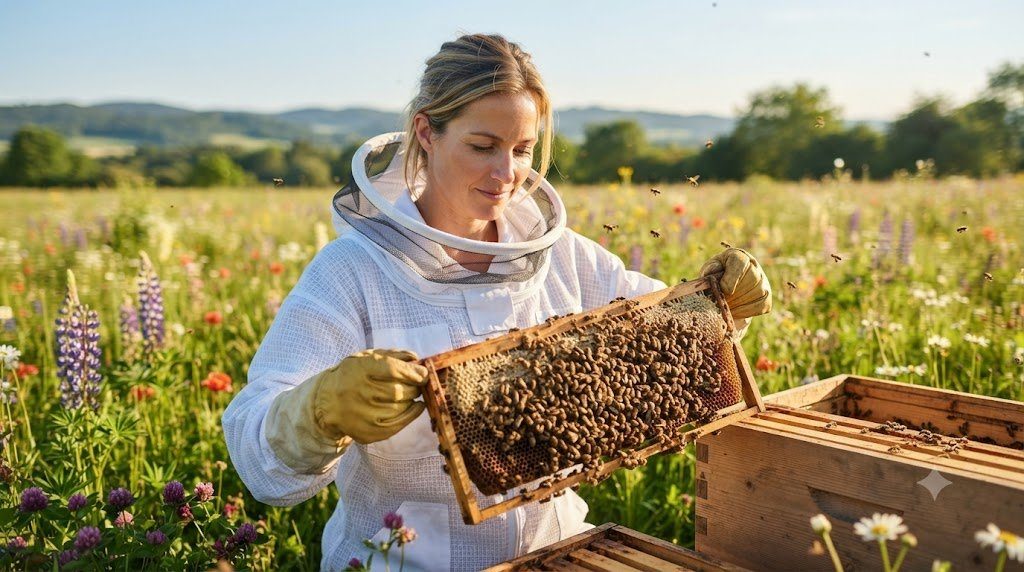
Why is knowing the exact day-by-day developmental clock of honey bee brood so powerful during a hive inspection? Because the brood comb is a living biological calendar! If you open a hive after a storm and cannot spot the queen, seeing upright standing eggs tells you the queen was alive and laying within the last 24 hours; seeing eggs tilted at 45 degrees means she was present 48 hours ago; and seeing eggs lying flat on the cell floor means they are 72 hours old and about to hatch.
| Developmental Milestone | Queen (Fertilized 2n) | Worker (Fertilized 2n) | Drone (Unfertilized 1n) | Diagnostic Visual & Inspection Cue |
|---|---|---|---|---|
| Egg Stage Duration | Days 1 – 3 (3 Days) | Days 1 – 3 (3 Days) | Days 1 – 3 (3 Days) | Day 1 stands 90°; Day 2 tilts 45°; Day 3 lies flat |
| Open Larval Feeding | Days 4 – 8.5 (5.5 Days) | Days 4 – 9 (6 Days) | Days 4 – 10 (6.5 Days) | Pearly white C-shaped larva floating in milky jelly |
| Cell Capping Day | Day 8.5 / Day 9 | Day 9 | Day 10 | Flat tan cap on worker; raised bullet dome on drone |
| Spinning Cocoon & Prepupa | Days 9 – 10 | Days 10 – 12 | Days 11 – 14 | Larva stretches lengthwise; defecates meconium at base |
| Pupal Eye Color Progression | White -> Pink -> Purple -> Dark | Days 13–20 (White to Purple) | Days 15–23 (Compound eyes meet) | Purple-eyed pupae confirm healthy metamorphosis |
| Adult Emergence (Eclosion) | Day 16 (Fastest!) | Day 21 | Day 24 | Callow fuzzy bee chews circular cap from inside |
| Post-Emergence Maturity | Mates Days 21–24; Lays Day 27+ | Nurses Day 4–12; Forages Day 21+ | Sexually mature at Day 36–40! | Drones require 12–16 days of feeding before DCA flight |
Larval Nutrition: Royal Jelly vs. Worker Jelly and Fermented Bee Bread
During the open larval phase, a single worker larva is visited by nurse bees approximately 1,300 to 2,000 times (roughly 10,000 brief inspection visits, of which ~1,500 involve actual trophallactic deposition of brood food). For the first 72 hours of larval life (Instars 1 to 3), worker larvae receive rich hypopharyngeal and mandibular gland secretions containing 65% moisture, 12%–15% crude protein, lipids (including 10-HDA), and B-complex vitamins. At the start of Day 7 (72 hours after hatching), nurse bees switch worker and drone larvae onto a coarser diet known as worker jelly / brood food—mixed heavily with regurgitated honey and fermented bee bread.
Why Bees Ferment Raw Pollen into ‘Bee Bread’
Raw floral pollen grains are encased in one of the most indestructible biological polymers on Earth: a double-layered outer shell of exine (sporopollenin) and cellulose intine designed to survive wind, UV radiation, and acid without rupturing. Adult nurse bees and larvae cannot easily digest intact raw pollen grains until that shell is cracked! Therefore, when foragers return with corbicular pollen pellets, young house bees pack the pellets into comb cells adjacent to the brood nest, glaze them with a thin film of honey, hypopharyngeal enzymes, and beneficial lactic acid bacteria (Apilactobacillus kunkeei and Lactobacillus spp.). Over several days of lactic acid fermentation at 34.5°C, the low pH (~4.1) germinates and osmotically fractures the sporopollenin wall, increasing protein and essential amino acid bioavailability while preserving the bee bread against mold spoilage for months.
In 1953, Dr. A.P. de Groot identified the 10 essential amino acids honey bees cannot synthesize internally: Arginine, Histidine, Isoleucine, Leucine, Lysine, Methionine, Phenylalanine, Threonine, Tryptophan, and Valine. Because single monoculture crops like dandelion (deficient in isoleucine and arginine), blueberry, or corn pollen lack complete profiles, colonies foraging on diverse polyfloral wildflowers boast 40% larger hypopharyngeal glands and dramatically stronger viral immunity!
The Vitellogenin – Juvenile Hormone Double Repressor Switch
How does a female worker bee know to clean cells on Days 1–3, secrete royal jelly on Days 5–12, build wax comb and receive nectar on Days 12–18, guard the entrance on Days 18–21, and transition into a field forager from Day 21 until death at Day 35–42? And how does that exact same genetic worker live for 180 to 240 days during winter? The master molecular clock is the Mutual Double-Repressor Circuit between Vitellogenin ($Vg$) and Juvenile Hormone ($JH$) discovered by Dr. Gro Amdam and Dr. Robert Page:
- High Vitellogenin / Low Juvenile Hormone (Nurse Bee & Winter Diutinus Bee State): When a young worker consumes abundant protein-rich bee bread, her fat body synthesizes high titers of Vitellogenin ($Vg$). High $Vg$ actively suppresses the corpora allata from secreting Juvenile Hormone ($JH$). As long as $Vg$ remains high and $JH$ remains low, the bee stays inside the safe hive, her hypopharyngeal glands remain plump, and $Vg$ scavenges free radicals—preventing cellular aging!
- Why Winter (Diutinus) Bees Live 7 Months: In autumn, as pollen vanishes and the queen stops laying eggs, the last cohorts of emerging workers have zero open larvae to feed. Instead of exporting their fat-body Vitellogenin out through their head glands as royal jelly, they hoard massive reserves of $Vg$ inside their fat bodies and hemolymph all winter long—suspending biological senescence until spring brood rearing drains their $Vg$ reserves!
- High Juvenile Hormone / Low Vitellogenin (Forager State): Once a nurse bee depletes her $Vg$ (or when older foragers emit Ethyl Oleate primer pheromone signaling a shortage of field bees), $JH$ titers surge. High $JH$ permanently shuts down $Vg$ synthesis, shrinks the hypopharyngeal glands, and converts the bee into a short-lived metabolic sprinter that ages out after roughly 800 kilometers of cumulative flight.
Stenothermic Brood Nest Regulation: Why 34.5°C Precision Shapes Adult Intelligence
The capped brood nest of Apis mellifera is the most tightly thermoregulated biological incubator in the insect world, maintained day and night between 33.5°C and 35.5°C (92.3°F–95.9°F) regardless of whether outside air sits at 0°C or 40°C. Remarkably, neurobiological experiments by Dr. Jürgen Tautz at the University of Würzburg demonstrated that the exact tenth-of-a-degree temperature at which a capped pupa is incubated programs its adult brain circuitry and behavioral specialization!
- Pupae Incubated at 35.0°C (95.0°F): Develop larger mushroom bodies (corpora pedunculata—the synaptic learning, olfactory memory, and spatial navigation centers of the honey bee brain) with 70% more microglomerular synaptic complexes. Upon reaching foraging age, these warm-reared bees excel at complex waggle-dance communication and long-range floral memory.
- Pupae Incubated at 32.0°C to 33.0°C (89.6°F–91.4°F): Emerge physically normal in appearance with intact wings, yet suffer significant deficits in olfactory associative learning and dance precision, performing primarily in-hive nursing and cleaning duties.
- Pupae Chilled Below 30°C or Overheated Above 37°C: Suffer high rates of crumpled wing emergence, shortened proboscis length, and 80% higher susceptibility to adult pesticide toxicity.
How Heater Bees Inject Thermal Energy Straight Through Empty Cells
Notice how every healthy brood frame has roughly 5% to 10% empty uncapped cells scattered evenly across the capped patch? Those empty cells are not ‘missed eggs’—they are thermal heating shafts! Specialized endothermic ‘heater bees’ crawl head-first into those empty cells surrounded by six adjacent capped pupae, press their 41°C burning-hot thoraxes firmly against the thin wax cell walls for 30 minutes at a time, and conduct radiant heat directly into six developing sisters simultaneously!
Clinical Diagnostic Inspection Workflow and Lab Sampling Protocols
Translating honey bee pathobiology, endocrinology, and pheromone chemistry into thriving colonies requires a systematic, repeatable Clinical Brood-Nest Inspection Protocol. Rather than pulling frames randomly from the middle of the hive (which risks rolling the queen between tight combs), always start by removing the outermost honey/pollen frame (#1 or #10) to create a wide working gap, then inspect frames sequentially toward the center while auditing five biological biomarkers.
| Biological Biomarker | Healthy Colony Baseline | Subclinical Warning Sign | Acute Pathological Crisis | Immediate Corrective Intervention |
|---|---|---|---|---|
| Egg & Young Larval Ring | Single upright eggs centered on floor; rich pool of white jelly | Dry larvae with minimal jelly (Nutritional stress) | Multiple eggs plastered on cell walls (Laying workers) | Feed 1:1 syrup + polyfloral pollen patty; unite laying workers w/ queenright nuc |
| Capped Brood Symmetry | >90% contiguous convex tan caps; 5–8% heater shafts | 15–25% spotty empty cells; occasional chewed pupae | Sunken greasy perforated caps; ropy brown scales (AFB) | Run alcohol mite wash & matchstick rope test; isolate hive tool |
| Varroa Mite Load (300 Bees) | < 1% (<3 mites/300 bees) in spring & autumn | 2% to 3% (6–9 mites/300 bees) in summer | > 4% (12+ mites) + bees with shriveled wings (DWV) | Apply temperature-matched IPM (Formic Pro, Thymol, or Oxalic + brood break) |
| Adult Bee Gut & Demography | Plump fuzzy nurses; clean entrance; active pollen loads | Slow spring buildup; high forager mortality | Dysentery streaking; crawling bees w/ K-wings (Nosema/CBPV) | Check 400x wet mount for Nosema spores; requeen & rotate dark comb |
| Acoustic & Pheromonal Tone | Calm low 180–220 Hz hum; cohesive frame carpet | Elevated roaring pitch when smoked; empty cups | High-pitched queenless roar; fanning without homing | Insert test frame of young eggs/larvae from healthy hive to verify queen status |
The ‘Test Frame of Eggs’ Assay: Definitive Queenlessness Diagnosis
What should you do when you open a hive in mid-summer, see zero eggs and zero young C-shaped larvae, hear a loud roaring hum, yet cannot tell whether the colony is truly queenless OR whether a slim, unmated virgin queen is hiding somewhere on the combs? Never blindly drop a $45 mated queen cage into a hive that might harbor a hidden virgin queen—the resident virgin will immediately sting the caged queen through the mesh!
Instead, perform the foolproof Test Frame Biological Assay:
- Go to a healthy, booming queenright colony in your yard, select a frame containing hundreds of fresh upright eggs and newly hatched 24-hour-old larvae, brush 100% of the adhering bees back into their parent hive, and mark the top bar of this test frame with a thumbtack.
- Insert this frame of fresh eggs right into the center of the suspect colony’s brood nest and close the hive.
- Read the Result Exactly 72 Hours Later: If the colony was truly queenless, the desperate nurse bees will have pulled 5 to 15 unmistakable emergency queen cells directly over the young larvae on your test frame! You can now either let them finish one prime cell OR pinch the emergency cells and introduce a mated queen with 100% confidence. Conversely, if zero queen cells are pulled on the test frame after 72 hours, a virgin (or newly mated queen about to start laying) is already present inside the hive!
In the United States and Canada, state apiary programs and the USDA-ARS Bee Research Laboratory (Beltsville, Maryland) provide free clinical microscopy and molecular diagnostics for suspected brood and adult bee diseases! To submit a suspicious brood sample, cut a 4×4-inch square of affected comb containing dead larvae/scales, wrap it in a dry paper towel or porous newspaper inside a cardboard box (NEVER wrap comb in plastic bags or aluminum foil, which causes saprophytic mold growth that ruins lab analysis!), and mail with your apiary contact form.
Frequently Asked Questions: Pheromones, Mites, and Brood Pathology
Does an alcohol wash kill the 300 nurse bees—and is a powdered sugar roll just as accurate?
While an alcohol wash (or Dawn ultra-dish-soap water wash) sacrifices ~300 nurse bees out of a colony of 45,000 bees (where the queen lays 1,500 new eggs every single day—meaning those 300 bees represent just 4.8 hours of the queen’s daily egg output!), comparative field validations by Dr. Randy Oliver show that agitated alcohol/soapy-water washes recover 98% to 100% of phoretic mites consistently. In contrast, a powdered sugar roll frequently undercounts mites by 30% to 50% on humid days or when performed with coarse sugar, giving beekeepers a false sense of security that can cost the entire colony of 45,000 bees in winter.
How can I tell the difference between laying worker drone brood and a drone-laying queen?
Both produce raised, bullet-shaped drone cappings inside worker-sized cells, but their egg-laying patterns are completely different! A failing or unmated drone-laying queen has a long abdomen that reaches the bottom of the cell, so she still lays 1 single unfertilized egg centered neatly on the cell floor in a cohesive patch. In contrast, laying workers have short abdomens that cannot reach the bottom of a deep comb cell; they lay 5 to 15 eggs chaoticly plastered along the vertical side walls of each cell, often depositing eggs right on top of stored bee bread (pollen) cells!
Why do bees throw white pupae out on the landing board after a cold spring night?
If a fast-expanding colony stretches its brood nest across 7 frames during warm April days and a sudden -3°C (26°F) freeze strikes overnight, the cluster must contract tightly toward the center to keep the core at 34.5°C. The outermost ring of brood left outside the contracted cluster mantle suffers Chilled Brood. Unlike infectious bacterial foulbrood, chilled brood affects a neat concentric outer ring of all ages simultaneously, turns gray-black without ropiness or foul odor, and hygienic house bees rapidly uncap and drag the dead white/gray pupae out onto the front porch within 48 hours as weather warms.