When an apiary grows from two backyard hives to fifteen, thirty, or a hundred productive colonies, the bottleneck of beekeeping shifts abruptly from the field yard to the honey house. Uncapping 600 frames by hand with a cold serrated bread knife and lifting heavy 60-pound buckets of sticky honey mixed with floating wax cappings into nylon mesh bags quickly turns harvest week into an exhausting ordeal.
Designing a clean, ergonomic, food-grade extraction workflow—built around thermostatically controlled heated uncapping planes, gravity-driven baffle sumps, progressive-cavity honey pumps, and passivated AISI 304 stainless steel—allows a single operator to uncap, spin, clarify, and bottle over 1,000 pounds of pristine raw floral honey in a single afternoon while preserving 100% of its natural enzymatic activity.
Metallurgy in the Honey House: Why AISI 304 Stainless Steel Is Mandatory
Why must every tank, extractor drum, uncapping tray, valve gate, and pipe fitting that contacts liquid honey be fabricated from AISI 304 (18/8 Austenitic) or 316 Food-Grade Stainless Steel or FDA-compliant High-Density Polyethylene (HDPE)—and NEVER galvanized steel, bare carbon steel, brass, or copper? The answer lies in honey’s fierce organic acidity!
Because gluconic acid secreted via glucose oxidase gives cured honey an acidic pH between 3.4 and 4.5 (comparable to tomato juice or wine), liquid honey is mildly corrosive to reactive base metals:
- Galvanized Zinc & Bare Iron Contamination: When acidic honey sits in contact with old galvanized zinc extractors or scratched tinplate drums, gluconic acid leaches dissolved zinc and ferric iron ions directly into the honey. Dissolved iron reacts with plant polyphenols and tannins in the honey to form ink-black ferric tannate complexes, turning golden honey muddy gray-black and imparting a harsh metallic astringency while risking heavy-metal toxicity!
- AISI 304 Austenitic Stainless Steel Passivation: Composed of 18% Chromium and 8% Nickel alloyed with iron, 304 stainless steel spontaneously forms an inert, self-healing, microscopic surface film of chromium oxide ($Cr_2O_3$) in the presence of oxygen. This passive layer is 100% impervious to gluconic acid at all honey processing temperatures, imparts zero flavor or color, and features sanitary TIG-welded seams that cannot harbor Zygosaccharomyces yeasts.
Every new beekeeper learns this lesson the hard way: NEVER spray hot water onto an extractor, uncapping tank, or floor coated with wax particles and honey! Hot water (>60°C) melts solid beeswax flecks into a thin, waterproof grease smear that glues itself across every stainless wall and clogs floor drains solid. Always flush equipment with high-pressure COLD water first: cold water dissolves 100% of the water-soluble honey while keeping wax bits hard and brittle so they float right into your strainer basket!
Engineering Comparison of Uncapping Hardware & Wax Separation Systems
Uncapping is the primary pace-setter of any honey harvest line. Compare throughput speeds, caramelization risks, and wax recovery methodologies across the five major uncapping and cappings-processing technologies below.
| Uncapping / Wax Hardware | Throughput (Frames / Hour) | Operating Temp / Mechanism | HMF / Scorch Risk | Honey Recovery from Cappings | Ideal Operational Scale |
|---|---|---|---|---|---|
| Cold Serrated Offset Knife + Scratcher | 15 to 25 frames/hr | Ambient (Manual sawing motion) | ZERO (No heat applied) | Drip tray (Leaves 20% honey in wax) | 1 to 5 hives (Low upfront cost) |
| Thermostatic Electric Heated Knife | 40 to 70 frames/hr | 75°C–85°C blade (Digital PID best) | Low if sliced continuously | Uncapping tank screen (Gravity drip) | 5 to 30 hives (Fast clean slicing) |
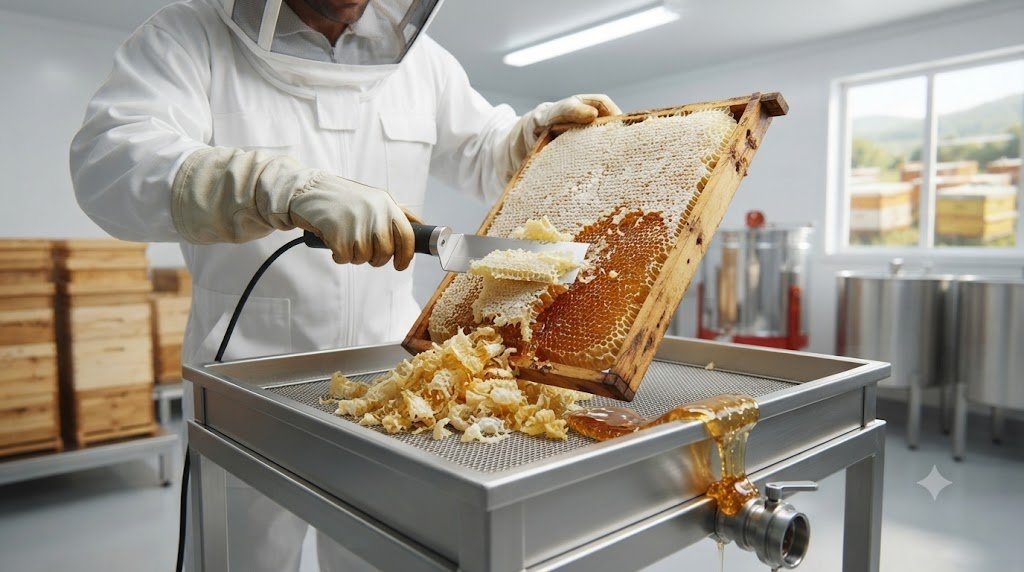
| Maxant / Pierce Heated Uncapping Plane | 60 to 100 frames/hr | Steam or electric copper plane blade | Very Low (Cappings curl away) | Drains in perforated stainless basket | 15 to 75 hives (Ergonomic pull stroke) |
| Motorized Flail / Vibrating Uncapper | 180 to 350+ frames/hr | Spinning nylon/chain flails or hot knives | ZERO on flail (Mechanical strip) | Feeds directly to Cappings Spinner/Ram | 50 to 1,000+ hives (Commercial line) |
| Centrifugal Cappings Spinner | Processes 500+ frames’ wax | High-RPM perforated basket spin | ZERO (Cold mechanical separation!) | Recovers 98% of raw cappings honey! | 30 to 500+ hives (Preserves raw quality) |
Heated Uncapping Knives vs. Uncapping Planes: Avoiding HMF Scorching
A standard thermostatically controlled electric uncapping knife operates at 75°C to 90°C (167°F–194°F) so its beveled steel edge melts effortlessly through the thin wax cappings bridging a 9-frame spaced fat comb. However, basic bi-metal internal thermostat knives cycle wildly in temperature—and if you set a red-hot electric knife down on the rim of your uncapping tank with a film of honey clinging to the blade for three minutes while loading the extractor, the honey on the blade caramelizes into burnt brown sugar and spikes Hydroxymethylfurfural (HMF)!
To prevent scorching with an electric knife, follow three operational rules: first, choose a knife with an external digital PID temperature controller (or plug a standard knife into a variable router speed rheostat/dimmer) dialed down to the minimum temperature that glides smoothly through wax (~75°C); second, keep a tall stainless cylinder of clean water beside the tank to dip and wipe the blade whenever you pause for more than 30 seconds; third, consider an Electric Uncapping Plane, whose curved copper fin guides the sliced wax capping sheet UP and over the blade immediately so liquid honey never lingers against the heating element.
Gravity Baffle Sumps: Continuous Clarification Without Clogged Mesh Bags
Anyone who has tried to strain 500 pounds of honey through a 200-micron nylon mesh bag knows what happens by bucket number three: wax cappings coat the inside of the mesh, completely blinding the pores so honey backs up and overflows onto the floor. Commercial honey houses eliminate fine mesh bags entirely during extraction by placing a Multi-Chamber Heated Baffle Sump Tank directly beneath the extractor honey gate:
- Archimedes / Stokes Density Separation: Because liquid honey has a high specific gravity of 1.42 g/cm³ while pure beeswax has a low specific gravity of 0.96 g/cm³, every wax particle, propolis fleck, and air bubble naturally wants to float rapidly to the surface—especially when a gentle 32°C–35°C water-jacket pad under the sump keeps honey viscosity low.
- Over-and-Under Vertical Baffle Plates: A stainless sump tank is divided horizontally into 4 or 5 compartments by alternating vertical stainless plates: Plate 1 extends from the top down to 2 inches above the floor (an Under-Baffle that traps 90% of floating wax cappings in Chamber 1 while letting clean heavy honey flow underneath); Plate 2 extends from the floor up to 3 inches below the surface (an Over-Baffle that stops any heavy sand/grit on the floor); Plate 3 is another Under-Baffle that skims off remaining micro-wax. By the time honey reaches the final float-switch chamber and is pumped by a low-RPM progressive-cavity or flexible-impeller honey pump into the settling tank, it is 99.5% free of wax without ever clogging a fine screen!
Recovering Cappings Honey Without Heat: Spinners vs. Wax Melters
Roughly 10% to 15% of your total honey crop comes off the knife entangled in the wet wax cappings! Never run wet cappings through a high-heat 85°C capping melter and mix that dark, heat-damaged honey back into your pristine raw extractor honey—doing so ruins the HMF, diastase number, and floral aroma of the entire batch. Instead, drain wet cappings overnight in a perforated stainless uncapping basket inside a 32°C warm room, or spin them bone-dry in a centrifugal cappings spinner (or adapt your radial extractor with a removable perforated stainless cappings basket insert) to recover 98% of that premium raw honey cold, before melting the dry wax cappings separately into golden 1-pound bullion blocks.
Floor-Plan Ergonomics, Sanitary Drains, and Automated Bottling Valves
Whether converting a 12×16-foot backyard garden shed or constructing a 2,000-square-foot commercial extraction facility, designing a Unidirectional Linear or U-Shaped Workflow eliminates cross-contamination and cuts labor in half:
- Zone 1 — Bee-Tight Warm Staging Room (32°C / 35% RH): Full supers enter on wheeled drip-tray dollies through an exterior double-door vestibule fitted with a top-corner one-way bee escape cone pointing outdoors (any stray straggler bees fly straight toward the sunlit window cone and exit the building, while zero exterior robber bees can enter!).
- Zone 2 — Uncapping & Centrifugal Extraction Station: Positioned directly beside the warm room door so frames travel less than 4 feet from super to uncapping tank to radial extractor reel, draining directly into the heated baffle sump below.
- Zone 3 — Elevated Jacketed Settling Tanks & Pneumatic/Gear Bottling Machines: A low-shear honey pump transfers clarified honey from the sump up into elevated 50-to-200-gallon stainless steel settling tanks equipped with no-drip spring-loaded scissor honey gates or programmable benchtop gear-pump filling machines (such as Nassenheider or Swienty Dana Api Matic units) capable of filling 400 exact 1-pound glass jars per hour to $\pm 1$ gram accuracy with zero messy strings!
Annual Equipment Maintenance, Sanitization, and Tool Ergonomics
Apicultural hardware operates in one of the most chemically and mechanically demanding environments in agriculture: sticky antimicrobial propolis glues steel and wood together at temperatures below 15°C and turns tacky above 30°C; acidic honey (pH 3.8) attacks unpassivated metals; and high-temperature smoker pyrolysis deposits creosote tar inside nozzles and hinges. Establishing a disciplined End-of-Season Hardware Sanitization & Winter Workshop Routine extends equipment lifespan by decades while preventing pathogen transfer between seasons.
| Equipment Category | Primary Fouling / Wear Agent | Approved Cleaning & Sanitization Solvent | Storage & Preventative Maintenance |
|---|---|---|---|
| 3-Layer Ventilated Suits & Veils | Venom isoamyl acetate, propolis, sweat | Cold/warm gentle wash w/ unscented detergent; isopropyl alcohol on propolis spots | Always detach veil and hand-wash screen; hang dry in shade (Zero bleach or dryer heat!) |
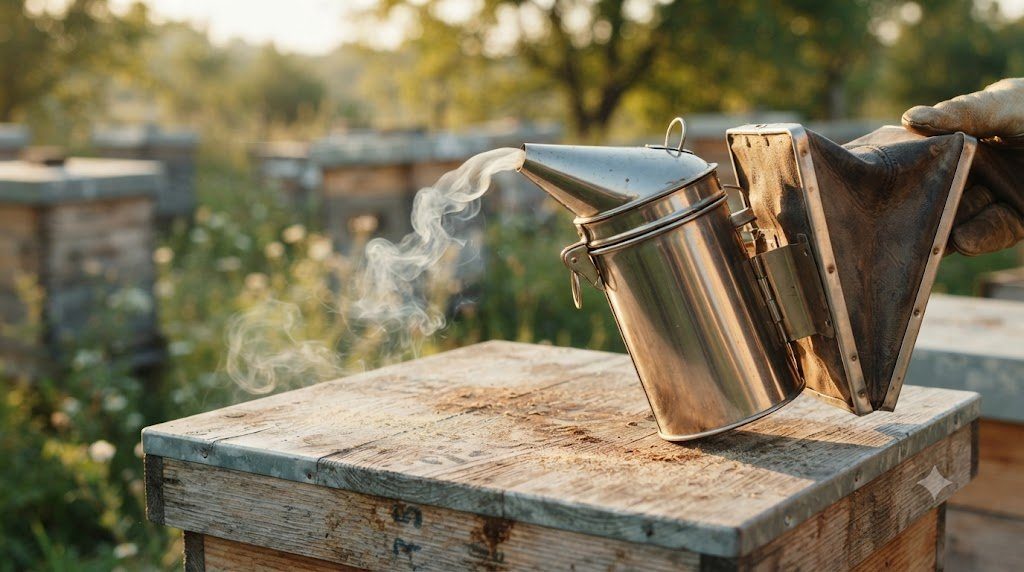
| Stainless Steel Bee Smokers | Creosote tar around lid rim; clogged bottom grate | Scrape cold creosote with hive tool; soak grate in washing soda (sodium carbonate) | Store indoors out of rain; condition leather bellows annually with neatsfoot oil |
| Steel Hive Tools (J-Hook / Flat) | Propolis, wax, potential AFB endospores | Flame-scorch blade in smoker coals + scrub w/ 91% rubbing alcohol or 10% bleach | Paint handle safety-orange or blaze-yellow so dropped tools are visible in tall grass |
| 304 Stainless Extractors & Tanks | Water-soluble honey + hydrophobic wax flecks | Flush w/ high-pressure COLD water first; wash w/ warm food-grade detergent + air dry | Lubricate bottom nylon/bronze bushing only w/ NSF H1 food-grade white mineral grease |
| Queen Excluders (Welded Wire) | Heavy bridge wax & propolis blocking 4.17mm gap | Freeze at -18°C overnight then snap brittle wax off w/ wire excluder scraper tool | Store flat on a level shelf (Hanging bent wire excluders widens gaps and lets queens pass!) |
Selecting the Right Hive Tool: Classic Flat vs. Italian J-Hook vs. Frame Grip
Walk up to any commercial beekeeper’s truck and you will find three distinct steel leverage instruments, each engineered for a specific mechanical task at the hive:
- The 10-Inch Standard Flat (Kelly) Hive Tool: Features a wide, flat ground chisel blade on one end for sliding horizontally between propolized super seams and scraping bottom boards, paired with a 90-degree bent scraper hook on the opposite end. It excels at heavy box separation and propolis cleaning without denting soft pine frame ears.
- The Italian J-Hook Frame Lifter Tool: Features a sharpened Curved J-hook with a beveled fulcrum pivot tooth. By hooking the tip of the ‘J’ beneath the frame ear lug to be lifted while resting the pivot tooth on top of the adjacent frame shoulder, pressing down on the handle converts your hand motion into a smooth 5:1 vertical mechanical jack—lifting the tightest propolized frame straight up without twisting your wrist!
- Spring-Loaded Cast Aluminum/Stainless Frame Grips: Clamps onto the center of the wooden top bar like a mechanical hand, allowing one-handed frame lifting when holding a smoker or queen-marking cage in your other hand.
Because propolis consists of 50% lipophilic plant flavonoid resins and 30% beeswax, soap and water alone merely smear sticky propolis across your hands! Keep a spray bottle of 91% Isopropyl Alcohol (rubbing alcohol) or a tub of Washing Soda (Sodium Carbonate, pH 11.5) in your honey house: alcohol dissolves sticky propolis resins on contact in 3 seconds, leaving hands and stainless steel spotless!
Frequently Asked Questions: Suits, Smokers, Frames, and Extractors
Why do bees keep stinging through my ankle socks even when wearing a full suit?
When bees are shaken off frames or bumped during an inspection, hundreds of disoriented older bees fall onto the grass around your boots. Honey bees possess a hardwired negative gravitaxis reflex: when dropped on the ground, they immediately walk upward in search of dark crevices—climbing straight over low top shoes and stinging through thin cotton athletic socks where the Achilles tendon stretches the fabric tight! Always wear tall leather or Muck/Wellington boots and pull the elastic ankle cuffs and stirrup straps of your bee suit down over the outside of the boot shaft.
Can I use a standard kitchen toaster-oven or hair dryer to uncap honey frames?
While a commercial electric heat gun (held 6 inches away and swept rapidly across the comb face for 2 seconds) can melt thin virgin wax cappings open through thermal expansion of the tiny air pocket trapped beneath each capping, prolonged hot air blows molten wax droplets into the honey and risks overheating the surface layer. For 5 to 50 hives, a cold serrated knife paired with a stainless steel cappings scratcher fork (or a thermostatic electric uncapping plane) produces cleaner combs and yields valuable pure wax cappings.
How do I stop my honey extractor from ‘walking’ and vibrating across the floor?
Even a radial extractor loaded with 18 frames will vibrate violently during the initial 60 seconds of spinning if three heavy 7-pound frames sit on one side of the reel while three light 3-pound frames sit opposite them! Always weigh frames by hand as you uncap them and load frames of equal weight directly across from each other (180 degrees opposite, or in balanced 120-degree triads). Additionally, bolt the extractor legs to a 4×4-foot sheet of 3/4-inch marine plywood resting on thick rubber anti-vibration pads so your own foot weight standing on the plywood platform anchors the drum solidly in place.