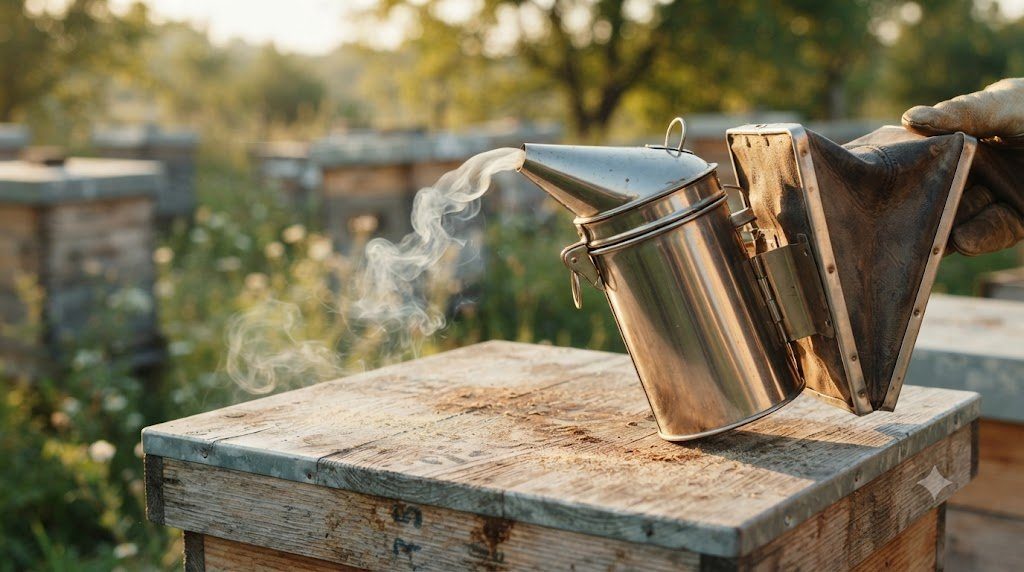
Since Moses Quinby invented the modern bellows-driven tin bee smoker in 1873 in St. Johnsville, New York—subsequently refined by T.F. Bingham to direct the air blast beneath an elevated fire grate without sucking glowing embers back into the leather bellows—the stainless steel bee smoker has remained the single most indispensable tool in apiculture. Yet walk through any beginner bee yard and you will see two recurring mistakes: either the smoker goes out ten minutes into the inspection just when a colony turns defensive, or the operator pumps thin, scorching-hot blue flame and ash onto the top bars, singeing wings and infuriating the bees.
Mastering the thermodynamics of incomplete smoldering pyrolysis, understanding the dual neurobiological mechanisms of how cool white smoke calms a colony, and choosing non-toxic cellulosic fuels will ensure your smoker produces thick, cool, marshmallow-white clouds for 3 continuous hours on a single lighting.
Neurobiology of Smoke: Why Cool White Smoke Calms Honey Bees
Why do a few gentle puffs of cool white smoke transform 50,000 defensive insects into calm, preoccupied comb dwellers within 45 seconds? Smoke acts on two independent physiological pathways simultaneously:
- Competitive Inhibition of Antennal Olfactory Receptors (Pheromone Masking): Electroantennogram (EAG) recordings by Dr. P.K. Visscher demonstrated that volatile phenolic and organic particulates in wood/plant smoke bind reversibly to the sensilla placodea olfactory receptor neurons on the honey bee’s antennae. For roughly 10 to 20 minutes after smoke exposure, the bee’s antennae are temporarily ‘blinded’ to volatile isoamyl acetate (Koschevnikov sting alarm pheromone) and 2-heptanone (mandibular guard alarm pheromone). If one guard bee is accidentally pinched during frame removal, her alarm broadcast is jammed before it can trigger a chain-reaction attack.
- Evolutionary Forest-Fire Engorgement Reflex: Because wild Apis mellifera colonies evolved living inside hollow forest trees, the presence of cool wood smoke signals a potentially catastrophic wildfire approaching the nest cavity. Within 30 to 60 seconds of detecting smoke, hundreds of house bees rush to uncapped honey cells and gorge their honey stomachs (crops) to capacity in preparation for emergency evacuation. A worker bee whose abdomen is distended with 50 mg of thick honey is both behaviorally preoccupied and anatomically reluctant to flex her abdomen into the C-curve posture required to drive a sting lancet!
Before directing a single puff of smoke into a hive entrance or over the top bars, ALWAYS puff the smoker twice across the bare skin on the back of your wrist from 4 inches away! If the smoke feels warm or hot—or if tiny black embers fly out of the nozzle—your fuel pack is too loose and burning via open oxidation rather than smoldering pyrolysis. Stuff a handful of fresh green grass into the cone nozzle immediately as a heat-absorbing spark arrestor!
Smoker Fuel Chemistry: Safe Cellulosic Fuels vs. Toxic Resins
Not all plant materials produce safe bee smoke. Fuels high in synthetic glues, petroleum dyes, fungal toxins, or volatile turpentine resins can anesthetize, poison, or enrage honey bees. Use the chemical fuel matrix below to assemble a clean, long-burning smoker charge.
| Smoker Fuel Material | Combustion / Pyrolysis Profile | Smoke Temperature & Density | Burn Duration | Safety & Apiary Recommendation |
|---|---|---|---|---|
| Dried Eastern White Pine Needles | Fast ignition; rich white terpene smoke | Cool when packed tightly | 30 to 45 mins | EXCELLENT (Gold-standard starter & main fuel) |
| Untreated Jute Burlap (Hessian) | Steady smolder; fragrant gray-white cloud | Very Cool; zero flying sparks | 45 to 75 mins | EXCELLENT (Verify sacks never held pesticides!) |
| Rotten Punky Hardwood (Oak/Maple) | Slow deep char; dense cool white smoke | Extremely Cool; long coal bed | 90 to 180 mins | BEST LONG-BURN FUEL (Dry completely before use) |
| Compressed Cotton / Wood Pellets | Dense ember bed once lit at base | Cool-Moderate (Needs green grass top) | 2 to 3+ hours | EXCELLENT for commercial multi-yard inspections |
| Staghorn Sumac Bobs (Rhus typhina) | High natural tannin; sweet cool smoke | Very Cool; pleasant aroma | 45 to 60 mins | EXCELLENT traditional North American fuel |
| Corrugated Cardboard (Plain Brown) | Fast starter; light wispy smoke | Hot if burned alone (Use as kindling) | 15 to 20 mins | Starter kindling ONLY (Remove all plastic tape/ink!) |
| Resinous Pine/Cedar Shavings (Pitch) | Heavy sticky black soot & hot tar | HOT (Spits boiling pitch droplets) | 30 mins | AVOID heavy pitchwood (Gums up nozzle & wings) |
| Treated Lumber / Glossy Paper / Twine | Releases arsenic, copper, dioxins, plastic | Lethal toxic fumes | N/A | STRICTLY PROHIBITED (Poisons bees and honey!) |
The 3-Layer Bottom-Up Pyrolysis Method: Lighting a Smoker That Never Goes Out
Why does a beginner’s smoker go out after ten minutes? Because they pack the chamber full of dry pine needles first and try to light the top of the pile! Since air enters from the bellows hole at the very bottom of the firebox, lighting the top of the fuel blows the fire upward out the nozzle leaving unburned fuel underneath. To achieve Bottom-Up Smoldering Pyrolysis (where a glowing red coal bed at the bottom grate slowly bakes dense white smoke out of tightly compressed unburned fuel above it without open flame), follow this 4-step sequence:
- Verify the Grate Clearance: Ensure the perforated false-bottom fire grate stands on its 1-inch legs at the bottom of the cylinder, with the air-channel notch facing the bellows tube hole in the rear wall.
- Layer 1 — The Red-Hot Starter Ember Base: Crumple a 4-inch ball of plain brown paper or a handful of loose dry pine needles, ignite it thoroughly with a butane torch or match, drop it onto the bottom grate, and pump the bellows gently while adding a small handful of dry kindling twigs or wood pellets until you have a roaring 2-inch bed of glowing red coals at the very bottom.
- Layer 2 — Dense Compressed Pyrolysis Fuel: Once the bottom coal bed is glowing fiercely, pack your main slow-burning fuel—such as tightly rolled untreated burlap, dry punky hardwood chunks, or fistfuls of compressed pine needles—firmly down on top of the coals using your hive tool while pumping the bellows steadily. Packing the upper fuel tightly starves the chamber of excess oxygen, extinguishing open yellow flames and forcing the bottom coals to bake thick, cool, billowing white smoke through the upper column.
- Layer 3 — The Green Grass Condenser & Spark Arrestor: Before closing the hinged conical lid, stuff a tightwad of freshly plucked green grass or green leafy clover into the underside of the cone dome. This moist green plug cools the ascending smoke by 15°C to 25°C, traps 100% of flying sparks and black ash, and prevents sticky creosote from dripping onto your combs.
Smoker Sizing, Heat Shields, and Safe Extinguishment
Always select a heavy-gauge 4×10 inch (10×25 cm) stainless steel smoker fitted with a wrap-around perforated wire heat shield and a welded resting hook (which hangs safely on the side of an open hive box so the smoker never tips over into dry summer grass). How you use smoke is just as important as how you light it: apply 2 to 3 gentle puffs across the front entrance and under the cracked inner cover, then wait 45 to 60 seconds before lifting the lid so guard bees have time to engorge on honey. At the conclusion of your inspection day, never dump live coals on the ground; plug the smoker spout tightly with a dedicated cork, wooden dowel, or wad of aluminum foil, or transfer the unburned fuel into a sealed metal ash can so the coals suffocate safely and can be reused as rapid-lighting charcoal at your next visit.
Liquid Smoke Misters vs. Traditional Pyrolysis Smokers: When to Use Each
During severe late-summer drought Conditions and Red Flag wildfire warnings in Western North America, Mediterranean Europe, and Australia, igniting a traditional ember-burning bee smoker in dry grass yards carries an unacceptable wildfire hazard (and is legally banned during Stage II fire restrictions). How can an apiarist inspect hives safely when open flames are prohibited?
- Dilute Aqueous Liquid Smoke / Clove-Lemongrass Sugar Mist: A handheld fine-mist trigger sprayer filled with water containing a few drops of natural hickory liquid smoke condensate (or 1:1 thin sugar water scented with 1 drop of therapeutic clove oil) provides short-term cooling and grooming distraction when misted gently across the top bars. When misted with sugar water, guard bees stop posturing and immediately begin licking their sisters clean via allo-grooming.
- Why Traditional Cool Smoke Still Wins for Deep Manipulations: While sugar misting works well for quick 3-minute super checks on gentle Carniolan colonies, liquid mist cannot match the downward convective penetration of gaseous pyrolysis smoke when driving bees down off bottom bars to prevent crushing during box reassembly. Whenever fire conditions are high but permitted, stand your lit smoker strictly inside a 5-gallon metal bucket containing 2 inches of damp sand and fit a fine stainless mesh spark screen inside the cone nozzle.
Annual Equipment Maintenance, Sanitization, and Tool Ergonomics
Apicultural hardware operates in one of the most chemically and mechanically demanding environments in agriculture: sticky antimicrobial propolis glues steel and wood together at temperatures below 15°C and turns tacky above 30°C; acidic honey (pH 3.8) attacks unpassivated metals; and high-temperature smoker pyrolysis deposits creosote tar inside nozzles and hinges. Establishing a disciplined End-of-Season Hardware Sanitization & Winter Workshop Routine extends equipment lifespan by decades while preventing pathogen transfer between seasons.
| Equipment Category | Primary Fouling / Wear Agent | Approved Cleaning & Sanitization Solvent | Storage & Preventative Maintenance |
|---|---|---|---|
| 3-Layer Ventilated Suits & Veils | Venom isoamyl acetate, propolis, sweat | Cold/warm gentle wash w/ unscented detergent; isopropyl alcohol on propolis spots | Always detach veil and hand-wash screen; hang dry in shade (Zero bleach or dryer heat!) |
| Stainless Steel Bee Smokers | Creosote tar around lid rim; clogged bottom grate | Scrape cold creosote with hive tool; soak grate in washing soda (sodium carbonate) | Store indoors out of rain; condition leather bellows annually with neatsfoot oil |
| Steel Hive Tools (J-Hook / Flat) | Propolis, wax, potential AFB endospores | Flame-scorch blade in smoker coals + scrub w/ 91% rubbing alcohol or 10% bleach | Paint handle safety-orange or blaze-yellow so dropped tools are visible in tall grass |
| 304 Stainless Extractors & Tanks | Water-soluble honey + hydrophobic wax flecks | Flush w/ high-pressure COLD water first; wash w/ warm food-grade detergent + air dry | Lubricate bottom nylon/bronze bushing only w/ NSF H1 food-grade white mineral grease |
| Queen Excluders (Welded Wire) | Heavy bridge wax & propolis blocking 4.17mm gap | Freeze at -18°C overnight then snap brittle wax off w/ wire excluder scraper tool | Store flat on a level shelf (Hanging bent wire excluders widens gaps and lets queens pass!) |
Selecting the Right Hive Tool: Classic Flat vs. Italian J-Hook vs. Frame Grip
Walk up to any commercial beekeeper’s truck and you will find three distinct steel leverage instruments, each engineered for a specific mechanical task at the hive:
- The 10-Inch Standard Flat (Kelly) Hive Tool: Features a wide, flat ground chisel blade on one end for sliding horizontally between propolized super seams and scraping bottom boards, paired with a 90-degree bent scraper hook on the opposite end. It excels at heavy box separation and propolis cleaning without denting soft pine frame ears.
- The Italian J-Hook Frame Lifter Tool: Features a sharpened Curved J-hook with a beveled fulcrum pivot tooth. By hooking the tip of the ‘J’ beneath the frame ear lug to be lifted while resting the pivot tooth on top of the adjacent frame shoulder, pressing down on the handle converts your hand motion into a smooth 5:1 vertical mechanical jack—lifting the tightest propolized frame straight up without twisting your wrist!
- Spring-Loaded Cast Aluminum/Stainless Frame Grips: Clamps onto the center of the wooden top bar like a mechanical hand, allowing one-handed frame lifting when holding a smoker or queen-marking cage in your other hand.
Because propolis consists of 50% lipophilic plant flavonoid resins and 30% beeswax, soap and water alone merely smear sticky propolis across your hands! Keep a spray bottle of 91% Isopropyl Alcohol (rubbing alcohol) or a tub of Washing Soda (Sodium Carbonate, pH 11.5) in your honey house: alcohol dissolves sticky propolis resins on contact in 3 seconds, leaving hands and stainless steel spotless!
Frequently Asked Questions: Suits, Smokers, Frames, and Extractors
Why do bees keep stinging through my ankle socks even when wearing a full suit?
When bees are shaken off frames or bumped during an inspection, hundreds of disoriented older bees fall onto the grass around your boots. Honey bees possess a hardwired negative gravitaxis reflex: when dropped on the ground, they immediately walk upward in search of dark crevices—climbing straight over low top shoes and stinging through thin cotton athletic socks where the Achilles tendon stretches the fabric tight! Always wear tall leather or Muck/Wellington boots and pull the elastic ankle cuffs and stirrup straps of your bee suit down over the outside of the boot shaft.
Can I use a standard kitchen toaster-oven or hair dryer to uncap honey frames?
While a commercial electric heat gun (held 6 inches away and swept rapidly across the comb face for 2 seconds) can melt thin virgin wax cappings open through thermal expansion of the tiny air pocket trapped beneath each capping, prolonged hot air blows molten wax droplets into the honey and risks overheating the surface layer. For 5 to 50 hives, a cold serrated knife paired with a stainless steel cappings scratcher fork (or a thermostatic electric uncapping plane) produces cleaner combs and yields valuable pure wax cappings.
How do I stop my honey extractor from ‘walking’ and vibrating across the floor?
Even a radial extractor loaded with 18 frames will vibrate violently during the initial 60 seconds of spinning if three heavy 7-pound frames sit on one side of the reel while three light 3-pound frames sit opposite them! Always weigh frames by hand as you uncap them and load frames of equal weight directly across from each other (180 degrees opposite, or in balanced 120-degree triads). Additionally, bolt the extractor legs to a 4×4-foot sheet of 3/4-inch marine plywood resting on thick rubber anti-vibration pads so your own foot weight standing on the plywood platform anchors the drum solidly in place.