Every pound of cured surplus honey stored inside a hive super represents the cumulative flight work of approximately 2 million individual floral visits and over 55,000 miles of collective wingbeat travel. Yet a honey bee colony does not send its 15,000 to 25,000 foragers out to wander randomly across the landscape. Instead, Apis mellifera operates as a decentralized economic supercomputer—continuously auditing thousands of square kilometers of floral patches, calculating net caloric return per minute of flight expenditure, and dynamically reallocating labor to the highest-yielding botanical sources via Karl von Frisch’s Nobel Prize-winning discovery: the waggle dance.
Understanding the biophysics of honey bee flight metabolism, solar-polarized optical navigation, waggle dance vector encoding, and receiver-bee tremble dances allows the science-minded apiarist to calculate apiary carrying capacity, site bee yards for maximum foraging efficiency, and interpret seasonal scale-hive weight curves.
Thoracic Flight Thermodynamics and Caloric Return on Investment
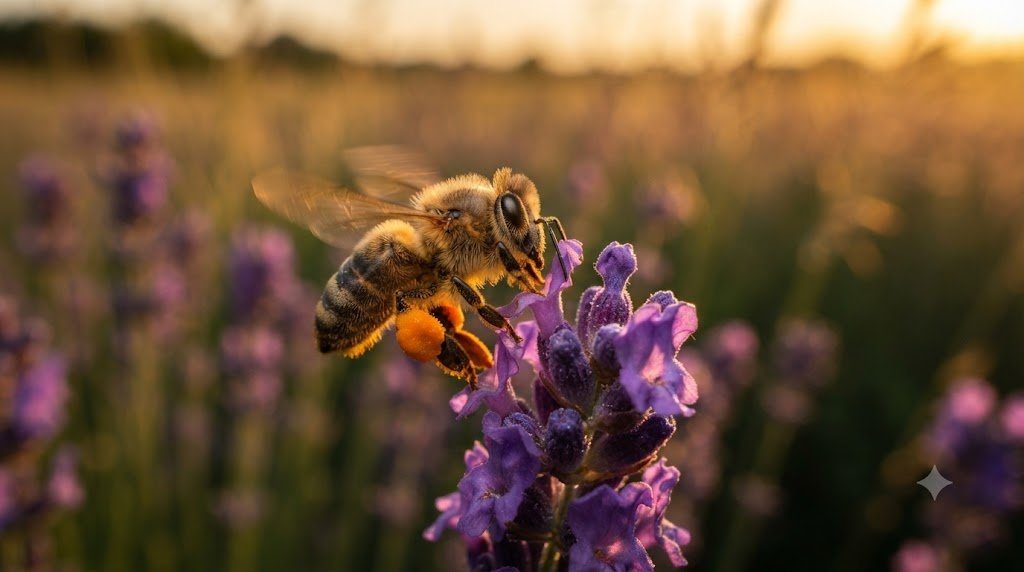
When an older worker bee transitions from internal hive duties (nursing, comb building, guarding) to external foraging around Day 21 of adult life, her physiology undergoes a profound transformation. Juvenile hormone titers rise while vitellogenin (fat-body storage protein) drops, slimming her abdomen for aerodynamic efficiency. To achieve takeoff, her indirect flight muscles (the dorsoventral and dorsal longitudinal muscles occupying the thorax) must reach an operating temperature of at least 35°C to 38°C (95°F–100°F), oscillating the wings at 230 to 250 Hz.
Crucially, honey bee flight muscles cannot oxidize lipids (fats) or proteins; they run exclusively on simple carbohydrates—glucose and fructose drawn from the honey crop across the proventriculus valve into the hemolymph as trehalose. In free flight, a foraging honey bee burns approximately 10 to 12 milligrams of sugar per hour (roughly 40–50 milliwatts of metabolic power). Consequently, a forager does not evaluate a floral patch simply by total nectar volume; her nervous system calculates Net Energetic Efficiency—the caloric value of the sucrose/glucose/fructose concentration minus the metabolic flight fuel burned traveling to the patch and probing individual corollas.
Why Foragers Ignore Dilute Nectar Below 15% Brix
Because evaporating excess water from nectar inside the hive requires metabolic energy, honey bees are finely tuned to sugar concentration (measured in degrees Brix). While pear blossoms frequently produce abundant nectar at only 8% to 12% sugar concentration, honey bees will readily abandon a pear orchard the moment adjacent dandelions (Taraxacum officinale) or mustards open with 35% to 45% Brix nectar. Furthermore, nectar viscosity rises exponentially above 60% sugar, meaning the optimal caloric intake rate per second of proboscis suction peaks at 50% to 60% sucrose concentration.
While honey bees can fly up to 8–10 km (5–6 miles) in extreme desert dearths, flight fuel consumption increases linearly with distance. A colony placed directly inside a blooming clover field stores 3 to 4 times more surplus honey than a colony placed just 2.5 km (1.5 miles) away, because long-distance foragers burn up to 40% of their crop payload simply powering the return flight!
Decoding the Waggle Dance: Solar Azimuth and Optical Flow Odometry
Inside the pitch-black cavity of the hive on the vertical surface of the lower combs (the ‘dance floor’ near the entrance), returning scout and recruit foragers execute figure-eight dances that transmit three exact parameters to surrounding follower bees: Direction, Distance, and Profitability, plus the floral odor clinging to their branched plumose body hairs.
| Dance Type / Signal | Distance to Floral Patch | Directional & Distance Encoding Mechanism | Colony Behavioral Response |
|---|---|---|---|
| Round Dance | < 50 meters from hive | Circular alternating loops; no directional vector; floral scent transferred | Recruits search immediately around the apiary for the specific floral odor |
| Sickle / Transitional Dance | 50 to 150 meters | Crescent-shaped figure-eight transitioning into short waggle run | Directs recruits to intermediate perimeter bushes and orchard trees |
| Waggle Dance (Figure-8) | > 150 meters to 10+ km | Angle of waggle run relative to vertical gravity = angle to Sun’s azimuth | Recruits fly exact vector and distance calibrated by retinal optical flow |
| Tremble Dance | N/A (In-Hive Bottleneck) | Forager walks erratically across combs vibrating body laterally for 20+ mins | Signals nectar receiver shortage; stimulates nurses to switch to nectar receiving |
| Stop Signal (Headbutt) | N/A (Hazard/Competition) | Follower delivers 150ms vibrational headbutt at 380 Hz to dancing bee | Inhibits waggle dancer when floral patch has predator attack or overcrowding |
Gravity-to-Solar Azimuth Transposition and Time Compensation
During the straight central run of the figure-eight waggle dance, the dancer vibrates her abdomen laterally at 13 to 15 Hz while emitting pulsed 250–280 Hz wing-buzz sounds through the wax comb substrate. The angle of this straight waggle run relative to straight up (antigravity on the vertical comb) equals the horizontal angle of the food source relative to the current azimuth of the Sun outside the hive:
- Straight Up on the Comb (0°): Fly directly toward the azimuth of the Sun.
- Straight Down on the Comb (180°): Fly directly away from the Sun.
- 60° to the Right of Vertical: Fly 60° to the right of the Sun’s current position.
Remarkably, because the Sun moves across the sky at an average rate of 15 degrees per hour (1 degree every 4 minutes), veteran dancing bees that remain inside the hive dancing for hours continuously rotate the angle of their waggle run counter-clockwise (in the Northern Hemisphere) using their internal circadian clock, even without seeing the sky! On overcast days, honey bees detect the pattern of ultraviolet polarized light through small patches of blue sky or clouds using specialized dorsal rim ommatidia in their compound eyes.
How Bees Measure Distance: Retinal Optical Flow, Not Energy
For decades, scientists assumed bees measured distance by how much metabolic fuel they burned on the outbound flight. However, landmark experiments by Dr. Mandyam Srinivasan proved that honey bees actually measure distance via retinal optical flow—the rate at which visual textures pass across their compound eyes during flight. Each 1 second of waggle run duration corresponds to roughly 750 to 1,000 meters of outdoor flight over typical vegetated terrain (roughly 1 millisecond per meter).
The Unloading Delay Metric: How Foragers Sense Colony Nectar Needs
How does an individual forager know whether the colony needs more nectar, more water for evaporative cooling, or whether the honey supers are backed up? She measures her unloading wait time inside the entrance zone:
- Short Unloading Delay (< 15 seconds): If a returning nectar forager is immediately greeted by eager receiver bees (middle-aged workers aged 12–18 days) who take her nectar crop within seconds, she perceives that the colony’s processing capacity exceeds incoming supply. She immediately executes vigorous, long-lasting waggle dances to recruit more foragers to her floral patch.
- Long Unloading Delay (> 45–60 seconds): If receiver bees are completely saturated with incoming nectar during a heavy basswood or tulip poplar flow—or if the beekeeper failed to add empty drawn supers—the returning forager must wander across the combs searching for an available receiver. When her wait time exceeds 50 seconds, she abandons the waggle dance and initiates the Tremble Dance, which inhibits new forager recruitment and recruits young hive bees to stop nursing and start ripening and storing nectar.
Applying Foraging Science to Apiary Stocking Density and Comb Management
For the practical apiarist, foraging energetics and dance neuroethology translate directly into two golden rules of honey production. First, provide abundant empty drawn comb directly above the brood nest before the main flow starts; a colony Needs roughly 2 to 3 supers of drawn surface area to spread out incoming dilute nectar droplets so receiver bees never create an unloading bottleneck that triggers tremble dances. Second, avoid overstocking a single yard: in diverse mixed forage, keeping yards stocked at 20 to 35 colonies per site prevents intra-apiary floral depletion and keeps average flight distances under 1.5 km, maximizing net surplus honey per hive.
Electrostatic Pollination Physics and Floral Electric Field Detection
The interaction between a foraging honey bee and a blooming flower involves more than visual color, ultraviolet nectar guides, and volatile floral terpenes—it also operates via electrostatic biophysics. As a honey bee flies through dry air beating her wings 230 times per second, friction against atmospheric dust and air molecules strips electrons from her waxy epicuticle, imparting a strong positive electrostatic charge of +100 to +450 millivolts to her body.
Meanwhile, rooted terrestrial plants maintain a weak negative electrical potential relative to the atmosphere. When a positively charged honey bee hovers within millimeters of a negatively charged floral anther, two remarkable phenomena occur:
- Electrostatic Pollen Jump: Negatively charged microscopic pollen grains literally leap across the air gap onto the positively charged branched (plumose) body hairs of the honey bee before she even touches the stamina!
- Mechanosensory Johnston’s Organ Electric Field Reading: Research by Dr. Daniel Robert at the University of Bristol proved that when a bee lands on a flower and drains its nectar, she transfers part of her positive charge to the blossom, temporarily altering the flower’s surrounding electric field for several minutes. Approaching foragers detect this altered electrostatic field via deflection of their antennae (sensed by the Johnston’s organ at the pedicel base) and skip the recently emptied flower without wasting time landing!
Calculating Apiary Carrying Capacity Across Floral Ecosystems
A single strong honey bee colony consumes roughly 150 to 200 kilograms (330 to 440 lbs) of nectar and 20 to 35 kilograms (44 to 77 lbs) of pollen annually just to sustain its own basal metabolism, thermoregulation, and brood rearing—before storing a single pound of surplus honey for the beekeeper! Therefore, in mixed woodland-suburban forage yielding 50 to 80 kg of nectar per hectare, placing more than 10 to 15 colonies in a single backyard forces bees to fly further and reduces per-colony surplus yields.
Seasonal Colony Management Calendar for Foraging Energetics and Waggle Dance Neuroethology
Successfully applying the principles of Foraging Energetics and Waggle Dance Neuroethology in a working apiary requires synchronizing every human manipulation with the colony’s internal phenological clock and external botanical degree-day accumulation. A manipulation that builds booming populations during an ascending spring pollen flow can trigger robbing, queen rejection, or absconding if attempted during a late-summer nectar dearth.
Across temperate and continental zones, colony population dynamics follow a predictable four-phase annual curve: the Late-Winter Brood Initiation Phase (January–March), the Exponential Spring Turnover & Reproduction Phase (April–June), the Summer Peak Storage & Consolidation Phase (July–August), and the Autumn Diutinus Transition & Winter Contraction Phase (September–December). Use the operational field matrix below to align your hive inspections with the colony’s biological priorities at each stage.
| Phenological Season | Adult Colony Population | Primary Queen & Brood Activity | Critical Apiarist Field Protocol | Mistakes to Strictly Avoid |
|---|---|---|---|---|
| Early Spring (Willow/Maple Bloom) | 12,000 to 20,000 (Turnover phase) | Oviposition ramps to 600–1,000 eggs/day | Verify queenright worker brood; feed 1:1 syrup + pollen sub if weather turns cold | Breaking cluster seal below 13°C (55°F); over-expanding brood nest too early |
| Mid-to-Late Spring (Fruit/Dandelion) | 25,000 to 45,000 (Rapid buildup) | Peak laying (1,500–2,000 eggs/day); drone rearing | Reverse brood boxes; add drawn supers ahead of flow; execute splits/grafting | Waiting until swarm cells are capped to add comb space |
| Peak Summer (Clover/Basswood) | 50,000 to 65,000 (Maximum force) | Brood plateaus; heavy nectar backfilling | Maintain 2–3 supers of drawn surface area; provide afternoon shade & water | Letting honey-bound brood nests shut down queen laying |
| Late Summer / Early Autumn | 30,000 to 40,000 (Winter bee rearing) | Queen lays long-lived diutinus winter cohort | Complete Varroa IPM below 1% threshold; requeen failing colonies in August | Delaying Varroa treatment until October after winter bees are damaged |
| Winter Dormancy (Cluster Phase) | 15,000 to 25,000 (Tight sphere) | Broodless in Nov/Dec; restarts Jan solstice | Verify 60–85 lbs stores, mouse guards, R-20 top insulation, and windbreak | Opening frames in freezing weather or feeding liquid syrup below 10°C |
Field Record-Keeping and Quantitative Hive Evaluation Metrics
Professional queen breeders and Master Beekeepers never rely on memory when managing ten or fifty hives. Maintaining a standardized water-resistant Hive Inspection Card or Digital Telemetry Log attached beneath every outer telescoping cover allows you to track multi-generational performance across five objective scoring criteria (graded on a 1-to-5 scale during every 10-day inspection):
- Brood Viability & Contiguity Score: A score of 5 indicates >92% solid concentric rings of single fertilized eggs, plump C-shaped larvae swimming in royal jelly, and uniform tan cappings. A spotty ‘shotgun’ pattern (<75% solid) signals either inbred diploid drone production (matched sex alleles at the csd locus), failing queen spermatheca, or brood pathology.
- Comb Adherence & Temperament Score: Evaluate whether workers remain calmly walking across the comb face while the frame is held in bright sunlight (Carniolan/Buckfast hallmark) versus running nervously into hanging festoons off the bottom bar or bumping the operator’s veil.
- Foraging Launch Threshold & Weight Gain: Track morning flight initiation temperatures and net weekly weight gain on a reference platform scale hive to identify your top 15% honey-producing mothers for next spring’s grafting bar.
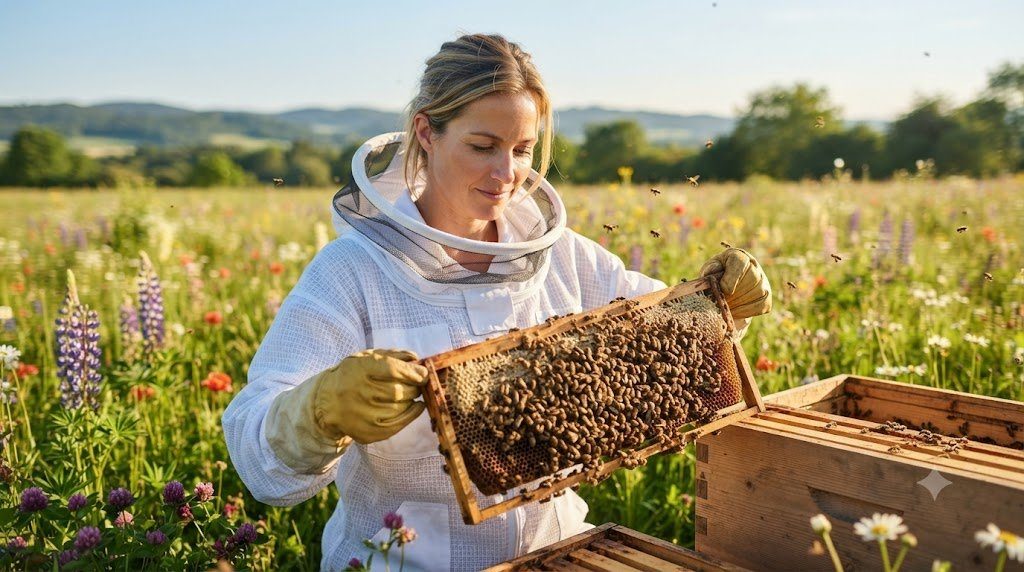
Whenever examining a brood frame for eggs, queen cups, or stock traits, ALWAYS hold the frame directly over the open center of the brood box—never swung out over the grass beside your boots! If the mated queen loses her tarsal grip on the comb edge and drops, she falls safely straight back into her own hive rather than vanishing into tall grass.
Frequently Asked Questions: Honey Bee Genetics, Swarming, and Queens
How often should a productive colony be requeened in a managed apiary?
While a queen honey bee can biologically live for 3 to 5 years, her daily egg-laying capacity and 9-ODA mandibular pheromone output peak during her first full production season and decline by roughly 20% to 30% in her third year. Colonies headed by two-year-old queens are approximately three times more likely to prepare to swarm in spring than colonies headed by vigorous young first-year queens. Therefore, commercial honey producers requeen on a 12-to-24-month cycle—ideally introducing young mated queens in late summer (August/September) when acceptance is high and young queens lay heavily into autumn to build a massive winter cluster.
Can I combine two weak colonies in autumn without finding both queens?
While performing a ‘Newspaper Combine’ (placing two sheets of slit black-and-white newspaper over the top bars of the stronger bottom colony and setting the weaker colony box on top so the bees chew through slowly over 48 hours and merge peacefully) works reliably, leaving both queens inside is a gamble—sometimes the older, inferior queen kills the younger queen, or both queens are injured in combat! Whenever possible, locate and remove the older or inferior queen 4 hours before setting the newspaper combine in place.
Why are my bees bearding heavily on the front of the hive on July evenings?
A dense ‘beard’ of 5,000 to 15,000 bees hanging calmly on the front landing board and lower hive wall on hot, humid summer evenings is completely normal thermoregulatory behavior—NOT a swarm! When all field foragers return home at dusk and internal brood nest temperatures threaten to rise above 35.5°C, older bees move outside onto the front porch so internal fanners have open air channels to cool the brood. In contrast, a true reproductive swarm departs between 10:00 AM and 2:00 PM in a swirling cloud and clusters on a nearby tree limb or fence post.