Inside the dark, bustling confines of a hive housing 50,000 sterile female workers, 500 drones, and a single reproductive queen, there is no central manager barking orders. Instead, social cohesion, reproductive monopoly, nursing allocation, orientation, and perimeter defense are orchestrated by a continuous symphony of volatile and non-volatile semiochemicals: honey bee pheromones. Secreted by at least fifteen specialized exocrine glands distributed across the head, thorax, and abdomen, these chemical messengers act along two distinct biological timelines: releaser pheromones (which trigger immediate, rapid behavioral responses via antennal olfactory neurons, such as stinging or Nasonov fanning) and primer pheromones (which alter long-term endocrine physiology and gene expression, such as suppressing worker ovary development).
For the observant apiarist, reading the pheromonal language of a hive—through scent, posture, and comb behavior—allows you to diagnose queenlessness within 30 seconds of lifting the lid, calm a defensive colony before a single sting is launched, and guide homeless swarms straight into bait hives.
Queen Mandibular Pheromone (QMP): 9-ODA and Reproductive Monopoly
The chemical crown of the queen honey bee is produced by a pair of large sac-like mandibular glands inside her head capsule, assisted by tarsal (footprint), Dufour’s, and tergal gland secretions. Queen Mandibular Pheromone (QMP) is a synergistic five-component blend of fatty acids and aromatic compounds:
- (E)-9-oxodec-2-enoic acid (9-ODA): The primary carboxylic acid (~150–250 $\mu$g in a mated queen), responsible for inhibiting queen cell construction and serving as the long-range aerial sex pheromone that attracts drones from 60 meters away at Drone Congregation Areas.
- (R)- and (S)-(E)-9-hydroxydec-2-enoic acid (9-HDA): Both enantiomers stabilize the cluster during swarming and calm retinue workers.
- Methyl p-hydroxybenzoate (HOB) and 4-hydroxy-3-methoxyphenylethanol (HVA): Aromatic compounds whose production surges only after a virgin queen mates and begins laying eggs, signaling true fecundity to her daughters.
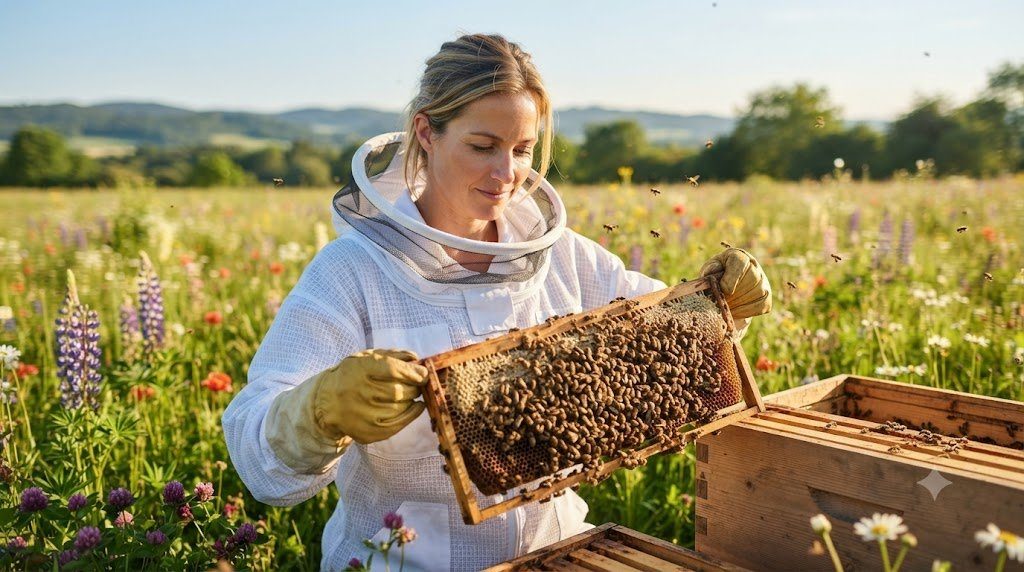
As the queen walks across the brood comb laying eggs, a shifting circle of 8 to 15 young nurse bees—her retinue—constantly palpate her body with their antennae, lick her cuticle, and groom her thorax. Within minutes, those retinue workers disperse across the comb, sharing trace micrograms of QMP with thousands of sister bees via trophallaxis. As long as every worker receives her daily threshold dose of QMP, Juvenile Hormone synthesis and ovarian development in workers remain inhibited. If the queen dies or is removed, QMP levels plummet within 15 to 30 minutes: workers begin roaring at a higher acoustic pitch, nervously running over the face of the comb, and within 4 to 12 hours begin modifying hexagonal worker cells around young larvae into vertical emergency queen cells.
It is a common myth that QMP alone prevents workers from laying unfertilized drone eggs! In reality, the strongest inhibitor of worker ovary activation is Open Brood Pheromone (specifically E-beta-ocimene and fatty acid esters emitted by young larvae). A colony only develops dysfunctional laying workers after it has been BOTH queenless AND completely without open larvae for 21+ consecutive days!
Master Atlas of Honey Bee Exocrine Glands & Chemical Messengers
The biochemical reference table below catalogs the major exocrine glands of Apis mellifera, their active molecular compounds, and their behavioral or physiological functions inside the superorganism.
| Exocrine Gland & Caste | Primary Chemical Compounds | Pheromone Type | Biological & Behavioral Function in Colony |
|---|---|---|---|
| Mandibular Gland (Queen) | 9-ODA, 9-HDA, HOB, HVA | Primer + Releaser | Inhibits queen cups; attracts retinue; drone sex attractant in flight |
| Mandibular Gland (Worker) | 2-Heptanone (in foragers); 10-HDA (in nurses) | Releaser / Nutritive | 2-Heptanone acts as mild anesthetic/repellent; 10-HDA preserves royal jelly |
| Nasonov Gland (Worker) | Geraniol, Nerolic acid, Citral, Geranic acid | Releaser (Attractant) | Homing beacon for lost bees, virgin queens, swarms, and water sources |
| Koschevnikov Gland (Worker) | Isoamyl acetate (Isopentyl acetate) + 20 esters | Releaser (Alarm) | Bananas/pear odor released on sting shaft; recruits guards to sting target |
| Dufour’s Gland (Queen) | Long-chain alkane/alkene esters | Releaser + Primer | Egg-marking signal (allows workers to police & eat worker-laid eggs) |
| Tarsal Arnhart Gland (All) | Oily hydrocarbon footprint secretion | Releaser | Queen footprints inhibit cup building on bottom bars; worker foraging trail mark |
| Salivary / Cuticular (Brood) | 10 Fatty Acid Methyl/Ethyl Esters + E-β-ocimene | Primer + Releaser | Signals larval age for capping; suppresses worker ovaries; stimulates pollen foraging |
The Nasonov Gland: Terpenoid Homing Beacons and Bait Hive Engineering
Located on the dorsal surface of the seventh abdominal tergite—normally concealed underneath the overlapping sixth tergite—the Nasonov gland of the worker bee synthesizes a fragrant seven-component blend of lemony plant-like monoterpenoids: geraniol, nerolic acid, geranic acid, (E,E)-farnesol, and citral (neral + geranial).
Whenever a colony is disturbed and shaken in front of a new hive, when a prime swarm settles into a cavity, or when a virgin queen returns from her nuptial flight, dozens of worker bees stand on the landing board with their abdomens elevated high in the air (‘sterzel’ posture), flex the tip of their abdomen downward to expose the pale white moist Nasonov membrane, and beat their wings furiously to broadcast a plume of citrusy scent downwind. Beekeepers leverage this exact neuroethology by placing 2 drops of pure lemongrass essential oil (which is 75%–85% citral) mixed with geraniol inside a sealed polyethylene microcentrifuge tube inside a 40-liter swarm trap—attracting scout bees from over a kilometer away!
Koschevnikov Alarm Pheromone and Brood Ester Policing
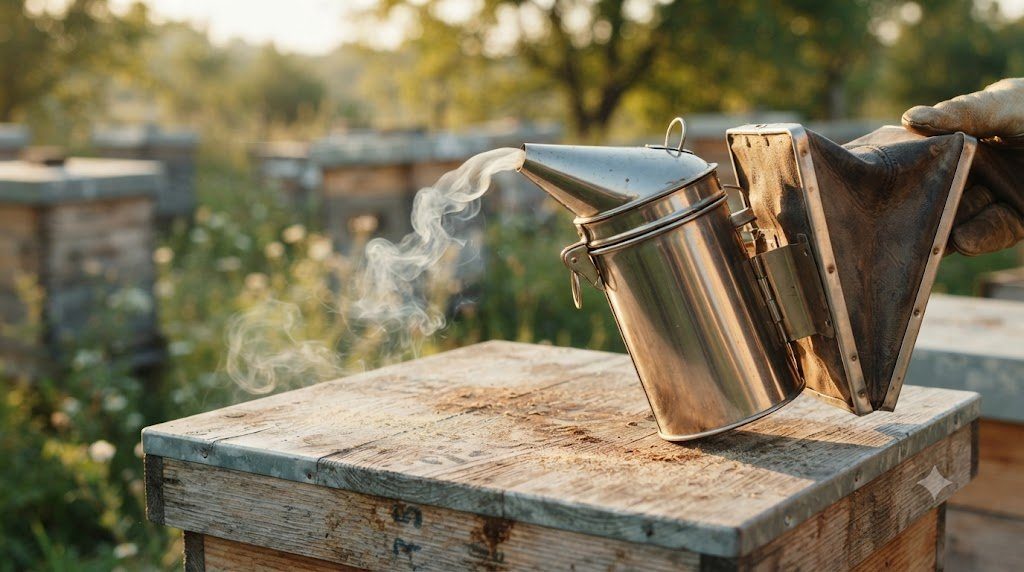
When a guard bee embeds her barbed lancet stinger into mammalian skin or leather gloves, the entire sting apparatus—along with the venom sac, musculature, and the Koschevnikov gland—is autotomized (ripped free from her abdomen). Instantly, the exposed Koschevnikov gland releases a volatile cloud of isoamyl acetate (isopentyl acetate), which smells unmistakably like overripe artificial banana candy. Isoamyl acetate vaporizes rapidly at body temperature, painting a chemical bullseye on the intruder and recruiting dozens of additional guard bees to sting the exact same spot—which is why puffing cool smoke onto a fresh sting site immediately is mandatory to mask the ester molecules.
Equally remarkable is Brood Recognition Pheromone (BRP), a precise cocktail of ten methyl and ethyl esters of palmitic, linoleic, linolenic, stearic, and oleic acids combined with the volatile terpene (E)-$\beta$-ocimene emitted by developing larvae. Nurse bees patrolling the pitch-black comb read the exact ratio of these esters with their antennae to determine whether a larva is 2 days old (requiring dilute worker jelly), 4 days old (requiring coarse honey and bee bread), or a 5th-instar prepupa ready to be capped with porous wax—or whether the larva is sick and must be uncapped and hygienically removed.
Queen Introduction Physics: Overcoming Cuticular Hydrocarbon Rejection
Why does a queenless colony sometimes ball, sting, and suffocate a newly purchased $45 mated queen the moment she walks out of her introduction cage, even though the colony desperately needs a queen? Because in addition to 9-ODA mandibular pheromones, every queen and worker bee carries a colony-specific odor badge of cuticular hydrocarbons (CHCs—long-chain alkanes and alkenes) derived from her previous hive’s wax comb and floral diet, plus each queen secretes unique esters from her Dufour’s gland and tarsal glands.
When an unfamiliar queen is dropped into a hive that still has open young larvae (from which the workers would rather raise one of their own genetic sisters!) or during a late-summer robbing dearth when guard bees are hyper-vigilant, older foragers perceive her foreign cuticular profile as an intruder and form a tight suffocating ball around her, heating her thorax to 45°C until she perishes. To guarantee 98%+ queen acceptance even with difficult stock replacements:
- Verify True Hopeless Queenlessness (Or Remove All Open Brood): Never introduce a caged queen into a hive that already has hidden queen cells or a secret virgin running on the comb!
- Remove Escort Attendant Workers From the Shipping Cage: The 5 or 6 worker attendants packed inside a mailed Benton cage frequently grasp the screen legs of host-hive bees and provoke fighting through the wire mesh. Release the attendant workers indoors against a closed window so you can place the queen into the introduction cage solo, forcing the host hive’s own nurse bees to feed her directly through the screen!
- Use a Push-In Mesh Comb Cage Over Emerging Brood: For high-value breeder queens or Russian/Carniolan-to-Italian transitions, press a 4×4-inch folded 8-mesh hardware cloth cage (with 1/2-inch bent legs) directly into a patch of dark comb containing emerging fuzzy callow bees and a few cells of open honey with the new queen underneath. Newly emerging 1-hour-old bees lack defensive instincts and immediately form a loving retinue around her as she begins laying eggs inside the cage within 48 hours; once she is actively laying on Day 4, her HVA/HOB fecundity pheromone output surges and the entire colony accepts her upon lifting the cage!
Clinical Diagnostic Inspection Workflow and Lab Sampling Protocols
Translating honey bee pathobiology, endocrinology, and pheromone chemistry into thriving colonies requires a systematic, repeatable Clinical Brood-Nest Inspection Protocol. Rather than pulling frames randomly from the middle of the hive (which risks rolling the queen between tight combs), always start by removing the outermost honey/pollen frame (#1 or #10) to create a wide working gap, then inspect frames sequentially toward the center while auditing five biological biomarkers.
| Biological Biomarker | Healthy Colony Baseline | Subclinical Warning Sign | Acute Pathological Crisis | Immediate Corrective Intervention |
|---|---|---|---|---|
| Egg & Young Larval Ring | Single upright eggs centered on floor; rich pool of white jelly | Dry larvae with minimal jelly (Nutritional stress) | Multiple eggs plastered on cell walls (Laying workers) | Feed 1:1 syrup + polyfloral pollen patty; unite laying workers w/ queenright nuc |
| Capped Brood Symmetry | >90% contiguous convex tan caps; 5–8% heater shafts | 15–25% spotty empty cells; occasional chewed pupae | Sunken greasy perforated caps; ropy brown scales (AFB) | Run alcohol mite wash & matchstick rope test; isolate hive tool |
| Varroa Mite Load (300 Bees) | < 1% (<3 mites/300 bees) in spring & autumn | 2% to 3% (6–9 mites/300 bees) in summer | > 4% (12+ mites) + bees with shriveled wings (DWV) | Apply temperature-matched IPM (Formic Pro, Thymol, or Oxalic + brood break) |
| Adult Bee Gut & Demography | Plump fuzzy nurses; clean entrance; active pollen loads | Slow spring buildup; high forager mortality | Dysentery streaking; crawling bees w/ K-wings (Nosema/CBPV) | Check 400x wet mount for Nosema spores; requeen & rotate dark comb |
| Acoustic & Pheromonal Tone | Calm low 180–220 Hz hum; cohesive frame carpet | Elevated roaring pitch when smoked; empty cups | High-pitched queenless roar; fanning without homing | Insert test frame of young eggs/larvae from healthy hive to verify queen status |
The ‘Test Frame of Eggs’ Assay: Definitive Queenlessness Diagnosis
What should you do when you open a hive in mid-summer, see zero eggs and zero young C-shaped larvae, hear a loud roaring hum, yet cannot tell whether the colony is truly queenless OR whether a slim, unmated virgin queen is hiding somewhere on the combs? Never blindly drop a $45 mated queen cage into a hive that might harbor a hidden virgin queen—the resident virgin will immediately sting the caged queen through the mesh!
Instead, perform the foolproof Test Frame Biological Assay:
- Go to a healthy, booming queenright colony in your yard, select a frame containing hundreds of fresh upright eggs and newly hatched 24-hour-old larvae, brush 100% of the adhering bees back into their parent hive, and mark the top bar of this test frame with a thumbtack.
- Insert this frame of fresh eggs right into the center of the suspect colony’s brood nest and close the hive.
- Read the Result Exactly 72 Hours Later: If the colony was truly queenless, the desperate nurse bees will have pulled 5 to 15 unmistakable emergency queen cells directly over the young larvae on your test frame! You can now either let them finish one prime cell OR pinch the emergency cells and introduce a mated queen with 100% confidence. Conversely, if zero queen cells are pulled on the test frame after 72 hours, a virgin (or newly mated queen about to start laying) is already present inside the hive!
In the United States and Canada, state apiary programs and the USDA-ARS Bee Research Laboratory (Beltsville, Maryland) provide free clinical microscopy and molecular diagnostics for suspected brood and adult bee diseases! To submit a suspicious brood sample, cut a 4×4-inch square of affected comb containing dead larvae/scales, wrap it in a dry paper towel or porous newspaper inside a cardboard box (NEVER wrap comb in plastic bags or aluminum foil, which causes saprophytic mold growth that ruins lab analysis!), and mail with your apiary contact form.
Frequently Asked Questions: Pheromones, Mites, and Brood Pathology
Does an alcohol wash kill the 300 nurse bees—and is a powdered sugar roll just as accurate?
While an alcohol wash (or Dawn ultra-dish-soap water wash) sacrifices ~300 nurse bees out of a colony of 45,000 bees (where the queen lays 1,500 new eggs every single day—meaning those 300 bees represent just 4.8 hours of the queen’s daily egg output!), comparative field validations by Dr. Randy Oliver show that agitated alcohol/soapy-water washes recover 98% to 100% of phoretic mites consistently. In contrast, a powdered sugar roll frequently undercounts mites by 30% to 50% on humid days or when performed with coarse sugar, giving beekeepers a false sense of security that can cost the entire colony of 45,000 bees in winter.
How can I tell the difference between laying worker drone brood and a drone-laying queen?
Both produce raised, bullet-shaped drone cappings inside worker-sized cells, but their egg-laying patterns are completely different! A failing or unmated drone-laying queen has a long abdomen that reaches the bottom of the cell, so she still lays 1 single unfertilized egg centered neatly on the cell floor in a cohesive patch. In contrast, laying workers have short abdomens that cannot reach the bottom of a deep comb cell; they lay 5 to 15 eggs chaoticly plastered along the vertical side walls of each cell, often depositing eggs right on top of stored bee bread (pollen) cells!
Why do bees throw white pupae out on the landing board after a cold spring night?
If a fast-expanding colony stretches its brood nest across 7 frames during warm April days and a sudden -3°C (26°F) freeze strikes overnight, the cluster must contract tightly toward the center to keep the core at 34.5°C. The outermost ring of brood left outside the contracted cluster mantle suffers Chilled Brood. Unlike infectious bacterial foulbrood, chilled brood affects a neat concentric outer ring of all ages simultaneously, turns gray-black without ropiness or foul odor, and hygienic house bees rapidly uncap and drag the dead white/gray pupae out onto the front porch within 48 hours as weather warms.