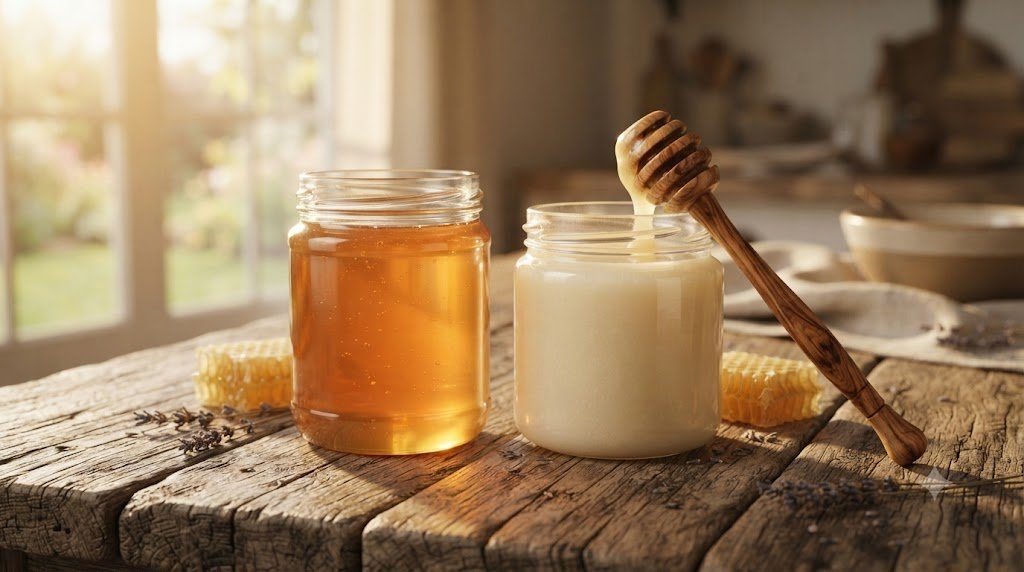
Virtually every beekeeper has received a call from a customer asking why the jar of liquid honey they bought in August turned solid in November—often wondering if the honey went bad or was adulterated with table sugar. In reality, natural granulation (crystallization) is the ultimate badge of pure, unheated raw floral honey. Because cured honey contains 70% to 80% dissolved sugars held in less than 18% water, it is a highly unstable supersaturated carbohydrate solution at room temperature.
However, left to crystallize randomly on a kitchen shelf, slow crystal growth produces large, coarse, gritty glucose monohydrate needles that crunch unpleasantly between the teeth—worse still, coarse crystallization releases bound water into the remaining liquid phase, raising water activity ($a_w$) and triggering secondary yeast fermentation! By mastering the physical chemistry of Glucose-to-Water ($G/W$) ratios and Dr. Elton J. Dyce’s famous 1931 Cornell University patent, any apiarist can transform fast-granulating floral honeys into velvety-smooth, spreadable Creamed (Spun) Honey that commands a premium market price.
The Physical Chemistry of Honey Granulation: Glucose vs. Fructose
Although glucose (dextrose) and fructose (levulose) share the exact same molecular formula ($C_6H_{12}O_6$), their three-dimensional stereochemistry gives them radically different solubilities in water at 20°C:
- D-Fructose is extremely hygroscopic and soluble: Saturation occurs only above ~79% weight-in-weight solution. Therefore, fructose never crystallizes in honey; it remains permanently in the liquid phase!
- D-Glucose has relatively low solubility in water: At 20°C (68°F), water can only hold roughly 47% glucose in stable equilibrium before the excess precipitates out as solid crystals of $\alpha$-D-glucose monohydrate ($C_6H_{12}O_6 \cdot H_2O$).
Consequently, the speed at which any botanical variety of honey crystallizes is governed by two predictive mathematical indices: the Fructose-to-Glucose Ratio ($F/G$) and the Glucose-to-Water Ratio ($G/W$):
| Botanical Floral Source | Typical F/G Ratio | Typical G/W Ratio | Natural Granulation Speed | Best Market Presentation |
|---|---|---|---|---|
| Canola / Rapeseed (Brassica napus) | 0.90 – 0.98 | 2.15 – 2.35 | Extreme (Crystallizes in 5–14 days—even in comb!) | Ideal base for Dyce Creamed Honey |
| Dandelion (Taraxacum officinale) | 0.85 – 0.95 | 2.10 – 2.25 | Very Fast (1 to 3 weeks after extraction) | Creamed honey or early spring cut-comb |
| Alfalfa & White Clover | 1.05 – 1.18 | 1.75 – 1.95 | Moderate (1 to 3 months on shelf) | Classic liquid jar or smooth creamed honey |
| Goldenrod & Aster (Autumn) | 1.10 – 1.22 | 1.80 – 2.00 | Fast-Moderate (3 to 6 weeks; coarse crystals) | Excellent when seeded into spiced creamed honey |
| Basswood / Linden (Tilia) | 1.20 – 1.32 | 1.55 – 1.70 | Slow (4 to 9 months) | Premium liquid varietal jar |
| Black Locust / Acacia (Robinia) | 1.50 – 1.70 | 1.25 – 1.40 | Virtually Never (Stays liquid 2 to 4+ years!) | Showcase crystal-clear liquid glass bottle |
| Tupelo (Nyssa ogeche) | 1.55 – 1.75 | 1.20 – 1.35 | Virtually Never (High levulose prevents crystals) | Ultra-premium liquid table & comb honey |
Here is a stoichiometric paradox every beekeeper must know: Glucose has a molecular weight of 180 g/mol, while a water molecule is 18 g/mol (10% of the mass of glucose). When glucose crystallizes as Glucose Monohydrate (1 glucose : 1 water), the solid crystal locks up only 9.09% water by weight—leaving behind the other ~9% water that was originally holding it in solution! This floods the remaining liquid fructose layer at the top of the jar with 21%+ moisture, causing yeasts to ferment the liquid layer on top of solid honey!
Temperature Dependency: Why 14°C (57°F) Is the Peak Crystallization Zone
Crystal growth rate in honey follows a classic bell curve governed by two competing physical forces: supersaturation driving force (which increases as temperature drops) versus molecular diffusion mobility / viscosity (which slows down as temperature drops):
- Below 0°C (-18°C Freezer Storage): Although supersaturation is maximal, honey viscosity becomes glass-like (>1,000,000 cP). Glucose molecules are frozen in place and cannot migrate to crystal nuclei. Therefore, storing liquid honey or comb honey in a deep freezer at -18°C (0°F) prevents crystallization indefinitely while preserving 100% of raw enzymes!
- At 13°C to 15°C (55°F–59°F): This is the Peak Crystallization Temperature. Supersaturation is high while viscosity remains low enough for rapid molecular diffusion. Never store liquid honey in a 14°C basement if you want it to stay liquid—and ALWAYS hold seeded creamed honey at 14°C when you want rapid micro-crystal interlocking!
- At 22°C to 26°C (Room Temperature): Slow, erratic crystal nucleation occurs around stray pollen grains, microscopic wax flecks, or tiny air bubbles, growing large (>0.5 mm) coarse needles over several months.
- At 38°C to 40°C (100°F–104°F): Existing glucose monohydrate crystals dissolve back into clear liquid solution without destroying diastase or invertase enzymes.
The Dyce Process: Engineering Velvety Micro-Crystalline Creamed Honey
The human tongue and palate cannot detect individual solid particles smaller than roughly 20 to 25 microns (0.025 mm). If a jar of honey contains millions of tiny, uniform glucose crystals measuring 5 to 15 microns in length rather than a few thousand jagged 500-micron crystals, the honey feels just like smooth dairy butter on the tongue, never drips off warm toast, and never separates into a watery top layer. Executing the Dyce Process at home or commercial scale requires five exact steps:
Step 1: Moisture Verification and Liquefaction of Base Honey
Select a high-glucose floral honey (or blend) with a moisture content strictly between 17.0% and 17.8%. Warm the liquid base honey gently in a water-jacketed tank or warming cabinet to 40°C (104°F) (classic commercial Dyce pasteurizes to 60°C to kill yeasts, but raw artisanal producers stay at 40°C with <17.5% moisture to preserve raw enzymes) until 100% of existing coarse crystals are dissolved and strained through a 200-micron mesh.
Step 2: Cooling to 24°C and Grinding the ‘Seed’ Starter
Cool the clarified liquid honey down to 23°C–25°C (73°F–77°F) BEFORE adding your starter seed! (If you add seed crystal to warm 35°C honey, the seed melts and your batch will grow coarse rock crystals). For the starter seed, take an existing smooth creamed honey—or grind naturally crystallized honey in a mortar and pestle or food processor until it feels completely smooth between your fingers—at a ratio of 5% to 10% by weight (e.g., 5 lbs of smooth starter seed per 50 lbs of liquid base honey).
Step 3: Low-RPM Homogenization and 14°C (57°F) Cold Incubation
Fold the 10% starter seed thoroughly into the 24°C liquid honey using a submerged helical paddle mixer at low speed (60–100 RPM) so zero air bubbles are whipped into the batch. Immediately bottle the seeded honey directly into its final wide-mouth glass jars (since it will become too firm to pour once set) and place the jars into a wine cooler, modified chest freezer with an Inkbird temperature controller, or cellar maintained at 14°C (57°F) for 5 to 7 days. Within one week, the billions of microscopic seed nuclei interlock into a firm, pearlescent, velvety spread that will retain its creamy texture at room temperature for years.
Safe Liquefaction of Crystallized 5-Gallon Buckets Without Scorching
Commercial and sideliner beekeepers routinely store their summer harvest in 60-pound (5-gallon) food-grade HDPE buckets and liquefy batches on demand throughout the winter for jarring. However, because solid crystallized honey has very poor thermal conductivity, wrapping a high-wattage industrial band heater around the outside of a 5-gallon plastic bucket set to 75°C will scorch the outer 2 inches of honey against the bucket wall into dark caramel long before the frozen core in the center melts!
To liquefy a solid 60-pound bucket of granulated honey with zero enzymatic loss or HMF elevation, use one of three precision gentle-heat systems:
- Thermostatic Insulated Warming Cabinet (38°C to 40°C / 100°F–104°F): Build an insulated plywood or rigid XPS foam cabinet (or repurpose a non-working upright chest refrigerator) heated by a ceramic reptile heat emitter or 100W incandescent bulb wired to a digital PID temperature probe taped to the bucket wall at 39°C (102°F), assisted by a small 12V computer fan to circulate air evenly. Within 36 to 48 hours, the entire bucket melts into crystal-clear raw honey without a single hotspot.
- Conical Immersion Heater (‘Melter Probe’): A thermostatically controlled stainless steel immersion ring set to 42°C is rested directly on top of the solid honey surface inside the open bucket. As it gently melts the top layer, gravity pulls the heated ring slowly down through the bucket to the floor over 18 hours.
- Sous-Vide Water Bath Circulation: Place glass jars or sealed pails inside a tub of water circulated by a culinary sous-vide immersion circulator set to an exact 39.5°C (103°F).
Commercial Grading, Pfund Colorimetry, and Food-Safety Standards
Transforming capped honey frames from the apiary into shelf-stable, legally compliant retail jars or bulk commercial drums requires adherence to international physicochemical standards established by the USDA Grades of Extracted Honey and the Codex Alimentarius Commission (Standard 12-1981). Whether marketing varietal artisanal jars at a farmers’ market or wholesaling 650-pound steel drums, grading honey by optical color, moisture content, floral purity, and clarity establishes objective market value.
In international trade, honey color is measured on the continuous millimeter scale of the Pfund Color Grader (or digital spectrophotometric transmittance at 560 nm), ranging from nearly colorless Water White (< 8 mm Pfund) through Dark Amber (> 114 mm Pfund). Generally, lighter spring honeys (acacia, white clover, fireweed, tupelo) feature delicate, mild floral esters, while dark late-summer and autumn honeys (buckwheat, heather, chestnut, forest honeydew) boast 3x to 5x higher total polyphenolic antioxidant capacity and mineral ash content.
| USDA / Pfund Color Grade | Pfund Scale Range (mm) | Optical Appearance | Representative Floral Sources | Flavor & Antioxidant Profile |
|---|---|---|---|---|
| Water White | 0 to 8 mm | Crystal clear / pale platinum | Fireweed, Black Locust (Acacia), Star Thistle | Ultra-delicate floral notes; lowest mineral ash |
| Extra White | 9 to 17 mm | Pale straw shimmer | Sweet Clover, White Dutch Clover, Basswood | Clean, classic sweet floral; top comb-honey grade |
| White | 18 to 34 mm | Bright golden champagne | Alfalfa, Orange Blossom, Sourwood, Sage | Aromatic, balanced sweetness; high consumer demand |
| Extra Light Amber | 35 to 50 mm | Warm sunlit gold | Wildflower blends, Palmetto, Sunflower, Tupelo | Rich floral complexity with smooth lingering finish |
| Light Amber | 51 to 85 mm | Rich amber-bronze | Eucalyptus, Goldenrod, Red Clover, Tulip Poplar | Full-bodied, malty-floral notes; high enzyme activity |
| Amber | 86 to 114 mm | Deep reddish-copper | Autumn Aster, Manuka, Wild Thyme, Sumac | Bold, herbaceous, complex mineral and phenolic profile |
| Dark Amber | > 114 mm (up to 140) | Dark mahogany / espresso | Buckwheat, Heather, Chestnut, Pine Honeydew | Robust molasses-malt tang; highest polyphenol antioxidants |
Sanitary Bottling, Labeling Compliance, and Clostridium botulinum Warnings
When packaging raw floral honey for public sale, presentation and legal label compliance build immediate consumer confidence while protecting the producer from regulatory liability:
- Pre-Warming and De-Bubbling Glass Jars: Always bottle into clean, bone-dry glass Queenline, Classic Hex, or Muth corked jars (Even 3 drops of rinse water left inside a newly washed jar will dilute the top surface layer of honey above 22% moisture and trigger mold or yeast fermentation!). Hold the settling tank honey at 30°C–32°C (86°F–90°F) and tilt the jar slightly as you open the scissor gate so the ribbon of honey slides smoothly down the inside glass wall without trapping air bubbles.
- Mandatory Infant Botulism Label Warning: Because raw agricultural dust and floral surfaces naturally harbor dormant environmental spores of Clostridium botulinum (which cannot germinate in honey’s low $a_w < 0.60$, but CAN colonize the immature, low-acid intestinal flora of human infants prior to 1 year of age), every honey label must prominently display: “WARNING: Do not feed honey to infants under one year of age.”
- Dual Net Weight Declaration & Producer Identity: Federal and state weights-and-measures laws require the net weight to be printed in the lower 30% of the principal display panel in both avoirdupois and metric units (e.g., NET WT 16 OZ (1 LB) 454g) alongside the common name (‘Pure Raw Honey’), floral source if monofloral, and the full physical street address or city/state/zip of the packer/apiary.
Because honey has a specific gravity of ~1.42 compared to water’s 1.00, volume ounces (Fluid Ounces) and weight ounces (Net Weight Ounces) are NOT equal! A standard 8-fluid-ounce (1 cup) canning jar holds exactly 12 ounces (0.75 lb) of honey by weight; a 1-pint (16 fl oz) jar holds 1.5 pounds (24 oz) of honey; and a 1-gallon jug holds approximately 12 pounds (5.44 kg) of honey. Always sell and label honey by NET WEIGHT, never fluid volume!
Frequently Asked Questions: Honey Ripening, Extraction, and Crystallization
Can I harvest honey from frames that previously held brood?
Technically yes—the honey stored inside clean dark comb that once held worker brood is chemically safe and identical in moisture to white-comb honey. However, old brood cocoons contain larval propolis varnish and water-soluble pigments that slightly darken the color and impart a heavier, earthier note compared to pristine virgin white honey supers, and you must NEVER harvest honey from brood frames that have ever been exposed to synthetic miticide strips (such as Amitraz/Apivar or Coumaphos). Keeping dedicated honey supers strictly for honey storage ensures water-white clarity and zero miticide carryover.
How do I fix a batch of honey that started to ferment slightly?
If a bucket of 19.2% moisture honey develops a slight fruity yeast aroma early in storage, you can salvage it for personal culinary baking or fermented honey-wine (Mead / Hydromel) production! Heating the honey briefly in a water bath to 63°C (145°F) for 30 minutes kills active Zygosaccharomyces yeast cells and drives off trace ethanol, though it can no longer be sold as ‘Raw Unheated Honey’. Better yet, pitching Saccharomyces cerevisiae wine yeast (such as Lalvin EC-1118 or 71B) into diluted 1:3 honey-water must transforms high-moisture honey into world-class artisanal mead.
Why did my creamed honey turn out gritty or separate at room temperature?
Gritty creamed honey is almost always caused by one of two mistakes during the Dyce process: either the starter seed crystal was added while the liquid base honey was still warm (>28°C / 82°F), melting the tiny seed crystals so only a few large surviving crystals grew into coarse sand; OR the seeded jars were stored in a warm 24°C room instead of a cold 14°C (57°F) incubator for the first 7 days. Re-liquefy the batch completely at 40°C, cool to 23°C, re-seed with 10% ultrafine starter, and chill at 14°C.