Two genetically identical sister queens installed into identical Langstroth hives just 400 meters apart on the same farm can easily differ in surplus honey production by 50 pounds and experience completely opposite winter survival outcomes. The difference rarely lies inside the hive box—it lies in the microclimate of the apiary site. Microclimate engineering governs how early in the morning your foragers break flight threshold, how many calories the colony burns fanning to evaporate nectar or heat the winter cluster, whether fungal chalkbrood and Nosema spores proliferate in damp shade, and whether returning field bees drift into neighboring hives carrying Varroa mites.
Whether you are establishing a two-hive suburban backyard sanctuary or laying out a 40-colony commercial out-yard, mastering solar insolation angles, katabatic cold-air drainage, porous windbreak aerodynamics, and spatial visual landmarks will pay dividends every single season.
Solar Insolation Physics: The Southeast Entrance Advantage
Why have master apiarists for centuries insisted on facing hive entrances toward the East-Southeast (100° to 135° azimuth in the Northern Hemisphere)? The answer lies in honey bee thoracic flight physiology and early-morning flower nectar dynamics. Many high-value agricultural crops and native wildflowers—including cucurbits (pumpkins, squash), basswood, buckwheat, and fruit trees—secrete their peak volume of nectar and dehisce fresh pollen between 6:00 AM and 10:30 AM before midday vapor pressure deficits dry the nectaries.
When first-light morning sun strikes the front wall and bottom board landing strip of an east-southeast facing hive at 6:30 AM, infrared radiant warming raises the microclimate at the entrance by 4°C to 7°C above ambient shade air. Guard and scout bees feel this thermal cue and initiate foraging flights 45 to 90 minutes earlier than colonies sitting in deep morning forest shade. Over a 60-day main nectar flow, an extra hour of prime morning foraging translates to roughly 20% more total foraging trips per colony.
Preventing Midday Thermal Stress: Dappled Afternoon Shade vs. Full Sun
While full winter sunlight is universally beneficial for keeping hive walls dry and allowing winter clusters to break formation for mid-winter cleansing flights, relentless 38°C (100°F) afternoon sun beating down on unshaded hives in July forces colonies in southern climates to divert thousands of field foragers into water carriers and entrance fanners. Therefore, the ideal microclimate sits beneath deciduous hardwood trees (or positioned with trees to the West/Southwest): in summer, the leafy canopy casts dappled afternoon shade from 2:00 PM onward; in autumn, the leaves drop, bathing the hives in 100% solar radiation all winter long.
In regions where the Small Hive Beetle (SHB) is endemic (such as the Southeastern United States and coastal Australia), placing hives in permanent, damp, dense forest shade over soft moist soil is a recipe for colony sliming! SHB adults strongly prefer shaded hives, and wandering beetle larvae require moist, friable soil beneath the hive to pupate. Full morning-to-midday sun over dry gravel or crushed limestone dramatically suppresses SHB reproduction.
Topographical Cold-Air Drainage and Porous Windbreak Aerodynamics
Cold air behaves exactly like liquid water: because cold, dense air is heavier than warm air, on clear radiative nights it flows downhill (katabatic flow) and pools in valley bottoms, creek hollows, and bowl-shaped topological depressions, creating frost pockets accompanied by 95% to 100% relative humidity fog. Placing an apiary at the very bottom of a damp ravine guarantees cold, sodden winter hives and rampant spring chalkbrood. Always site your bee yard on a mid-slope bench or gentle south-facing knoll where cold air drains away downhill below the hive stands.
| Environmental / Site Factor | Optimal Engineering Target | Suboptimal / Hazardous Condition | Biological Impact on Colony |
|---|---|---|---|
| Entrance Solar Azimuth | East-Southeast (100°–135° N. Hem.) | North or West (Into prevailing winter wind) | 45–90 min earlier morning foraging; dry entrance |
| Topographical Elevation | Mid-slope bench with downhill air drainage | Valley floor frost pocket or exposed hill crest | Prevents radiative frost pooling and damp winter fog |
| Windbreak Porosity | 50% to 60% Semi-Porous (Hedgerow / Slatted fence) | Solid brick/metal wall (Creates leeward vortex) | Reduces wind speed by 70% for 8x height downstream |
| Hive Stand Height | 16 to 20 inches (40–50 cm) off ground | Cinder blocks <4 inches in wet tall grass | Eliminates skunk predation, toad attacks, and ground dampness |
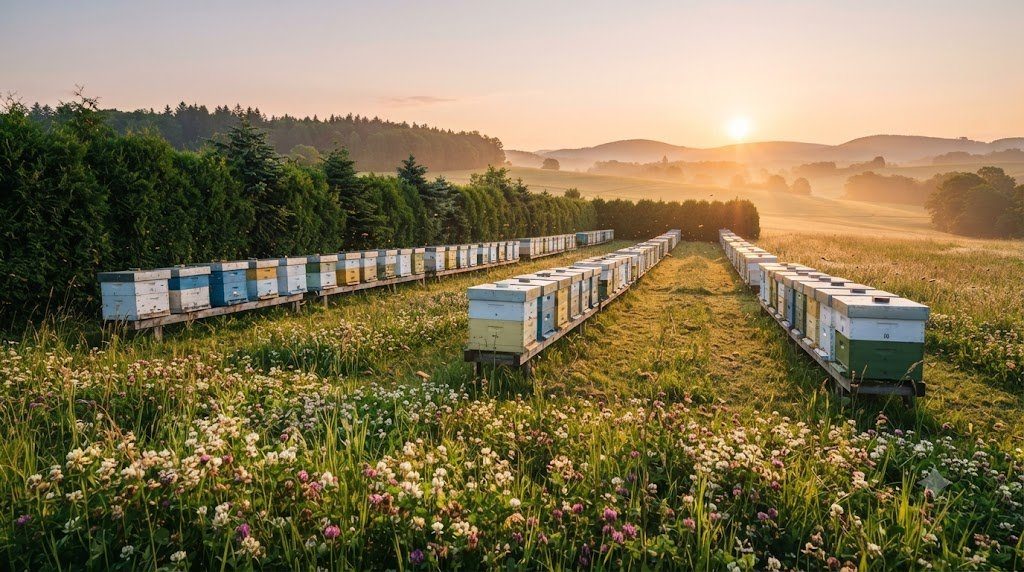
| Hive Layout Geometry | Horseshoe, S-curve, or staggered facing pairs | Long straight military row of 20+ white boxes | Reduces forager & virgin queen drifting from 40% to <5% |
| Permanent Water Source | 15 to 50 meters from hives in sun-warmed spot | Zero water on site (Bees visit neighbor’s pool) | Provides mineral-rich evaporative cooling water all summer |
Why a 50% Porous Windbreak Beats a Solid Wall
In aerodynamic fluid mechanics, when a 40 mph winter wind hits a 100% solid wooden or masonry wall, the air stream shoots sharply upward over the crest, creating a low-pressure vacuum zone directly behind the wall that sucks freezing air down in violent, swirling turbulent eddies (leeward vortices) right onto your hive roofs. In contrast, a 50% to 60% porous windbreak—such as an evergreen conifer hedge, woven willow wattle, or snow-fence slats with 1-inch gaps—allows a small fraction of air to bleed through cleanly, breaking kinetic momentum without creating a turbulent vacuum vortex and sheltering the apiary for a distance of 8 to 10 times the height of the barrier.
Eliminating Forager Drift and Mite Transmission via Layout Geometry
Traditional early-20th-century beekeeping books often illustrated apiaries arranged in long, ruler-straight rows of identical white-painted hives spaced 3 feet apart, all facing the exact same direction. Subsequent mark-and-recapture entomological research by Dr. Jaycox and Dr. Thomas Seeley revealed that in straight, uniform rows of identical hives, up to 35% to 50% of returning foragers (and drones) drift into the wrong hive—particularly piling into the colonies at the two ends of the row!
Drifting is not merely an inconvenience that imbalances colony populations; it is the primary horizontal super-highway for Varroa destructor, Deformed Wing Virus (DWV), and Nosema ceranae transmission between colonies inside an apiary. To reduce drifting below 5%, implement three spatial engineering practices:
- Break Up Straight Lines into Horseshoes, Arcs, or 4-Way Pallets: Arrange hive stands in curved crescents, S-curves, or groups of 2 to 4 hives angled 45 to 90 degrees away from their immediate neighbors.
- Use Bee-Visible Geometric Entrance Markers: Honey bees possess trichromatic vision shifted toward the ultraviolet spectrum (peak photoreceptors at 340 nm UV, 430 nm Blue, and 540 nm Green; they cannot see pure red, which appears black to them). Painting distinct geometric symbols—such as a blue circle, a yellow cross, a black triangle, or alternating colored brood boxes—above the entrance gives returning foragers and newly mated virgin queens an unmistakable visual beacon.
- Maintain Vertical Landmarks: Incorporating small shrubs, boulders, or fence posts between hive stands provides 3D retinal parallax landmarks that bees use during final landing approach maneuvers.
Designing a Dedicated Apiary Watering Station and Skunk Defense
During hot summer weather, a single booming honey bee colony requires 1 to 2 liters (1 to 2 quarts) of water per day to dilute crystallized winter honey for larval food and to evaporate droplets inside the brood nest so temperatures never exceed 36°C (above which pupal wing deformities occur). Because honey bees are creatures of extreme habit, once scout bees lock onto a water source in early spring—such as a neighbor’s chlorinated swimming pool or livestock trough—they will visit that exact spot all summer. Establish a permanent, sun-warmed trickle water station filled with moss, wine corks, or lava rocks (providing dry landing perches so bees never drown) spiked with a pinch of sea salt or natural compost tea (roughly 0.1%–0.3% mineral salinity, which bees strongly prefer over distilled tap water) before the first warm days of March. Finally, elevate all hives on sturdy rails 18 inches (45 cm) above the ground so nocturnal striped skunks (Mephitis mephitis) cannot scratch at the entrance without exposing their vulnerable bellies to guard bee stings.
Suburban Good-Neighbor Flight-Path Engineering and Electric Bear Fencing
How can an urban or suburban beekeeper maintain four booming hives on a quarter-acre lot without a single foraging bee colliding with a neighbor mowing their lawn 15 feet away? By exploiting vertical flight-cone aerodynamics! When a honey bee exits a hive entrance facing an open lawn, she flies outward on a gentle 10-degree upward glide path, staying at human head height (5 to 6 feet off the ground) for 30 to 50 feet before climbing into the canopy.
However, if you plant a dense 6-foot privacy hedge, bamboo screen, lattice trellis, or fence panel 5 to 6 feet directly in front of the hive entrance, departing and returning foragers are forced to pitch sharply upward at a 60-degree angle immediately upon takeoff. Within 6 feet of the hive, 100% of the bee traffic is flying 10 to 15 feet overhead—completely invisible and harmless to neighbors, children, and pets walking on the other side of the hedge!
High-Joule Electric Bear Fence Specifications (7,000+ Volts)
In rural regions inhabited by black bears (Ursus americanus) or grizzly bears, wooden fences and ratchet straps are useless once a bear smells 40 pounds of warm brood protein and honey. Because a bear’s thick fur Coat acts as an electrical insulator up to 3,000 volts, an effective apicultural bear perimeter requires a low-impedance solar or AC energizer delivering at least 1.0 to 3.0 stored Joules at 7,000 to 9,000 Volts across 4 to 5 strands of high-tensile galvanized wire (spaced at 6, 14, 22, 32, and 42 inches off the ground), grounded via three 6-foot copper-clad ground rods driven into moist earth, with raw bacon strips wrapped onto the hot wire to shock the bear’s wet, conductive nose on first approach.
Structural Maintenance, Carpentry Tolerances, and Seasonal Hive Audits
A well-engineered beehive is a precision thermodynamic vessel designed to serve a colony continuously for 15 to 25 years. Whether you operate 8-frame or 10-frame Langstroth stacks, horizontal Kenyan top-bar troughs, or insulated Warré towers, minor dimensional warping, rotting bottom-board runners, or unsealed roof seams rapidly compromise both bee space tolerances (7.9 mm) and winter moisture regulation.
Integrating an annual Carpentry & Microclimate Audit into your late-winter and late-summer apiary workflow ensures that hardware failures never trigger comb bridging, robbing breaches, or winter condensation losses. Review the structural inspection matrix below across all five hive zones.
| Hive Structural Zone | Critical Engineering Tolerance | Common Field Failure Mode | Corrective Maintenance & Upgrade |
|---|---|---|---|
| Hive Stand & Ground Base | 16–20 in. elevation; 1.5° forward tilt | Rotting timber runners; hive tips backward | Use concrete blocks + 4×4 pressure-treated rails; shim rear 1/4″ higher so rain drains out front |
| Bottom Board & Entrance | 9.5 mm winter / 19 mm summer opening | Warped pine floor creates rear robbing gap | Build floors from rot-resistant Western Red Cedar; install 1/4″ galvanized mouse guard in Oct |
| Brood Box Finger Joints | Square 90° corners; 7.9 mm top bee space | Corner separation when prying propolis | Glue all finger pins with Titebond III PVA + cross-nail with 7d ring-shank galvanized nails |
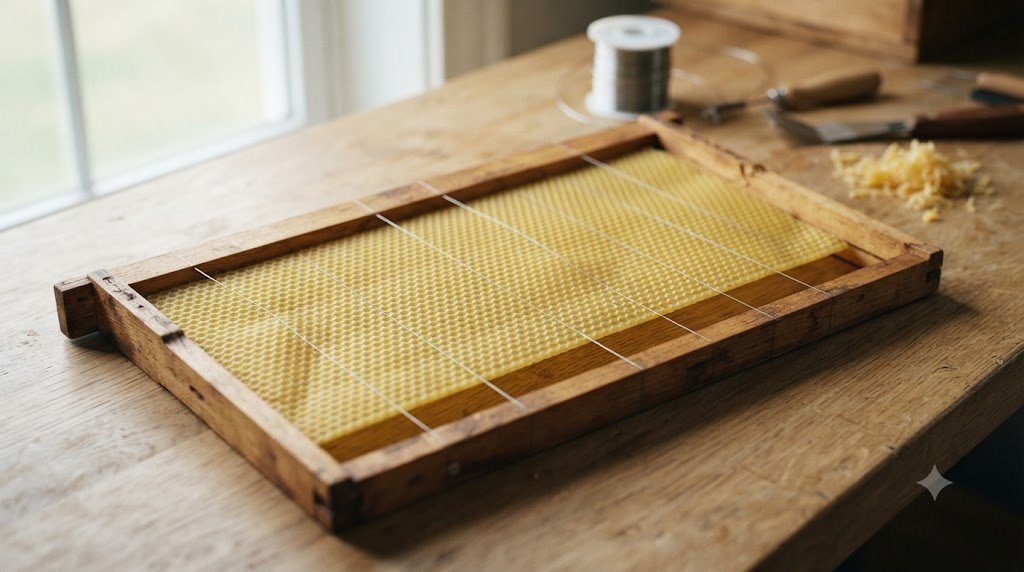
| Frame Rest Rabbets | 16 mm depth x 9.5 mm width (+ metal rail) | Propolized frame ears split wood rabbet | Install galvanized steel J-profile frame rest strips; coat contact edge with food-grade petrolatum |
| Telescoping Roof & Insulation | R-20+ ceiling; overhanging aluminum flashing | Pinhole leak wets inner cover & chills cluster | Fold seamless 0.019″ aluminum flashing over corners; insert 2″–4″ XPS foam board under lid |
Managing Robbing Defense Through Entrance Aperture Engineering
In nature, wild hollow tree nests studied by Dr. Thomas Seeley possess a small, single knot-hole entrance averaging just 12 to 20 square centimeters (roughly a 1.5-to-2-inch round hole)—which ten guard bees can defend effortlessly against wasps, yellowjackets (Vespula spp.), and neighboring robber bees. In contrast, a wide-open 10-frame Langstroth bottom board without an entrance reducer presents an enormous 300-square-centimeter (14.75 x 0.75 inch) undefended boulevard!
- When to Use the Smallest (1-Inch) Notch: Keep nuclear colonies, newly hived swarms, and spring packages restricted to the smallest 1-inch to 2-inch entrance opening until the box is 80% drawn, and immediately reduce all hives down to the medium or small opening the day the summer nectar flow stops in July/August.
- Installing Perforated Metal Robbing Screens: During severe late-summer nectar dearths or after pulling wet honey supers, attach a folded #8 hardware-cloth Robbing Screen across the front entrance. Resident bees know how to walk up and exit the top slot of the screen, whereas incoming robber bees—attracted by the plume of honey odor—slam repeatedly against the lower wire mesh face without finding the upper side entrance!
When heavy propolis builds up along the wooden frame-rest rabbets and Hoffman sidebar shoulders, prying a tight frame loose causes it to pop upward with a violent jolt—alarming guard bees and risking rolling the queen against the adjacent comb. Once each spring, scrape excess propolis lumps off the metal frame rests with your flat hive tool blade and rub a tiny smear of pure beeswax or food-grade mineral oil along the metal rail so frames slide like silk!
Frequently Asked Questions: Hive Architecture, Insulation, and Siting
Can I move a beehive 20 feet across my backyard in the middle of summer?
Every apiarist must obey the “Under 3 Feet or Over 3 Miles Rule”! Foraging honey bees lock the exact GPS-like visual landmark coordinates of their hive entrance into their long-term mushroom-body memory. If you pick up a hive at night in July and move it 25 feet across the yard, the next morning 15,000 field bees will fly out, return to the exact spot where the hive used to sit, and hover helplessly on the empty grass until they die of exhaustion! To move a hive a short distance within the same yard, either slide the hive 2 to 3 feet per day over several days, OR move the hive to a temporary out-yard at least 3 miles (5 km) away for 14 days before bringing it back to the new spot, OR stack a dense bundle of leafy evergreen branches directly across the front entrance so exiting bees notice the obstruction and execute a full orientation flight.
Should I use a Queen Excluder below my honey supers?
A precision welded round-wire metal Queen Excluder (spaced at exactly 4.14 mm to 4.20 mm / 0.163 inches—large enough for worker thoraxes measuring 3.8–4.0 mm to pass through while blocking the larger 4.4–4.6 mm thorax of the mated queen and 5.2 mm drones) guarantees 100% brood-free honey supers at harvest. However, bees frequently treat a bare foundation super placed above an excluder as a ceiling barrier (‘honey excluder’). The professional trick is to omit the excluder for the first 7 days while bees draw out new comb or put 1 drawn comb frame in the center of the super as a ‘ladder’ above the excluder to draw nurse and receiver bees upstairs immediately.
Is cedar worth the higher cost over Eastern White Pine for hive boxes?
Western Red Cedar (Thuja plicata) is naturally rich in antifungal thujaplicin heartwood oils, weighs roughly 15% less than pine when dry, and resists rot for 20+ years even without paint—making it unmatched for bottom boards,hive stands, and Warré moisture quilts. For standard brood boxes and supers, well-painted kiln-dried Eastern White Pine offers superior nail-holding strength at half the cost.