Before Major Francesco De Hruschka of Venice invented the centrifugal honey extractor in 1865—reportedly inspired after watching his young son swing a basket of honeycomb around on a rope and noticing nectar droplets flung out by centrifugal force—harvesting liquid honey required crushing the wax comb to pulp. Because bees must consume approximately 6 to 8 pounds of honey to metabolically synthesize and secrete 1 pound of new beeswax scales from their four pairs of ventral abdominal wax glands, destroying the comb at every harvest severely penalized future honey yields.
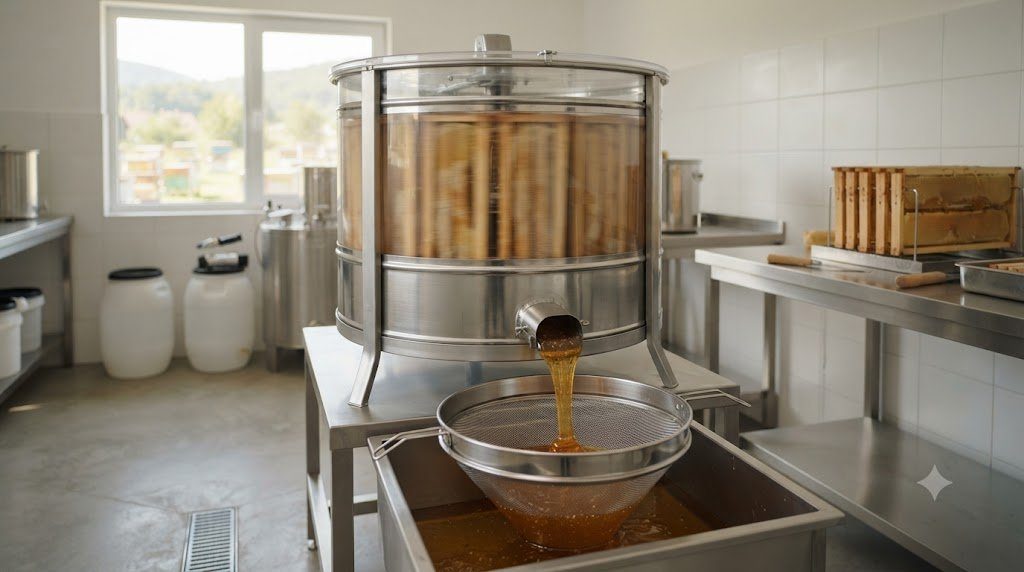
Centrifugal extraction allows the apiarist to slice off only the paper-thin wax cappings, spin out 98% of the liquid floral honey, and return the intact drawn comb straight back to the colony to be refilled within days. Yet operating an extractor without blowing out delicate comb walls, whipping microscopic air bubbles into the honey, or scorching enzymes requires a solid grasp of rotational physics, honey viscosity-temperature curves, and multi-stage filtration.
Tangential vs. Radial Extractor Physics and Vector Forces
All centrifugal honey extractors fall into one of two mechanical geometries based on how the wooden frames are oriented relative to the central spinning shaft: Tangential or Radial.
Tangential Extractors: High Force on One Face at a Time
In a tangential extractor (common in 2-frame, 3-frame, and 4-frame hobbyist units), the flat face of the comb sits perpendicular to the radius of the drum—like the outer walls of a square box surrounding the center axle. When the basket spins, centrifugal force ($F_c = m \cdot \omega^2 \cdot r$) pushes the honey in the outer face straight out against the wire basket mesh, while the honey in the inner face presses heavily against the central midrib foundation. If you spin a tangential extractor at full speed immediately, the weight of the inner-face honey will rip the entire wax comb right out of the wooden frame! Therefore, tangential extraction requires a strict 3-step flip protocol:
- Spin Side A at slow speed (120–150 RPM) for 2 minutes to remove ~50% of its weight.
- Stop the reel, lift and flip all frames 180 degrees to face Side B outward, and spin Side B from slow up to full speed (250–300 RPM) for 3 minutes until Side B is 100% empty.
- Flip all frames back to Side A and spin at full speed (250–300 RPM) for 2 minutes to remove the remaining half.
Radial Extractors: Leveraging the 13-Degree Upward Cell Tilt
In a radial extractor (6-frame, 9-frame, 20-frame, and up to 120-frame commercial units), frames are loaded like the spokes of a bicycle wheel with the heavy wooden top bar facing outward against the drum wall and the bottom bar pointing toward the center shaft. How can honey exit both faces of the comb simultaneously without flipping the frames? Because honey bees naturally build hexagonal cells tilted 9 to 14 degrees upward from the central midrib toward the top bar! When the reel spins, the outward radial force acts parallel to the upward slope of the cells on both sides of the frame simultaneously, sliding the honey cleanly toward the outer perimeter wall while exerting zero perpendicular bending force against the fragile wax midrib.
When loading frames into a radial extractor, the TOP BAR of every frame must ALWAYS face the outer wall of the drum, and the bottom bar must face the center axle! If you accidentally load frames backwards with the bottom bar facing out, you are fighting the 13-degree cell slope—trapping honey inside the cells and rupturing the comb.
Engineering Comparison: Tangential vs. Radial vs. Crush-and-Strain
Use the performance matrix below to select the right extraction architecture and RPM ramp profile for your apiary size and frame type.
| Extraction System | Frame Orientation | Frame Flipping Required? | Comb Blow-Out Risk | Cycle Time per Batch | Ideal Apiary Size & Comb Type |
|---|---|---|---|---|---|
| Tangential (2 to 4 Frame) | Flat comb face faces drum wall | YES (3-step flip cycle mandatory) | High if spun fast on step 1 | 8 to 12 mins (for 2–4 frames) | 1–6 hives; Deep frames; thick/viscous heather honey |
| Radial (9 to 24 Frame) | Spokes of wheel (Top bar out) | NO (Both sides empty at once) | Very Low (Force runs along midrib) | 12 to 18 mins (for 9–24 frames) | 5–50 hives; Medium/Shallow frames (Best efficiency) |
| Commercial Radial (60–120 Fr) | Horizontal or Vertical Radial | NO (Programmable VFD ramp) | Extremely Low (Automated ramp) | 10 to 14 mins (for 60–120 frames) | 50–1,000+ hives; wired or heavy-waxed foundation |
| Crush and Strain | Combs cut from top bars | N/A (Gravitational mesh drip) | 100% Comb harvested for wax | 12 to 24 hours passive drip | Top-bar/Warré hives or small foundationless batches |
Viscosity-Temperature Dynamics: The 32°C (90°F) Extraction Sweet Spot
Honey is a Newtonian fluid (with the notable exception of thixotropic European heather Calluna vulgaris and New Zealand Mānuka Leptospermum scoparium honeys, which are gel-like until agitated with a pin-roller loosener). Its dynamic viscosity drops exponentially with small increases in temperature: at 20°C (68°F), 17% moisture honey has a thick, sluggish viscosity of roughly 13,500 centipoise (cP); warming that exact same honey to 32°C to 35°C (90°F–95°F—natural brood nest temperature) plunges its viscosity by nearly 80% down to 2,500–3,000 cP!
Attempting to extract supers that have sat in an unheated 18°C garage for three days guarantees broken combs, burnt extractor motor bearings, and up to 15% of your honey left clinging to the cell walls. Always extract supers immediately upon pulling them warm from the hive, or store them in a 32°C warm room prior to uncapping. Conversely, never heat honey above 40°C (104°F): temperatures above 42°C rapidly denature invertase and diastase enzymes, drive off volatile floral esters, darken the color via Maillard reactions, and spike Hydroxymethylfurfural (HMF).
Straining vs. Micro-Filtration: Preserving Pollen for Botanical Provenance
As liquid honey exits the honey gate at the bottom of the extractor, it carries broken wax cappings bits, propolis flecks, and occasional bee parts. How you clarify this stream determines whether your final product remains authentic Raw Unfiltered/Strained Honey or degraded industrial syrup:
- Double-Sieve Straining (600 Micron Coarse + 200 Micron Fine): Passing warm honey through a stainless steel double-sieve (or 600/400/200-micron conical nylon bucket strainers) removes 100% of visible wax cappings and debris while allowing natural microscopic floral pollen grains (which range from 15 to 100 microns in diameter) to remain suspended in the honey. Preserving natural pollen is essential for melissopalynology (pollen verification of botanical origin) and consumer antioxidant value.
- Gravitational Settling Baffles (The Secret to Crystal-Clear Jars): Even after 200-micron straining, freshly extracted honey is cloudy with millions of microscopic air bubbles whipped in during spinning, plus microscopic wax dust. Never bottle straight from the extractor! Pump or pour the strained honey into a tall stainless steel or food-grade HDPE settling tank with a bottom honey gate and let it rest undisturbed in a warm 30°C room for 48 to 72 hours. By Stokes’ Law, every air bubble and micro-wax particle floats to the top surface as a white foam layer, allowing you to draw crystal-clear, sparkling raw honey off the bottom spigot into your jars.
Post-Extraction Wet Super Management: Hive Cleaning vs. Dry Storage
Once your frames exit the radial extractor, the drawn wax cells are still coated with a thin, glistening film of residual honey (‘wet supers’) amounting to roughly 1.5 to 2.5 pounds of honey per 10-frame medium super. How you handle these wet supers before winter storage determines whether you trigger a yard-wide robbing catastrophe or invite wax moth devastation:
- NEVER Stack Wet Supers Outdoors in the Open Apiary! Setting wet supers out on a table in the sun for the bees to ‘clean up’ is one of the most dangerous practices in beekeeping. It trains thousands of foragers into manic robber bees, triggers fighting that kills hundreds of bees on the combs, and once the supers are licked dry, the frenzied robber clouds immediately attack the weakest nucleus hives in your yard—while sharing diseases across every hive!
- The Above-Inner-Cover Nighttime Clean-Out Method: To dry wet supers safely inside the hive, place the telescopic inner cover on top of your strong hive (with the central oval escape hole left OPEN), stack 2 to 4 wet supers on top of the inner cover at dusk, and close the lid. Because the wet supers sit above the narrow inner-cover hole, the colony below treats the space as an external chamber rather than part of their nest; house bees climb up overnight, carry every drop of honey down into the brood box, and leave the supers bone-dry and spotless within 48 hours!
Protecting Drawn Comb from Greater Wax Moth (Galleria mellonella) Without Mothballs
Never use toxic household naphthalene mothballs on beekeeping equipment (naphthalene dissolves into beeswax and kills brood the following spring!). Instead, store bone-dry drawn supers stacked vertically inside a mouse-proof shed on open-mesh risers with the top and bottom open to daylight and fresh air drafts—because Greater Wax Moth larvae detest bright light and cold winter air—or apply biological Bacillus thuringiensis Berliner aizawai (Certan / B402) spore spray directly onto the combs before winter storage.
Commercial Grading, Pfund Colorimetry, and Food-Safety Standards
Transforming capped honey frames from the apiary into shelf-stable, legally compliant retail jars or bulk commercial drums requires adherence to international physicochemical standards established by the USDA Grades of Extracted Honey and the Codex Alimentarius Commission (Standard 12-1981). Whether marketing varietal artisanal jars at a farmers’ market or wholesaling 650-pound steel drums, grading honey by optical color, moisture content, floral purity, and clarity establishes objective market value.
In international trade, honey color is measured on the continuous millimeter scale of the Pfund Color Grader (or digital spectrophotometric transmittance at 560 nm), ranging from nearly colorless Water White (< 8 mm Pfund) through Dark Amber (> 114 mm Pfund). Generally, lighter spring honeys (acacia, white clover, fireweed, tupelo) feature delicate, mild floral esters, while dark late-summer and autumn honeys (buckwheat, heather, chestnut, forest honeydew) boast 3x to 5x higher total polyphenolic antioxidant capacity and mineral ash content.
| USDA / Pfund Color Grade | Pfund Scale Range (mm) | Optical Appearance | Representative Floral Sources | Flavor & Antioxidant Profile |
|---|---|---|---|---|
| Water White | 0 to 8 mm | Crystal clear / pale platinum | Fireweed, Black Locust (Acacia), Star Thistle | Ultra-delicate floral notes; lowest mineral ash |
| Extra White | 9 to 17 mm | Pale straw shimmer | Sweet Clover, White Dutch Clover, Basswood | Clean, classic sweet floral; top comb-honey grade |
| White | 18 to 34 mm | Bright golden champagne | Alfalfa, Orange Blossom, Sourwood, Sage | Aromatic, balanced sweetness; high consumer demand |
| Extra Light Amber | 35 to 50 mm | Warm sunlit gold | Wildflower blends, Palmetto, Sunflower, Tupelo | Rich floral complexity with smooth lingering finish |
| Light Amber | 51 to 85 mm | Rich amber-bronze | Eucalyptus, Goldenrod, Red Clover, Tulip Poplar | Full-bodied, malty-floral notes; high enzyme activity |
| Amber | 86 to 114 mm | Deep reddish-copper | Autumn Aster, Manuka, Wild Thyme, Sumac | Bold, herbaceous, complex mineral and phenolic profile |
| Dark Amber | > 114 mm (up to 140) | Dark mahogany / espresso | Buckwheat, Heather, Chestnut, Pine Honeydew | Robust molasses-malt tang; highest polyphenol antioxidants |
Sanitary Bottling, Labeling Compliance, and Clostridium botulinum Warnings
When packaging raw floral honey for public sale, presentation and legal label compliance build immediate consumer confidence while protecting the producer from regulatory liability:
- Pre-Warming and De-Bubbling Glass Jars: Always bottle into clean, bone-dry glass Queenline, Classic Hex, or Muth corked jars (Even 3 drops of rinse water left inside a newly washed jar will dilute the top surface layer of honey above 22% moisture and trigger mold or yeast fermentation!). Hold the settling tank honey at 30°C–32°C (86°F–90°F) and tilt the jar slightly as you open the scissor gate so the ribbon of honey slides smoothly down the inside glass wall without trapping air bubbles.
- Mandatory Infant Botulism Label Warning: Because raw agricultural dust and floral surfaces naturally harbor dormant environmental spores of Clostridium botulinum (which cannot germinate in honey’s low $a_w < 0.60$, but CAN colonize the immature, low-acid intestinal flora of human infants prior to 1 year of age), every honey label must prominently display: “WARNING: Do not feed honey to infants under one year of age.”
- Dual Net Weight Declaration & Producer Identity: Federal and state weights-and-measures laws require the net weight to be printed in the lower 30% of the principal display panel in both avoirdupois and metric units (e.g., NET WT 16 OZ (1 LB) 454g) alongside the common name (‘Pure Raw Honey’), floral source if monofloral, and the full physical street address or city/state/zip of the packer/apiary.
Because honey has a specific gravity of ~1.42 compared to water’s 1.00, volume ounces (Fluid Ounces) and weight ounces (Net Weight Ounces) are NOT equal! A standard 8-fluid-ounce (1 cup) canning jar holds exactly 12 ounces (0.75 lb) of honey by weight; a 1-pint (16 fl oz) jar holds 1.5 pounds (24 oz) of honey; and a 1-gallon jug holds approximately 12 pounds (5.44 kg) of honey. Always sell and label honey by NET WEIGHT, never fluid volume!
Frequently Asked Questions: Honey Ripening, Extraction, and Crystallization
Can I harvest honey from frames that previously held brood?
Technically yes—the honey stored inside clean dark comb that once held worker brood is chemically safe and identical in moisture to white-comb honey. However, old brood cocoons contain larval propolis varnish and water-soluble pigments that slightly darken the color and impart a heavier, earthier note compared to pristine virgin white honey supers, and you must NEVER harvest honey from brood frames that have ever been exposed to synthetic miticide strips (such as Amitraz/Apivar or Coumaphos). Keeping dedicated honey supers strictly for honey storage ensures water-white clarity and zero miticide carryover.
How do I fix a batch of honey that started to ferment slightly?
If a bucket of 19.2% moisture honey develops a slight fruity yeast aroma early in storage, you can salvage it for personal culinary baking or fermented honey-wine (Mead / Hydromel) production! Heating the honey briefly in a water bath to 63°C (145°F) for 30 minutes kills active Zygosaccharomyces yeast cells and drives off trace ethanol, though it can no longer be sold as ‘Raw Unheated Honey’. Better yet, pitching Saccharomyces cerevisiae wine yeast (such as Lalvin EC-1118 or 71B) into diluted 1:3 honey-water must transforms high-moisture honey into world-class artisanal mead.
Why did my creamed honey turn out gritty or separate at room temperature?
Gritty creamed honey is almost always caused by one of two mistakes during the Dyce process: either the starter seed crystal was added while the liquid base honey was still warm (>28°C / 82°F), melting the tiny seed crystals so only a few large surviving crystals grew into coarse sand; OR the seeded jars were stored in a warm 24°C room instead of a cold 14°C (57°F) incubator for the first 7 days. Re-liquefy the batch completely at 40°C, cool to 23°C, re-seed with 10% ultrafine starter, and chill at 14°C.