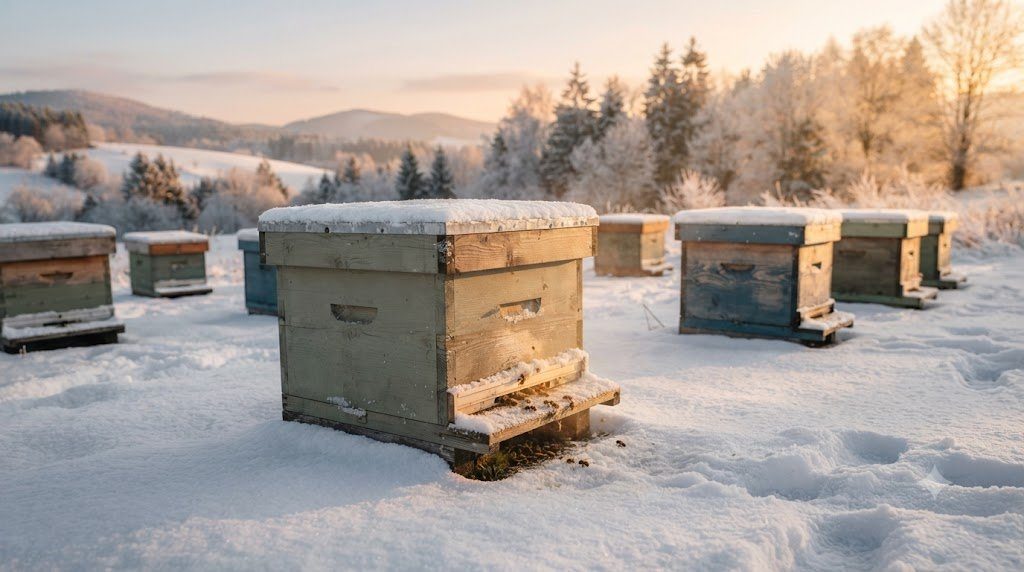
Every autumn across temperate and northern latitudes, beekeepers repeat the timeless adage: “Cold doesn’t kill honey bees—wetness kills honey bees.” While completely true—a dry cluster with ample honey stores can survive ambient temperatures plunging below -35°C (-31°F), whereas a cluster soaked to the skin by icy condensation water loses the insulating air pockets trapped in its plumose body hairs and freezes to death at -2°C—for over a century beekeepers drew the wrong engineering conclusion on how to prevent that moisture.
Throughout the 20th century, standard management dictated cutting upper entrances or propping open inner covers in winter to vent moisture out the top of the hive. In recent years, however, pioneering thermodynamic research by aerospace engineer Étienne Tardif, physicist Dr. Derek Mitchell, and evolutionary biologist Dr. Thomas Seeley has revolutionized winter hive management: proving how heavily insulated ceilings (R-20+ vs. R-3 walls) turn a hive into a natural condensing hive that recycles metabolic heat and water while slashing winter honey consumption by up to 40%.
Metabolic Stoichiometry of the Winter Honey Bee Cluster
Unlike bears or solitary bumblebee queens that hibernate and allow their body temperatures to drop near freezing, the honey bee colony remains metabolically active all winter long as an endothermic superorganism. When ambient air inside the hive drops below 14°C (57°F), bees pull together into a tight sphere across the empty cells of the lower comb faces. The outermost shell of older bees—the insulating mantle, packed 2.5 to 7.5 cm thick with bees interlocking their hairy thoraxes—is maintained right above chill-coma threshold at 8°C to 10°C (46°F–50°F). Meanwhile, inside the core of the cluster, heater bees uncouple their wings from their flight mechanisms and shiver their isometric thoracic muscles, maintaining an internal core temperature of 20°C to 24°C (68°F–75°F) when broodless in early winter, and ramping right back up to 34.5°C (94°F) the moment winter solstice passes and January brood rearing begins.
How Burning 1 Kilogram of Honey Produces 0.68 Liters of Water
Where does all the water inside a winter hive come from? It comes directly from cellular respiration of the honey itself! Cured floral honey consists of roughly 80% simple sugars (glucose and fructose, $C_6H_{12}O_6$) and 18% liquid water. When heater bees oxidize glucose inside their flight-muscle mitochondria ($C_6H_{12}O_6 + 6O_2 \rightarrow 6CO_2 + 6H_2O + \text{Heat}$), every 180 grams of sugar burned yields 108 grams of newly created metabolic water, plus the original 18% moisture already dissolved in the honey. In total, for every 10 pounds (4.54 kg) of honey a winter cluster consumes, the bees exhale approximately 6.8 pounds (3.1 liters / 0.8 gallons) of warm water vapor directly into the hive cavity!
Warm air exhaled from the top of the winter cluster rises at roughly 22°C and 80% relative humidity ( carrying ~15.5 g/m³ of water vapor). If that warm plume hits an uninsulated 3/4-inch pine inner cover chilled by outside winter air to -5°C (R-value ~0.9), the air immediately drops below its Dew Point directly overhead, condensing into icy droplets that rain straight down onto the shivering cluster!
Thermodynamic Comparison: Vented Uninsulated vs. Sealed Condensing Hives
There are two fundamentally different engineering pathways to prevent overhead condensation from dripping onto the winter cluster: the traditional Upper-Ventilation System and the modern High-Top-Insulation Condensing Hive System. Both work when engineered correctly—and both fail catastrophically if half-implemented!
| Engineering Parameter | Traditional Upper-Vented Pine Hive | Modern Sealed Condensing Hive (Tree Model) | Failed Hybrid (Worst Possible Mistake!) |
|---|---|---|---|
| Wall Thermal Resistance | R-0.9 (3/4″ Pine Wood Only) or R-5 Wrap | R-3 to R-7 (Wood + 1″ EPS Foam or Poly Hive) | R-7 Insulated Side Walls |
| Roof / Ceiling R-Value | R-1 to R-3 (Inner cover + moisture board) | R-20 to R-30 (4″–6″ XPS/PIR Foam in Roof) | R-1 Uninsulated Thin Inner Cover (Wall > Roof!) |
| Upper Entrance / Vent | Open 3/4″ auger hole or notched inner cover | ZERO Upper Entrance (100% Vapor-Sealed Top) | Zero Upper Entrance (Sealed top with cold lid) |
| Where Dew Point Occurs | Moist air exhausted outside via chimney draft | Condenses low on cooler side walls away from bees | Condenses on cold ceiling & rains on cluster! |
| Thermal Plume Retention | Low (Rising heat escapes out upper vent hole) | Very High (Warm buoyant air bubble trapped at top) | High moisture trapped overhead; lethal chilling |
| Winter Honey Burn Rate | High (55–85 lbs to offset convective draft loss) | Low (30–45 lbs; latent heat of condensation recovered) | Colony often perishes from wet freezing in Jan/Feb |
The Physics of the Condensing Hive: Why Roof Insulation Must Exceed Wall R-Value
In a wild hollow oak tree studied by Dr. Thomas Seeley, the tree cavity has a single small entrance at the bottom, zero upper vent holes, thick woody walls, and a deeply insulated ceiling. How does the wild colony stay bone-dry overhead while actually drinking the condensation on the lower walls in February when they need water to dilute honey for early brood? The secret is Differential R-Value:
- Ceiling R-Value Must Be at Least 3x to 4x Higher Than Wall R-Value: When you place a solid 4-inch block of Extruded Polystyrene (XPS) or Polyisocyanurate (PIR) rigid foam insulation (R-20 to R-26) directly on top of a sealed inner cover or migratory lid (with no upper vent hole!), and leave the side walls at R-1 (bare pine) or R-5 (1-inch foam wrap), the ceiling directly above the cluster becomes the warmest surface inside the entire hive.
- Buoyant Heat Bubble & Downward Wall Flow: Because there is no upper vent hole to act as a drafty chimney, the warm air rising off the cluster stays trapped in a buoyant thermal pocket at the top of the box, keeping the ceiling surface well above the dew point. As this air cools slightly at the outer perimeter, it sinks down along the cooler interior wooden side walls.
- Latent Heat Recovery and Safe Wall Condensation: When the moisture finally reaches its dew point partway down the cooler side walls—inches away from the central cluster—it condenses harmlessly on the vertical wood walls and runs out the slightly forward-tilted bottom board. Better yet, when 1 gram of water vapor condenses into liquid water on the hive wall, it releases 2,260 Joules of Latent Heat of Vaporization back into the hive interior, acting as a thermodynamic heat battery!
If you wrap the sides of your hive with thick insulation but leave a thin, uninsulated wooden lid on top without an upper vent, you turn the ceiling into the coldest surface in the hive—creating a cold-plate condenser directly over the bees’ heads. Always insulate the roof FIRST (minimum R-15 to R-20), and only insulate walls to a lower R-value than the lid.
Autumn Preparation Checklist: Stores Weight, Mouse Guards, and Emergency Feeding
Regardless of whether you run a sealed condensing top or a ventilated quilt box, successful overwintering is won or lost in August and September. Ensure your colonies enter November meeting four strict biological benchmarks:
- Varroa Mite Load Below 1% Before Winter Bees Are Reared: The long-lived diutinus winter bees rich in fat-body vitellogenin are reared between late August and October. If Varroa mites parasitize those autumn pupae, the resulting adults have compromised fat bodies and die by January regardless of how much honey or insulation you provide.
- Minimum Cured Food Reserves: Ensure 40 to 50 lbs of capped honey in mild southern zones, 60 to 70 lbs in mid-latitude transition zones, and 80 to 90+ lbs in northern continental zones. Finish all heavy 2:1 sucrose autumn liquid feeding before daytime temperatures drop below 12°C (55°F) so bees have warm weather to dehydrate and cap the syrup.
- 1/4-Inch Hardware Cloth Mouse Guards: Install galvanized 1/4-inch (6.3 mm) hardware cloth or punched metal entrance reducers in October before field mice (Peromyscus spp.) move inside the warm lower combs and destroy frames while disturbing the cluster.
- Late-Winter Emergency Dry Sugar (Mountain Camp / Fondant): Never feed liquid syrup in freezing weather! If a colony runs light in February and the cluster has migrated to the top bars, place a newspaper sheet with misted granulated white sucrose (the Mountain Camp method) or a 2-pound baker’s fondant patty inside a 2-inch wooden eke rim directly over the top bars beneath your R-20 insulated lid.
Expanded Polystyrene (EPS) & Polyurethane Hives vs. Woodenware
Across Scandinavia, Germany, Canada, and northern US states, commercial and hobbyist apiarists have increasingly adopted high-density Expanded Polystyrene (EPS, density 100 kg/m³) and rigid Polyurethane (PUR) hive bodies (such as Lyson, Paradise Honey, Apimaye, and Betterbee Lappe systems). How does high-density molded foam compare thermodynamically to traditional 19 mm (3/4-inch) Eastern White Pine?
- 6x to 8x Higher Wall Thermal Resistance (R-Value): Standard 19 mm pine wood offers a modest thermal resistance of R-0.95 ($U \approx 5.9 \text{ W/m}^2\text{K}$). A 35 mm to 40 mm thick high-density EPS or insulated double-wall hive body provides R-6.5 to R-8.0 ($U \approx 0.75 \text{ W/m}^2\text{K}$).
- Brood Nest Expansion to Outside Comb Walls: In an uninsulated wooden box in April, cold night air chills the outer 2 frames on each side, restricting the queen to laying on the central 5 or 6 frames. In an EPS hive, thermal imaging shows the colony maintains 34.5°C across all 8 or 10 frames simultaneously, accelerating spring buildup by 2 to 3 weeks.
- Reduced Winter Food Consumption (30%–40% Savings): Controlled multi-winter field trials in Minnesota and Alberta consistently show that colonies overwintered in EPS hives with R-20 roofs consume 12 to 18 kg (26–40 lbs) of winter stores compared to 25 to 35 kg (55–77 lbs) in unwrapped wooden hives.
Disinfecting Polystyrene Hive Bodies Safely (No Blowtorch!)
Because polystyrene melts above 95°C, you can never flame-scorch an EPS hive with a propane torch like woodenware. Instead, scrape propolis gently with a plastic putty knife or flat hive tool, and wash EPS boxes in a 2% sodium hydroxide (caustic soda / lye) or 1% Virkon S / sodium hypochlorite bleach bath at 45°C, followed by a thorough clean water rinse and sun-drying.
Structural Maintenance, Carpentry Tolerances, and Seasonal Hive Audits
A well-engineered beehive is a precision thermodynamic vessel designed to serve a colony continuously for 15 to 25 years. Whether you operate 8-frame or 10-frame Langstroth stacks, horizontal Kenyan top-bar troughs, or insulated Warré towers, minor dimensional warping, rotting bottom-board runners, or unsealed roof seams rapidly compromise both bee space tolerances (7.9 mm) and winter moisture regulation.
Integrating an annual Carpentry & Microclimate Audit into your late-winter and late-summer apiary workflow ensures that hardware failures never trigger comb bridging, robbing breaches, or winter condensation losses. Review the structural inspection matrix below across all five hive zones.
| Hive Structural Zone | Critical Engineering Tolerance | Common Field Failure Mode | Corrective Maintenance & Upgrade |
|---|---|---|---|
| Hive Stand & Ground Base | 16–20 in. elevation; 1.5° forward tilt | Rotting timber runners; hive tips backward | Use concrete blocks + 4×4 pressure-treated rails; shim rear 1/4″ higher so rain drains out front |
| Bottom Board & Entrance | 9.5 mm winter / 19 mm summer opening | Warped pine floor creates rear robbing gap | Build floors from rot-resistant Western Red Cedar; install 1/4″ galvanized mouse guard in Oct |
| Brood Box Finger Joints | Square 90° corners; 7.9 mm top bee space | Corner separation when prying propolis | Glue all finger pins with Titebond III PVA + cross-nail with 7d ring-shank galvanized nails |
| Frame Rest Rabbets | 16 mm depth x 9.5 mm width (+ metal rail) | Propolized frame ears split wood rabbet | Install galvanized steel J-profile frame rest strips; coat contact edge with food-grade petrolatum |
| Telescoping Roof & Insulation | R-20+ ceiling; overhanging aluminum flashing | Pinhole leak wets inner cover & chills cluster | Fold seamless 0.019″ aluminum flashing over corners; insert 2″–4″ XPS foam board under lid |
Managing Robbing Defense Through Entrance Aperture Engineering
In nature, wild hollow tree nests studied by Dr. Thomas Seeley possess a small, single knot-hole entrance averaging just 12 to 20 square centimeters (roughly a 1.5-to-2-inch round hole)—which ten guard bees can defend effortlessly against wasps, yellowjackets (Vespula spp.), and neighboring robber bees. In contrast, a wide-open 10-frame Langstroth bottom board without an entrance reducer presents an enormous 300-square-centimeter (14.75 x 0.75 inch) undefended boulevard!
- When to Use the Smallest (1-Inch) Notch: Keep nuclear colonies, newly hived swarms, and spring packages restricted to the smallest 1-inch to 2-inch entrance opening until the box is 80% drawn, and immediately reduce all hives down to the medium or small opening the day the summer nectar flow stops in July/August.
- Installing Perforated Metal Robbing Screens: During severe late-summer nectar dearths or after pulling wet honey supers, attach a folded #8 hardware-cloth Robbing Screen across the front entrance. Resident bees know how to walk up and exit the top slot of the screen, whereas incoming robber bees—attracted by the plume of honey odor—slam repeatedly against the lower wire mesh face without finding the upper side entrance!
When heavy propolis builds up along the wooden frame-rest rabbets and Hoffman sidebar shoulders, prying a tight frame loose causes it to pop upward with a violent jolt—alarming guard bees and risking rolling the queen against the adjacent comb. Once each spring, scrape excess propolis lumps off the metal frame rests with your flat hive tool blade and rub a tiny smear of pure beeswax or food-grade mineral oil along the metal rail so frames slide like silk!
Frequently Asked Questions: Hive Architecture, Insulation, and Siting
Can I move a beehive 20 feet across my backyard in the middle of summer?
Every apiarist must obey the “Under 3 Feet or Over 3 Miles Rule”! Foraging honey bees lock the exact GPS-like visual landmark coordinates of their hive entrance into their long-term mushroom-body memory. If you pick up a hive at night in July and move it 25 feet across the yard, the next morning 15,000 field bees will fly out, return to the exact spot where the hive used to sit, and hover helplessly on the empty grass until they die of exhaustion! To move a hive a short distance within the same yard, either slide the hive 2 to 3 feet per day over several days, OR move the hive to a temporary out-yard at least 3 miles (5 km) away for 14 days before bringing it back to the new spot, OR stack a dense bundle of leafy evergreen branches directly across the front entrance so exiting bees notice the obstruction and execute a full orientation flight.
Should I use a Queen Excluder below my honey supers?
A precision welded round-wire metal Queen Excluder (spaced at exactly 4.14 mm to 4.20 mm / 0.163 inches—large enough for worker thoraxes measuring 3.8–4.0 mm to pass through while blocking the larger 4.4–4.6 mm thorax of the mated queen and 5.2 mm drones) guarantees 100% brood-free honey supers at harvest. However, bees frequently treat a bare foundation super placed above an excluder as a ceiling barrier (‘honey excluder’). The professional trick is to omit the excluder for the first 7 days while bees draw out new comb or put 1 drawn comb frame in the center of the super as a ‘ladder’ above the excluder to draw nurse and receiver bees upstairs immediately.
Is cedar worth the higher cost over Eastern White Pine for hive boxes?
Western Red Cedar (Thuja plicata) is naturally rich in antifungal thujaplicin heartwood oils, weighs roughly 15% less than pine when dry, and resists rot for 20+ years even without paint—making it unmatched for bottom boards,hive stands, and Warré moisture quilts. For standard brood boxes and supers, well-painted kiln-dried Eastern White Pine offers superior nail-holding strength at half the cost.