At the heart of every productive, gentle, disease-resistant colony stands a high-capacity queen with richly developed ovaries and a fully inseminated spermatheca. While hobbyist beekeepers often rely on shipped commercial queens or simple emergency splits, mastering the science of controlled queen rearing transforms an apiarist from a passive consumer of bee stock into an independent breeder capable of propagating their very best local survivor genetics. Moreover, emergency queens raised by small splits from older 2-to-3-day-old worker larvae frequently suffer from reduced ovariole counts (120–140 ovarioles per ovary) compared to purposely grafted queens raised from 12-to-24-hour-old larvae inside a roaring, nutritional powerhouse cell builder (180–200+ ovarioles per ovary).
In this comprehensive apicultural manual, we explore the endocrinology of caste determination, step-by-step larval grafting via the Doolittle method, the engineering of queenless starter-finisher and Cloake board cell builders, and the management of mating nuclei and Drone Congregation Areas (DCAs).
Epigenetics of Caste Determination and the 24-Hour Larval Window
Every fertilized diploid egg laid by a honey bee queen possesses the exact same genetic potential to become either a sterile female worker living 6 weeks in summer or a reproductive queen capable of laying 1,500 to 2,000 eggs per day for 3 to 5 years. The divergence between worker and queen is not genetic, but epigenetic and nutritional.
During the first 72 hours after hatching from the egg (3 days after oviposition), all female larvae are fed royal jelly secreted by the hypopharyngeal and mandibular glands of young nurse bees (aged 5 to 12 days). However, a larva destined to become a queen receives massive, continuous floods of royal jelly rich in Royalactin (Major Royal Jelly Protein 1, or MRJP1), 10-hydroxy-2-decenoic acid (10-HDA), and simple sugars (roughly 34% sugar vs. 12% in worker jelly). This high-sugar phagostimulant triggers the larval corpora allata to secrete elevated levels of Juvenile Hormone (JH) and suppresses DNA methyltransferase 3 (Dnmt3), preventing the programmed cell death (apoptosis) of the larval ovarian primordia that normally reduces a worker’s ovaries to vestigial filaments.
Why Grafting 12-to-24-Hour-Old Larvae Is Non-Negotiable
Although a colony can biologically convert a female larva into a queen up until roughly 72 hours after hatching, every hour past the first 24 hours of larval life results in a measurable loss of adult queen quality. Research led by Dr. David Tarpy at North Carolina State University demonstrates that queens grafted as 0-to-24-hour first-instar larvae possess significantly heavier birth weights (>200 mg), larger thoracic widths, higher total ovariole numbers, and store 5.5 to 7.0 million viable spermatozoa in their spermathecae after mating—Directly correlating with lower supersedure rates and stronger retinue pheromone attraction.
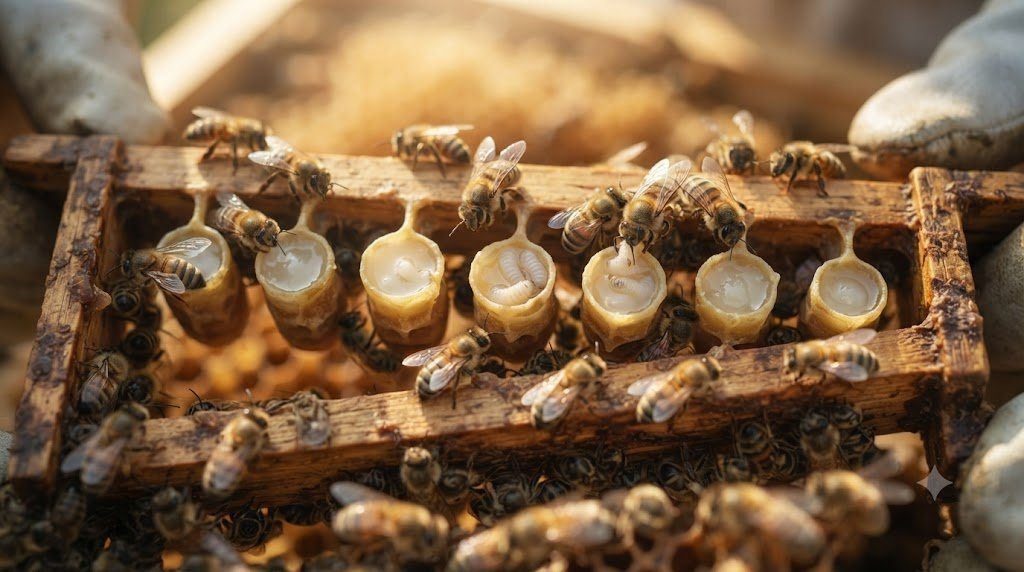
When looking down into the bottom of a dark drawn comb cell with an LED headlamp, a newly hatched 12-to-24-hour-old larva is barely larger than the egg itself, shaped like a tiny translucent comma (slight C-curve) floating in a crystal-clear or slightly milky pool of royal jelly. If the larva forms a closed ‘C’ ring filling more than one-third of the cell floor, it is already 36 to 48 hours old and should be skipped!
Complete 16-Day Queen Ontogeny and Apiary Action Schedule
Successful queen rearing requires strict adherence to the biological developmental clock of the queen. Missing the Day 10/11 cell transfer window by even 24 hours can result in the first emerging virgin chewing open and killing every sister cell on the grafting bar.
| Developmental Day | Grafting Calendar Day | Biological Stage of Queen | Critical Apiary Management Action |
|---|---|---|---|
| Days 1 – 3 | Day -3 to Day 0 | Fertilized Diploid Egg | Confine breeder queen to dark drawn frame 4 days prior if timing exact hatch |
| Day 4 (12–24 hr) | Day 0 (Grafting Day) | 1st Instar Larva (<24h old) | Graft tiny comma larvae into 9mm wax/plastic cups; place in Starter/Cell Builder |
| Days 5 – 8 | Days +1 to +4 | 2nd to 5th Instar Larva | Check cell acceptance at +24h; feed cell builder 1:1 syrup + pollen patty if no flow |
| Day 9 | Day +5 | Cell Capped; Prepupa Spins Cocoon | Cells are sealed by nurses; handle upright only—still delicate |
| Days 10 – 13 | Days +6 to +9 | Sensitive Metamorphic Pupa | DO NOT JOLT, TILT, OR SHAKE CELLS! Wings and appendages are forming |
| Days 14 – 15 | Days +10 to +11 | Hardened Chitin Pupa (Ripe Cell) | Transfer ripe cells into Mating Nucs or roller cages (Must complete on Day +10/+11!) |
| Day 16 | Day +12 | Adult Virgin Queen Emerges | Virgin chews circular cap off cell tip; hardens cuticle over next 5 days |
| Days 21 – 24 | Days +17 to +20 | Nuptial Flights at DCA | Virgin mates with 12–20+ drones in warm afternoon weather (>20°C / 68°F, winds <15 mph) |
| Days 26 – 28 | Days +22 to +24 | Oviposition Begins | Inspect mating nucs for cohesive patches of single fertilized worker eggs |
The Doolittle Grafting Method: Tools, Humidity, and Technique
Developed by Gilbert M. Doolittle in his seminal 1889 treatise Scientific Queen-Rearing, artificial larval transfer into downward-facing wax or JZ-BZ plastic queen cups remains the universal industry standard. To achieve 85% to 95% cell acceptance on your grafting bars, control three physical variables:
- Ambient Temperature and Relative Humidity: Young first-instar larvae desiccate rapidly when exposed to dry air. Perform grafting indoors or inside a shaded vehicle maintained at 24°C to 30°C (75°F–86°F) with >60% relative humidity. Keep a damp warm towel draped over the breeder frame at all times except the exact row you are actively grafting.
- Grafting Tool Mechanics (Chinese Feather/Plastic vs. German Steel): Whether using a flexible bamboo-tongued Chinese grafting tool or a finely bent stainless steel Swiss/German needle, approach the larva from behind the curve of its back spine. Slide the tip beneath the pool of royal jelly so you lift the larva floating on its original cushion of jelly without puncturing its delicate spiracles, then gently deposit it into the center floor of the cell cup.
- Dry Grafting vs. Priming: While some apiarists prime cell cups with a tiny droplet of 1:1 royal jelly diluted with distilled water, controlled trials show that ‘dry grafting’ into cell cups that have been polished overnight inside the cell builder colony yields equal or superior acceptance—provided the lifted larva carries a generous bead of its native royal jelly on the tip of the tool.
Engineering the Cell Builder: Queenless Starter-Finisher vs. Cloake Board
Even the most precise graft will fail if placed into a weak or poorly provisioned colony. A world-class cell builder must be overflowing with 6-to-12-day-old nurse bees, stuffed with fresh polyfloral bee bread (pollen) frames directly flanking the grafting bar, and experiencing a simulated or natural heavy nectar flow.
The Queenless Starter-Finisher Colony
To prepare a single-box overflowing queenless cell builder, condense a strong double-deep colony down into a single 10-frame deep hive body 24 hours before grafting. Remove the queen (along with 2 frames of brood) to a separate nucleus box. Pack the single deep builder with: two outer frames of honey, two frames of solid stored pollen/bee bread, four frames of sealed emerging brood (which supplies thousands of new nurses daily without demanding larval food), and a central gap for the grafting frame. Shake an additional 3 to 4 frames of nurse bees from open brood combs of auxiliary hives directly into the builder so bees literally beard out the entrance. Twenty-four hours after dequeening, insert your bar of 20 to 30 grafted cups between the pollen frame and emerging brood.
The Cloake Board (Queenright Switching Builder)
Invented by New Zealand apiarist Harry Cloake, the Cloake board is a modified queen excluder mounted inside a wooden rim with a removable galvanized metal slide and a reversal entrance. The queen is confined to the bottom deep box below the excluder, while open brood, pollen, and nurse bees are drawn into the upper deep box. The day before grafting, the metal slide is pushed in—instantly splitting the single vertical stack into a queenless top box whose field bees fly out the front upper entrance while nurses inside feel acutely queenless and start the grafted cells with 95%+ acceptance. Twenty-four hours after grafting, the metal slide is pulled out, allowing nurses from both boxes to finish and seal the royal cells in a cohesive queenright environment.
A virgin queen is only as good as the drones she mates with! Because drones take 24 days to emerge and another 12 to 16 days to reach sexual maturity (36–40 days total from egg), you must insert drone-comb frames into your strongest, most hygienic breeder colonies at least 25 days BEFORE you pick up your grafting tool.
Mating Nucleus Kinematics and Post-Mating Evaluation
On Day +10 or +11 after grafting, gently remove the ripe, peanut-textured queen cells from the builder and press one cell between the top bars of the brood frames inside prepared 2-frame, 3-frame, or 5-frame mating nuclei. Paint the front entrance of each mating nuc with distinct geometric shapes in blue, yellow, white, and black (colors within the honey bee ultraviolet-trichromatic visual spectrum) and orient entrances in alternating compass directions to prevent returning virgin queens from drifting into the wrong hive after their nuptial flight. Wait until at least Day +24 to +28 after grafting so you can verify not just single eggs, but uniform pearly-white capped worker brood before harvesting and caging the newly mated queen.
Anatomical & Morphometric Benchmarking of Newly Mated Queens
How do commercial queen breeders and research laboratories verify that a batch of grafted queens received optimal royal jelly nutrition and mated with an adequate number of drones? Beyond observing a solid, contiguous brood pattern after Day 28, breeders evaluate four quantitative morphometric and physiological benchmarks:
- Emergence Wet Weight (> 200 to 230 mg): Virgin queens weighed on an analytical balance immediately upon emerging from their cells on Day 16 should exceed 200 milligrams (and reach 240–280 mg once laying). Queens grafted from older 48-hour larvae frequently emerge under 165 mg with stunted abdomens.
- Thoracic Width (> 4.4 to 4.7 mm): Measured across the mesonotum with precision digital calipers, thoracic width is fixed at pupation and strongly correlates with total ovariole number (160–200 ovarioles per ovary).
- Spermathecal Sperm Count & Viability (> 5.0 Million Viable Sperm): In laboratory quality control samples, a laying queen’s spherical spermatheca (measuring ~1.1 mm in diameter inside the 6th abdominal segment) should appear opaque pearly-tan with dense swirling spermatozoa rather than translucent clear (unmated or poorly mated), containing 5 to 7 million sperm with >85% live green fluorescence under SYBR-14/propidium iodide staining.
- Retinue Court Density (10 to 16 Attendant Workers): A queen secreting robust 9-ODA and HVA mandibular pheromones commands an immediate oval halo of 10 to 16 young nurse bees turning inward toward her as she pauses between oviposition events.
Queen Banking and Shipping Cage Candy Bioengineering
When harvesting 20 mated queens from mating nuclei on the same morning, queens not immediately introduced into production hives are placed into three-hole Benton wooden cages or JZ-BZ plastic shipping cages provisioned with Fondant Queen Candy (made strictly from powdered sucrose kneaded with invert sugar syrup or HFCS—never raw floral honey, which can transmit American Foulbrood endospores across state lines!). If storing queens inside a queenless ‘Queen Bank’ colony for more than 5 days, place cages screen-side-open in a holding frame flanked by open larval brood frames so young nurse bees continually feed the banked queens royal jelly through the mesh.
Seasonal Colony Management Calendar for Queen Rearing Science and Grafting Mechanics
Successfully applying the principles of Queen Rearing Science and Grafting Mechanics in a working apiary requires synchronizing every human manipulation with the colony’s internal phenological clock and external botanical degree-day accumulation. A manipulation that builds booming populations during an ascending spring pollen flow can trigger robbing, queen rejection, or absconding if attempted during a late-summer nectar dearth.
Across temperate and continental zones, colony population dynamics follow a predictable four-phase annual curve: the Late-Winter Brood Initiation Phase (January–March), the Exponential Spring Turnover & Reproduction Phase (April–June), the Summer Peak Storage & Consolidation Phase (July–August), and the Autumn Diutinus Transition & Winter Contraction Phase (September–December). Use the operational field matrix below to align your hive inspections with the colony’s biological priorities at each stage.
| Phenological Season | Adult Colony Population | Primary Queen & Brood Activity | Critical Apiarist Field Protocol | Mistakes to Strictly Avoid |
|---|---|---|---|---|
| Early Spring (Willow/Maple Bloom) | 12,000 to 20,000 (Turnover phase) | Oviposition ramps to 600–1,000 eggs/day | Verify queenright worker brood; feed 1:1 syrup + pollen sub if weather turns cold | Breaking cluster seal below 13°C (55°F); over-expanding brood nest too early |
| Mid-to-Late Spring (Fruit/Dandelion) | 25,000 to 45,000 (Rapid buildup) | Peak laying (1,500–2,000 eggs/day); drone rearing | Reverse brood boxes; add drawn supers ahead of flow; execute splits/grafting | Waiting until swarm cells are capped to add comb space |
| Peak Summer (Clover/Basswood) | 50,000 to 65,000 (Maximum force) | Brood plateaus; heavy nectar backfilling | Maintain 2–3 supers of drawn surface area; provide afternoon shade & water | Letting honey-bound brood nests shut down queen laying |
| Late Summer / Early Autumn | 30,000 to 40,000 (Winter bee rearing) | Queen lays long-lived diutinus winter cohort | Complete Varroa IPM below 1% threshold; requeen failing colonies in August | Delaying Varroa treatment until October after winter bees are damaged |
| Winter Dormancy (Cluster Phase) | 15,000 to 25,000 (Tight sphere) | Broodless in Nov/Dec; restarts Jan solstice | Verify 60–85 lbs stores, mouse guards, R-20 top insulation, and windbreak | Opening frames in freezing weather or feeding liquid syrup below 10°C |
Field Record-Keeping and Quantitative Hive Evaluation Metrics
Professional queen breeders and Master Beekeepers never rely on memory when managing ten or fifty hives. Maintaining a standardized water-resistant Hive Inspection Card or Digital Telemetry Log attached beneath every outer telescoping cover allows you to track multi-generational performance across five objective scoring criteria (graded on a 1-to-5 scale during every 10-day inspection):
- Brood Viability & Contiguity Score: A score of 5 indicates >92% solid concentric rings of single fertilized eggs, plump C-shaped larvae swimming in royal jelly, and uniform tan cappings. A spotty ‘shotgun’ pattern (<75% solid) signals either inbred diploid drone production (matched sex alleles at the csd locus), failing queen spermatheca, or brood pathology.
- Comb Adherence & Temperament Score: Evaluate whether workers remain calmly walking across the comb face while the frame is held in bright sunlight (Carniolan/Buckfast hallmark) versus running nervously into hanging festoons off the bottom bar or bumping the operator’s veil.
- Foraging Launch Threshold & Weight Gain: Track morning flight initiation temperatures and net weekly weight gain on a reference platform scale hive to identify your top 15% honey-producing mothers for next spring’s grafting bar.
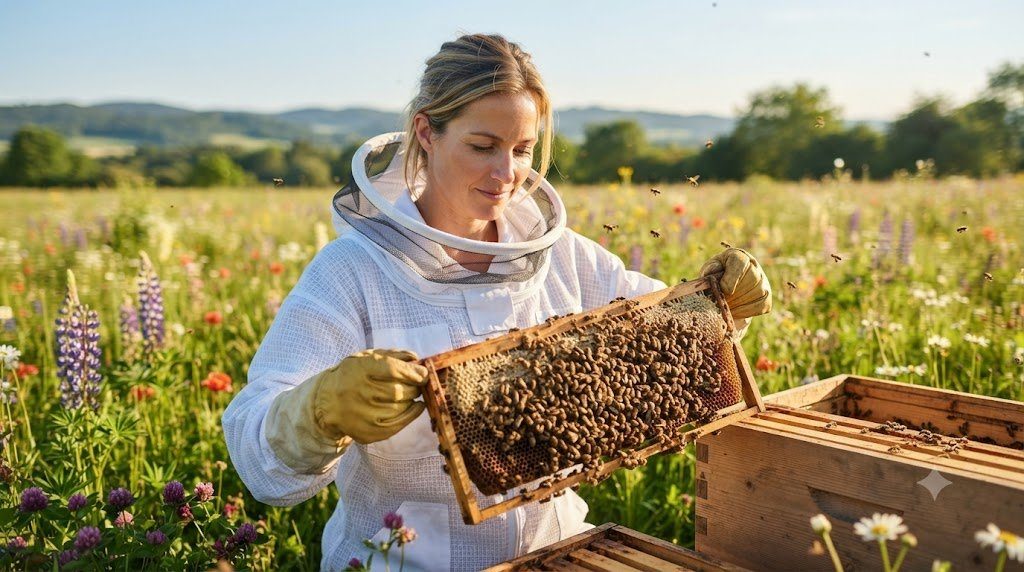
Whenever examining a brood frame for eggs, queen cups, or stock traits, ALWAYS hold the frame directly over the open center of the brood box—never swung out over the grass beside your boots! If the mated queen loses her tarsal grip on the comb edge and drops, she falls safely straight back into her own hive rather than vanishing into tall grass.
Frequently Asked Questions: Honey Bee Genetics, Swarming, and Queens
How often should a productive colony be requeened in a managed apiary?
While a queen honey bee can biologically live for 3 to 5 years, her daily egg-laying capacity and 9-ODA mandibular pheromone output peak during her first full production season and decline by roughly 20% to 30% in her third year. Colonies headed by two-year-old queens are approximately three times more likely to prepare to swarm in spring than colonies headed by vigorous young first-year queens. Therefore, commercial honey producers requeen on a 12-to-24-month cycle—ideally introducing young mated queens in late summer (August/September) when acceptance is high and young queens lay heavily into autumn to build a massive winter cluster.
Can I combine two weak colonies in autumn without finding both queens?
While performing a ‘Newspaper Combine’ (placing two sheets of slit black-and-white newspaper over the top bars of the stronger bottom colony and setting the weaker colony box on top so the bees chew through slowly over 48 hours and merge peacefully) works reliably, leaving both queens inside is a gamble—sometimes the older, inferior queen kills the younger queen, or both queens are injured in combat! Whenever possible, locate and remove the older or inferior queen 4 hours before setting the newspaper combine in place.
Why are my bees bearding heavily on the front of the hive on July evenings?
A dense ‘beard’ of 5,000 to 15,000 bees hanging calmly on the front landing board and lower hive wall on hot, humid summer evenings is completely normal thermoregulatory behavior—NOT a swarm! When all field foragers return home at dusk and internal brood nest temperatures threaten to rise above 35.5°C, older bees move outside onto the front porch so internal fanners have open air channels to cool the brood. In contrast, a true reproductive swarm departs between 10:00 AM and 2:00 PM in a swirling cloud and clusters on a nearby tree limb or fence post.