There are few heartbreaks in beekeeping worse than harvesting 200 pounds of fragrant summer honey, bottling it in glass jars, and opening your pantry three months later to find foaming, sour-smelling, carbonated jars popping their lids. Honey fermentation is caused by osmotolerant yeasts of the genus Zygosaccharomyces (principally Zygosaccharomyces rouxii and Z. mellis) naturally present on flower petals, bee bodies, and honey house equipment. These specialized yeasts cannot metabolize sugars when honey moisture sits safely below 17.1%, but their growth rate accelerates rapidly once moisture climbs above 18.6% to 19.0%.
Preventing fermentation while preserving the delicate volatile aromatics and enzymes of raw honey requires disciplined harvest timing, optical refractometer calibration, gentle bee-clearing methods that never taint honey with chemical fumes, and pre-extraction super dehumidification.
Why the ‘80% Capped Rule’ Can Fail—and How to Test with a Refractometer
Beginner beekeeping books routinely teach a simple visual rule of thumb: “Harvest a frame when at least 80% of the cells are capped with wax.” While useful in arid or temperate continental summers, the 80% capped rule can fail disastrously in two common scenarios: first, during high-humidity subtropical flows (such as coastal palmetto, mangrove, or rainy autumn goldenrod), bees will occasionally cap honey at 19.2% to 20.5% moisture; second, if a late afternoon nectar shake enters the remaining 20% uncapped cells on the morning you pull supers, that thin 35%-moisture nectar mixes into your extractor and pushes the entire batch over 19%!
Calibrating Your Honey Refractometer (12%–27% Water Scale)
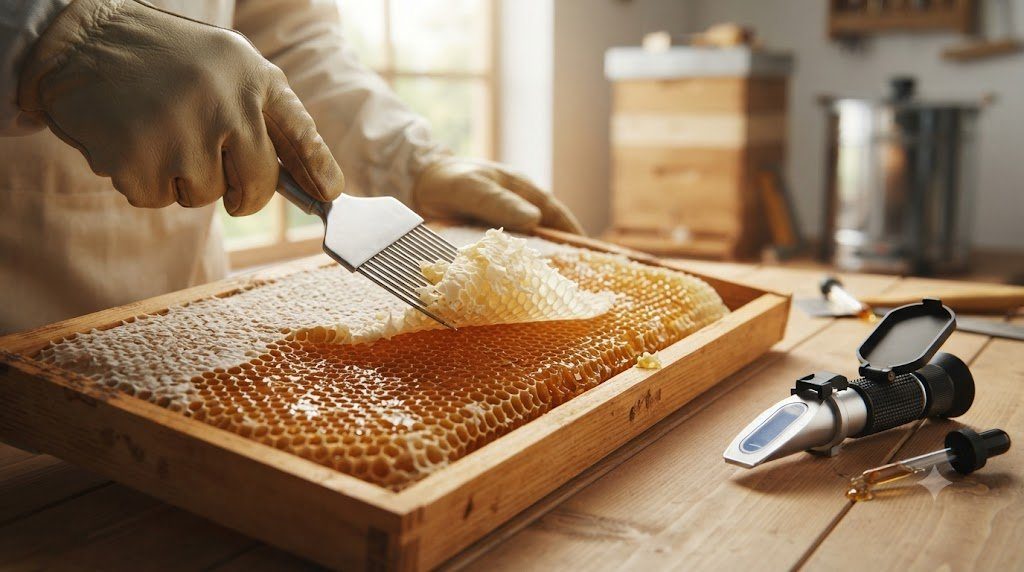
Never guess honey moisture by eye. A dedicated Brix/Honey Moisture Optical Refractometer (scaled specifically for 12% to 30% water content with Automatic Temperature Compensation, ATC) measures the refractive index of light passing through a thin smear of honey on a glass prism. Because regular culinary Brix refractometers (0–32% Brix) cannot read the high density of honey (78–86% Brix), you must use a dedicated honey refractometer and calibrate it before every harvest season:
- Calibration Reference Fluid: Do NOT use distilled water to calibrate a honey refractometer (water reads 0% Brix, far off the 70–90% scale). Instead, apply 1 drop of diiodomethane reference oil (refractive index $n_D = 1.515$, corresponding to 19.2% water on standard calibration blocks) or extra-virgin olive oil (which reliably reads 27.0% water / 71.5% Brix at 20°C).
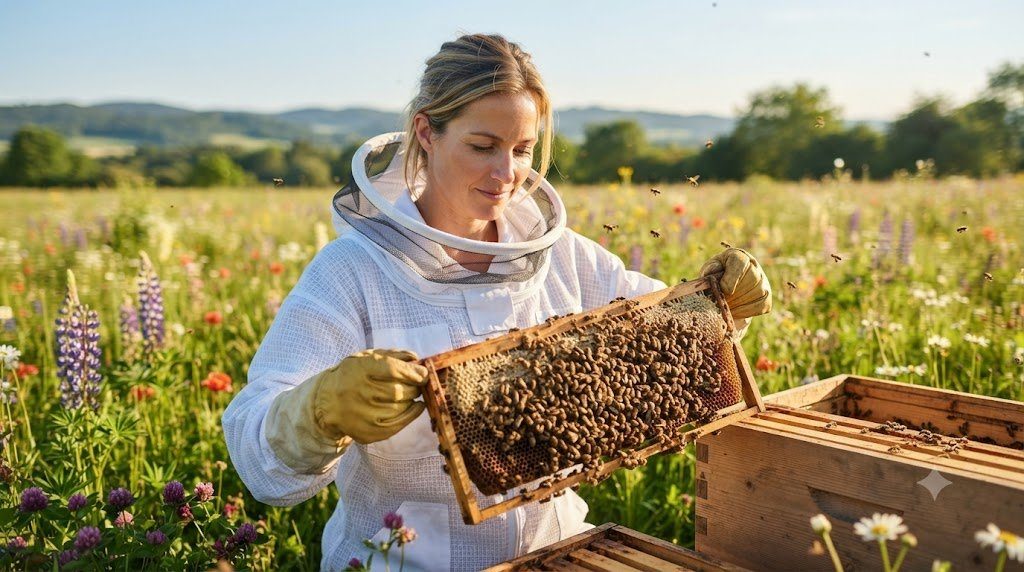
- The Field Shake Test + Prism Test: When inspecting a super with 20% uncapped cells, hold a frame horizontally over the open hive and give it one sharp downward jerk. If thin droplets fly out of the uncapped cells onto the top bars, it is unripe nectar—put the frame back! If zero droplets fall out, dip a clean toothpick into three uncapped cells, smear the sample onto the refractometer prism, wait 30 seconds for the sample temperature to equilibrate with the metal body, and read the shadow line. Only pull supers reading 18.2% water or lower.
Classic microbiological studies by Dr. A.G. Lochhead established the exact relationship between honey moisture content and fermentation risk:
• Below 17.1% Moisture: 100% Safe from fermentation regardless of yeast spore count.
• 17.1% to 18.0% Moisture: Safe unless yeast spore count exceeds 1,000 spores/gram.
• 18.1% to 19.0% Moisture: Safe only if yeast count is very low (<10 spores/gram); risky if honey crystallizes!
• Above 19.1% Moisture: High danger of fermentation within weeks at 15°C–25°C.
Comparing Bee Removal Methods When Pulling Honey Supers
Before carrying heavy honey supers into the extraction room, you must clear the remaining 5,000 to 15,000 house bees out of the boxes without triggering a yard-wide robbing frenzy or contaminating the wax with smoke or repellent odors.
| Bee Clearing Method | Time Required | Equipment Needed | Risk of Honey Odor / Contamination | Best Operational Scale |
|---|---|---|---|---|
| Porter / Triangle Escape Board | 18 to 24 Hours (Overnight) | One-way labyrinth board placed under supers | ZERO (100% chemical- and smoke-free) | 1 to 25 hives (Home / Sideliner yard) |
| Brush & Shake (Bee Brush) | 15 mins per super | Soft horsehair brush + covered empty super | Zero chemical risk; high robbing risk in dearth | 1 to 5 hives during active nectar flow |
| High-Velocity Bee Blower | 2 to 3 mins per super | Gas or cordless leaf/bee blower + chute stand | ZERO (Mechanical air stream clears 99% of bees) | 10 to 100+ hives (Fast single-trip harvest) |
| Butyric Anhydride (Bee Go) | 5 to 8 mins per super | Fume pad + chemical repellent in warm sun | Moderate if over-applied; foul pungent odor | Commercial migratory yards only |
| Benzaldehyde / Fischer’s Bee Quick | 5 to 10 mins per super | Black solar fume pad + natural almond extract | Very Low (Non-toxic food-grade almond scent) | 5 to 100 hives in sunny 21°C–32°C weather |
The Triangle Escape Board: Stress-Free Overnight Clearing
For backyard and sideliner beekeepers with 1 to 30 hives, the Triangle Escape Board (or conical mesh escape board) is hands-down the cleanest, calmest way to harvest honey. Constructed from a framed plywood sheet with a 2-inch entrance hole in the center feeding into a downward-facing wire-screen triangle with three narrow 3/8-inch exit apexes, the escape board is slipped between the brood chamber (or queen excluder) and the honey supers 24 hours before harvest.
As temperatures cool overnight, house bees inside the honey supers walk down through the center hole toward the warmth and queen pheromone of the brood nest, exit the three points of the triangle, and cannot figure out how to walk back through the sharp apexes—because honey bees instinctively follow flat walls and corners rather than mid-wall points. However, you must observe one critical rule: Verify 100% that there is NO brood inside the honey supers and NO cracks in the upper super walls! If open or capped brood is present above the escape board, nurse bees will refuse to abandon it; if an upper crack exists above the escape board, robber bees will discover the unguarded honey supers and rob them dry by morning.
Building a Warm Dehumidification Room for High-Moisture Supers
What if autumn rain is approaching, your supers are 90% capped, and your refractometer still reads 19.4% moisture? Never extract wet honey and try to dry it in a bucket—once honey is in a deep cylindrical pail, only the top 2 millimeters of surface area is exposed to air! Instead, dry the honey inside the stacked supers before uncapping:
- Stack your harvested honey supers criss-crossed (or on pallets with 2×4 bottom spacer blocks) inside a small, sealed, insulated room or closet heated with a space heater to 32°C to 35°C (90°F–95°F).
- Place a high-capacity commercial compressor dehumidifier inside the room set to 30% relative humidity, and position a 20-inch box fan on top of or beside the super stack to blow warm, bone-dry air continuously between the combs.
- Within 24 to 48 hours, the warm dry airflow removes 1.5% to 2.5% moisture straight through the porous wax cappings (and up to 4% from uncapped cells), dropping a 19.5% batch down to a rock-solid 17.2% while keeping the combs at the exact 34°C temperature needed for effortless high-speed extraction!
Cut-Comb, Ross Rounds, and Chunk Honey Harvesting Protocols
Not every honey super requires an extractor! Producing artisanal Cut-Comb Honey or Chunk Honey (a wide-mouth glass jar containing a vertical pristine slab of white comb honey submerged in clear liquid floral honey) commands 50% to 100% higher retail prices per pound while requiring zero centrifugal extraction machinery. However, producing tender, melt-in-your-mouth comb honey requires specialized super management:
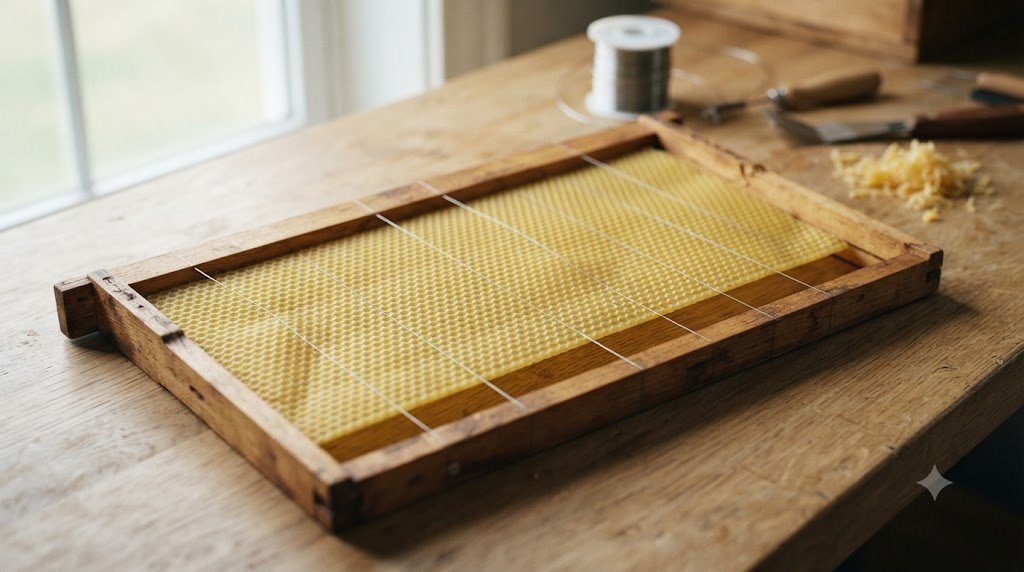
- Use Exclusively Ultra-Thin Unwired Virgin Foundation (or Foundationless Frames): Standard medium-brood wax foundation has a thick milled midrib that feels like chewing a wax candle in the mouth. Outfit shallow 5-11/16″ supers exclusively with Thin Surplus Unwired Beeswax Foundation made from snow-white virgin cappings wax, or use split-top frames with a 15 mm starter strip.
- Super Only Over Roaring Colonies During Intense White Nectar Flows: If bees draw comb slowly during a weak dribble flow, they walk across the wax with dusty pollen-covered feet, staining the cappings yellow-brown (‘travel stain’). Crowd a booming double-deep colony down to a single brood box (or super right as clover, basswood, or sourwood bursts into bloom) so the bees draw, fill, and seal the entire shallow super snow-white within 10 to 14 days!
- 48-Hour Deep Freeze at -18°C (0°F) for Wax Moth Egg Sterilization: Because comb honey never passes through a strainer, microscopic eggs of the Greater Wax Moth (Galleria mellonella) or Small Hive Beetle can hide on the comb edges. Immediately after cutting comb squares and placing them on a wire draining rack for 4 hours to drip cut-edge honey, seal the comb boxes in airtight freezer bags and freeze at -18°C (0°F) for 48 hours. This kills 100% of insect eggs (egg, larva, pupa, adult) while simultaneously preventing the honey inside the cells from crystallizing!
Commercial Grading, Pfund Colorimetry, and Food-Safety Standards
Transforming capped honey frames from the apiary into shelf-stable, legally compliant retail jars or bulk commercial drums requires adherence to international physicochemical standards established by the USDA Grades of Extracted Honey and the Codex Alimentarius Commission (Standard 12-1981). Whether marketing varietal artisanal jars at a farmers’ market or wholesaling 650-pound steel drums, grading honey by optical color, moisture content, floral purity, and clarity establishes objective market value.
In international trade, honey color is measured on the continuous millimeter scale of the Pfund Color Grader (or digital spectrophotometric transmittance at 560 nm), ranging from nearly colorless Water White (< 8 mm Pfund) through Dark Amber (> 114 mm Pfund). Generally, lighter spring honeys (acacia, white clover, fireweed, tupelo) feature delicate, mild floral esters, while dark late-summer and autumn honeys (buckwheat, heather, chestnut, forest honeydew) boast 3x to 5x higher total polyphenolic antioxidant capacity and mineral ash content.
| USDA / Pfund Color Grade | Pfund Scale Range (mm) | Optical Appearance | Representative Floral Sources | Flavor & Antioxidant Profile |
|---|---|---|---|---|
| Water White | 0 to 8 mm | Crystal clear / pale platinum | Fireweed, Black Locust (Acacia), Star Thistle | Ultra-delicate floral notes; lowest mineral ash |
| Extra White | 9 to 17 mm | Pale straw shimmer | Sweet Clover, White Dutch Clover, Basswood | Clean, classic sweet floral; top comb-honey grade |
| White | 18 to 34 mm | Bright golden champagne | Alfalfa, Orange Blossom, Sourwood, Sage | Aromatic, balanced sweetness; high consumer demand |
| Extra Light Amber | 35 to 50 mm | Warm sunlit gold | Wildflower blends, Palmetto, Sunflower, Tupelo | Rich floral complexity with smooth lingering finish |
| Light Amber | 51 to 85 mm | Rich amber-bronze | Eucalyptus, Goldenrod, Red Clover, Tulip Poplar | Full-bodied, malty-floral notes; high enzyme activity |
| Amber | 86 to 114 mm | Deep reddish-copper | Autumn Aster, Manuka, Wild Thyme, Sumac | Bold, herbaceous, complex mineral and phenolic profile |
| Dark Amber | > 114 mm (up to 140) | Dark mahogany / espresso | Buckwheat, Heather, Chestnut, Pine Honeydew | Robust molasses-malt tang; highest polyphenol antioxidants |
Sanitary Bottling, Labeling Compliance, and Clostridium botulinum Warnings
When packaging raw floral honey for public sale, presentation and legal label compliance build immediate consumer confidence while protecting the producer from regulatory liability:
- Pre-Warming and De-Bubbling Glass Jars: Always bottle into clean, bone-dry glass Queenline, Classic Hex, or Muth corked jars (Even 3 drops of rinse water left inside a newly washed jar will dilute the top surface layer of honey above 22% moisture and trigger mold or yeast fermentation!). Hold the settling tank honey at 30°C–32°C (86°F–90°F) and tilt the jar slightly as you open the scissor gate so the ribbon of honey slides smoothly down the inside glass wall without trapping air bubbles.
- Mandatory Infant Botulism Label Warning: Because raw agricultural dust and floral surfaces naturally harbor dormant environmental spores of Clostridium botulinum (which cannot germinate in honey’s low $a_w < 0.60$, but CAN colonize the immature, low-acid intestinal flora of human infants prior to 1 year of age), every honey label must prominently display: “WARNING: Do not feed honey to infants under one year of age.”
- Dual Net Weight Declaration & Producer Identity: Federal and state weights-and-measures laws require the net weight to be printed in the lower 30% of the principal display panel in both avoirdupois and metric units (e.g., NET WT 16 OZ (1 LB) 454g) alongside the common name (‘Pure Raw Honey’), floral source if monofloral, and the full physical street address or city/state/zip of the packer/apiary.
Because honey has a specific gravity of ~1.42 compared to water’s 1.00, volume ounces (Fluid Ounces) and weight ounces (Net Weight Ounces) are NOT equal! A standard 8-fluid-ounce (1 cup) canning jar holds exactly 12 ounces (0.75 lb) of honey by weight; a 1-pint (16 fl oz) jar holds 1.5 pounds (24 oz) of honey; and a 1-gallon jug holds approximately 12 pounds (5.44 kg) of honey. Always sell and label honey by NET WEIGHT, never fluid volume!
Frequently Asked Questions: Honey Ripening, Extraction, and Crystallization
Can I harvest honey from frames that previously held brood?
Technically yes—the honey stored inside clean dark comb that once held worker brood is chemically safe and identical in moisture to white-comb honey. However, old brood cocoons contain larval propolis varnish and water-soluble pigments that slightly darken the color and impart a heavier, earthier note compared to pristine virgin white honey supers, and you must NEVER harvest honey from brood frames that have ever been exposed to synthetic miticide strips (such as Amitraz/Apivar or Coumaphos). Keeping dedicated honey supers strictly for honey storage ensures water-white clarity and zero miticide carryover.
How do I fix a batch of honey that started to ferment slightly?
If a bucket of 19.2% moisture honey develops a slight fruity yeast aroma early in storage, you can salvage it for personal culinary baking or fermented honey-wine (Mead / Hydromel) production! Heating the honey briefly in a water bath to 63°C (145°F) for 30 minutes kills active Zygosaccharomyces yeast cells and drives off trace ethanol, though it can no longer be sold as ‘Raw Unheated Honey’. Better yet, pitching Saccharomyces cerevisiae wine yeast (such as Lalvin EC-1118 or 71B) into diluted 1:3 honey-water must transforms high-moisture honey into world-class artisanal mead.
Why did my creamed honey turn out gritty or separate at room temperature?
Gritty creamed honey is almost always caused by one of two mistakes during the Dyce process: either the starter seed crystal was added while the liquid base honey was still warm (>28°C / 82°F), melting the tiny seed crystals so only a few large surviving crystals grew into coarse sand; OR the seeded jars were stored in a warm 24°C room instead of a cold 14°C (57°F) incubator for the first 7 days. Re-liquefy the batch completely at 40°C, cool to 23°C, re-seed with 10% ultrafine starter, and chill at 14°C.