Raw floral nectar collected by foraging honey bees is neither shelf-stable nor chemically equivalent to honey. Freshly secreted by plant floral or extrafloral nectaries, raw nectar is an aqueous solution containing 60% to 80% water and 20% to 40% dissolved sugars—predominantly the disaccharide sucrose ($C_{12}H_{22}O_{11}$), alongside variable trace fractions of glucose, fructose, amino acids (principally proline), minerals, and volatile aromatic terpenes. Left sitting at 34°C inside a humid hive without biological intervention, raw nectar would ferment into sour alcohol and acetic acid within 48 hours due to ubiquitous ambient osmophilic yeasts.
To transform perishable botanical sap into an immortal carbohydrate vault capable of remaining unspoiled for millennia—as famously demonstrated by intact honey vessels excavated from Egyptian pharaonic tombs—the honey bee colony executes a sophisticated two-stage biochemical and thermodynamic manufacturing process: enzymatic carbohydrate inversion coupled with active evaporative dehydration.
Enzymatic Catalysis: Hypopharyngeal Invertase, Diastase, and Glucose Oxidase
The conversion of floral nectar into honey begins the exact millisecond a forager sucks nectar up through her proboscis and passes it across the oesophagus into her honey stomach (crop, or Ingluvies). While in flight—and extensively once she returns to the hive and transfers the droplet via trophallaxis to middle-aged receiver bees—secretions from the hypopharyngeal glands located in the worker’s head capsule are mixed into the liquid. Three primary enzymes drive this transformation:
- Invertase ($\alpha$-glucosidase / Sucrase): Invertase hydrolyzes the $\alpha$-1,2-glycosidic bond of each sucrose disaccharide molecule ($C_{12}H_{22}O_{11} + H_2O$), splitting it into two equimolar monosaccharide simple sugars: D-glucose (dextrose) and D-fructose (levulose). Why does this matter? First, an inverted mixture of glucose and fructose can be packed to a far higher dissolved solids concentration (>82% by weight) than pure sucrose before precipitating out of solution, dramatically raising osmotic pressure. Second, simple monosaccharides can be absorbed directly across the honey bee midgut without requiring digestive energy during winter clustering.
- Glucose Oxidase (GOX): Whilst nectar is still dilute (25% to 50% moisture) and vulnerable to microbial spoilage during ripening inside open comb cells, glucose oxidase catalyzes the oxidation of a small fraction of $\beta$-D-glucose in the presence of water and oxygen into two potent antimicrobial compounds: D-glucono-$\delta$-lactone (which hydrolyzes into Gluconic Acid) and Hydrogen Peroxide ($H_2O_2$). Gluconic acid plunges the pH of ripening honey down to a fiercely acidic 3.4 to 4.5, while nascent hydrogen peroxide sterilizes the open nectar droplets. Once the honey is dehydrated below 18% moisture and capped with wax, glucose oxidase goes dormant—reactivating only if the honey is later diluted on a wound dressing!
- Diastase ($\alpha$- and $\beta$-Amylase): Breaks down trace plant starches and dextrins into simpler maltose sugars. Because diastase is highly heat-sensitive, international food authorities (Codex Alimentarius and EU Honey Directive) measure the Diastase Number (Schade scale > 8) along with Hydroxymethylfurfural (HMF < 40 mg/kg) as the legal benchmark to verify that commercial honey has not been adulterated or overheated during pasteurization.
How do food laboratories distinguish genuine bee-ripened floral honey from cheap industrial invert-sugar syrups made with acid or fungal enzymes? They test for the amino acid L-Proline! Honey bees add copious proline via their hypopharyngeal cephalic secretions while processing nectar. Genuine floral honey contains > 180 to 500+ mg/kg of proline; synthetic syrups and hastily stored sugar-water feed fall well below 100 mg/kg.
Biochemical Transformation from Raw Floral Nectar to Cured Honey
The analytical comparison below illustrates how enzymatic catalysis and active dehydration radically alter the chemical, osmotic, and microbiological profile of floral nectar over the 3-to-7-day ripening window inside the hive.
| Physicochemical Parameter | Raw Floral Nectar (Incoming) | Mid-Ripening Uncapped Nectar | Fully Cured Capped Floral Honey |
|---|---|---|---|
| Moisture Content (% Water) | 60.0% to 80.0% Water | 25.0% to 40.0% Water | 15.5% to 18.2% Water (Codex Max <20%) |
| Dissolved Solids (°Brix) | 20° to 40° Brix | 60° to 75° Brix | 81.5° to 84.5° Brix |
| Sucrose Content (%) | 15% to 35% (Dominant sugar) | 5% to 12% (Hydrolyzing) | < 1.5% to 5.0% (Fully inverted) |
| Fructose + Glucose (%) | 2% to 15% | 45% to 65% | 68% to 78% (Fructose ~38%, Glucose ~31%) |
| Water Activity (aw) | 0.95 to 0.99 (Rapid spoilage) | 0.75 to 0.85 (GOX H2O2 active) | 0.52 to 0.59 (Zero microbial growth!) |
| Acidity (pH Value) | 5.5 to 6.8 (Near neutral) | 4.2 to 4.8 (Acidifying) | 3.4 to 4.5 (Dominated by Gluconic Acid) |
| Specific Gravity (@ 20°C) | 1.08 to 1.15 g/cm³ | 1.28 to 1.35 g/cm³ | 1.415 to 1.435 g/cm³ (~11.8 lbs/gallon) |
Thermodynamics of Evaporative Ripening: Tongue-Lashing and Fanning Arrays
Removing 50 to 60 percentage points of water from incoming nectar is an enormous thermodynamic undertaking: evaporating 1 kilogram of water requires approximately 2,420 kilojoules of latent heat energy. Receiver bees accomplish this dehydration in two synchronized phases:
Phase 1: Active Bubble Manipulation (‘Tongue-Lashing’ / Regurgitation)
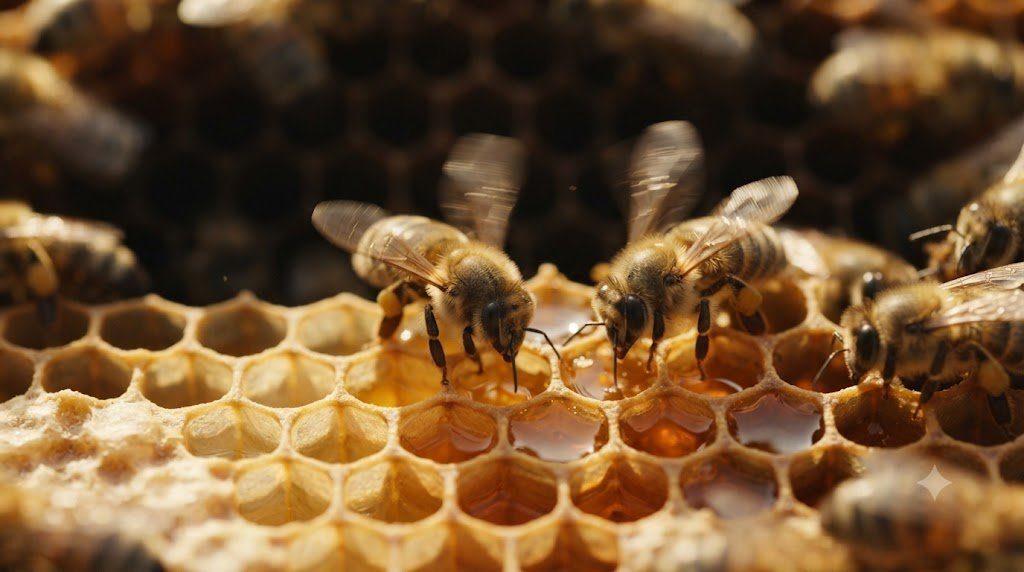
Upon receiving a load of nectar from a returning forager, a receiver bee retreats to a quiet vertical comb face in the upper brood nest or lower super. Facing upward, she opens her mandibles and repeatedly regurgitates a thin film of warm nectar across the unfolded surface of her glossa (tongue), holds the stretched droplet exposed to the warm dry air of the hive for 5 to 10 seconds, sucks it back into her crop, and repeats the cycle 80 to 100 times over 20 minutes. This exposes a massive surface-area-to-volume film to 34°C hive air, flashing off the initial 15% to 25% of water while thoroughly mixing hypopharyngeal invertase into the droplet.
Phase 2: Thin-Film Cell Spreading and Coordinated Entrance Fanning
Next, the receiver bee deposits the partially concentrated droplet into an empty hexagonal wax cell—not filling the cell to the brim, but painting a tiny hanging droplet along the upper ceiling wall of the 13-degree upward-tilted cell so only 20% to 30% of the cell volume is occupied. By spreading incoming nectar across thousands of partial cells (which is why a colony needs 2 to 3 empty drawn supers during a heavy flow even if the final cured crop will only fill 1 super!), the bees maximize evaporative surface area. Simultaneously, hundreds of fanning workers anchor their tarsal claws to the bottom board and inner walls in organized chains: one side of the entrance fans warm, moisture-saturated air OUT of the hive while the opposite side pulls drier ambient air IN, operating as a counter-current industrial food dehydrator day and night.
Water Activity ($a_w < 0.60$) and Osmophilic Yeast Inhibition
Once the moisture content drops below 18.0% to 18.6%, the water activity ($a_w$—the ratio of the vapor pressure of water in the honey to the vapor pressure of pure water) falls below 0.60. At $a_w < 0.60$, virtually every free water molecule is tightly bound via hydrogen bonding to fructose and glucose hydroxyl groups. If a bacterial cell or yeast spore lands in 17.5% moisture honey, hypertonic osmotic pressure immediately sucks the intracellular water out of the microbe via plasmolysis, desiccating it into dormancy. Recognizing via antennal hygrosensors that the honey has reached this safe threshold, wax-secreting bees cap the cell with an airtight, snow-white dome of pure newly secreted beeswax.
Hydroxymethylfurfural (HMF) Kinetics and Maillard Thermal Degradation
Why do international honey quality standards (Codex Alimentarius and the European Union Council Directive 2001/110/EC) enforce a strict maximum legal ceiling of 40 mg/kg of Hydroxymethylfurfural (HMF) for table honey (and 80 mg/kg for tropical honeys)? Because HMF is the definitive chemical clock of thermal abuse and storage aging!
Freshly capped raw honey inside the comb contains virtually zero HMF (0.5 to 3.0 mg/kg). However, when hexose monosaccharides—specifically D-fructose—are exposed to heat in the naturally acidic environment of honey (pH 3.8, catalyzed by gluconic acid), fructose undergoes an acid-catalyzed dehydration reaction losing three water molecules ($C_6H_{12}O_6 – 3H_2O \rightarrow C_6H_6O_3$) to form the cyclic aldehyde 5-hydroxymethylfurfural (HMF). Simultaneously, free amino acids (proline and lysine) react with reducing sugars via the non-enzymatic Maillard reaction, darkening the honey from water-white to amber-brown and destroying delicate floral volatiles.
Time-Temperature Half-Life of Diastase and HMF Doubling Rates
The rate of HMF formation increases exponentially with temperature: holding honey at 20°C (68°F) requires 2 to 4 years to reach 40 mg/kg HMF; holding honey in a hot warehouse or warming cabinet at 40°C (104°F) reaches 40 mg/kg in 30 to 50 days; overheating honey to 70°C (158°F) generates 40 mg/kg HMF in less than 9 to 15 hours while destroying 50% of its natural diastase enzyme activity! Worse yet, HMF above 150 mg/kg is acutely toxic to honey bee midgut cells—which is why you must NEVER boil sugar syrup with lemon juice or vinegar on a stove to make home-cooked ‘invert syrup’ for winter bee feed!
Commercial Grading, Pfund Colorimetry, and Food-Safety Standards
Transforming capped honey frames from the apiary into shelf-stable, legally compliant retail jars or bulk commercial drums requires adherence to international physicochemical standards established by the USDA Grades of Extracted Honey and the Codex Alimentarius Commission (Standard 12-1981). Whether marketing varietal artisanal jars at a farmers’ market or wholesaling 650-pound steel drums, grading honey by optical color, moisture content, floral purity, and clarity establishes objective market value.
In international trade, honey color is measured on the continuous millimeter scale of the Pfund Color Grader (or digital spectrophotometric transmittance at 560 nm), ranging from nearly colorless Water White (< 8 mm Pfund) through Dark Amber (> 114 mm Pfund). Generally, lighter spring honeys (acacia, white clover, fireweed, tupelo) feature delicate, mild floral esters, while dark late-summer and autumn honeys (buckwheat, heather, chestnut, forest honeydew) boast 3x to 5x higher total polyphenolic antioxidant capacity and mineral ash content.
| USDA / Pfund Color Grade | Pfund Scale Range (mm) | Optical Appearance | Representative Floral Sources | Flavor & Antioxidant Profile |
|---|---|---|---|---|
| Water White | 0 to 8 mm | Crystal clear / pale platinum | Fireweed, Black Locust (Acacia), Star Thistle | Ultra-delicate floral notes; lowest mineral ash |
| Extra White | 9 to 17 mm | Pale straw shimmer | Sweet Clover, White Dutch Clover, Basswood | Clean, classic sweet floral; top comb-honey grade |
| White | 18 to 34 mm | Bright golden champagne | Alfalfa, Orange Blossom, Sourwood, Sage | Aromatic, balanced sweetness; high consumer demand |
| Extra Light Amber | 35 to 50 mm | Warm sunlit gold | Wildflower blends, Palmetto, Sunflower, Tupelo | Rich floral complexity with smooth lingering finish |
| Light Amber | 51 to 85 mm | Rich amber-bronze | Eucalyptus, Goldenrod, Red Clover, Tulip Poplar | Full-bodied, malty-floral notes; high enzyme activity |
| Amber | 86 to 114 mm | Deep reddish-copper | Autumn Aster, Manuka, Wild Thyme, Sumac | Bold, herbaceous, complex mineral and phenolic profile |
| Dark Amber | > 114 mm (up to 140) | Dark mahogany / espresso | Buckwheat, Heather, Chestnut, Pine Honeydew | Robust molasses-malt tang; highest polyphenol antioxidants |
Sanitary Bottling, Labeling Compliance, and Clostridium botulinum Warnings
When packaging raw floral honey for public sale, presentation and legal label compliance build immediate consumer confidence while protecting the producer from regulatory liability:
- Pre-Warming and De-Bubbling Glass Jars: Always bottle into clean, bone-dry glass Queenline, Classic Hex, or Muth corked jars (Even 3 drops of rinse water left inside a newly washed jar will dilute the top surface layer of honey above 22% moisture and trigger mold or yeast fermentation!). Hold the settling tank honey at 30°C–32°C (86°F–90°F) and tilt the jar slightly as you open the scissor gate so the ribbon of honey slides smoothly down the inside glass wall without trapping air bubbles.
- Mandatory Infant Botulism Label Warning: Because raw agricultural dust and floral surfaces naturally harbor dormant environmental spores of Clostridium botulinum (which cannot germinate in honey’s low $a_w < 0.60$, but CAN colonize the immature, low-acid intestinal flora of human infants prior to 1 year of age), every honey label must prominently display: “WARNING: Do not feed honey to infants under one year of age.”
- Dual Net Weight Declaration & Producer Identity: Federal and state weights-and-measures laws require the net weight to be printed in the lower 30% of the principal display panel in both avoirdupois and metric units (e.g., NET WT 16 OZ (1 LB) 454g) alongside the common name (‘Pure Raw Honey’), floral source if monofloral, and the full physical street address or city/state/zip of the packer/apiary.
Because honey has a specific gravity of ~1.42 compared to water’s 1.00, volume ounces (Fluid Ounces) and weight ounces (Net Weight Ounces) are NOT equal! A standard 8-fluid-ounce (1 cup) canning jar holds exactly 12 ounces (0.75 lb) of honey by weight; a 1-pint (16 fl oz) jar holds 1.5 pounds (24 oz) of honey; and a 1-gallon jug holds approximately 12 pounds (5.44 kg) of honey. Always sell and label honey by NET WEIGHT, never fluid volume!
Frequently Asked Questions: Honey Ripening, Extraction, and Crystallization
Can I harvest honey from frames that previously held brood?
Technically yes—the honey stored inside clean dark comb that once held worker brood is chemically safe and identical in moisture to white-comb honey. However, old brood cocoons contain larval propolis varnish and water-soluble pigments that slightly darken the color and impart a heavier, earthier note compared to pristine virgin white honey supers, and you must NEVER harvest honey from brood frames that have ever been exposed to synthetic miticide strips (such as Amitraz/Apivar or Coumaphos). Keeping dedicated honey supers strictly for honey storage ensures water-white clarity and zero miticide carryover.
How do I fix a batch of honey that started to ferment slightly?
If a bucket of 19.2% moisture honey develops a slight fruity yeast aroma early in storage, you can salvage it for personal culinary baking or fermented honey-wine (Mead / Hydromel) production! Heating the honey briefly in a water bath to 63°C (145°F) for 30 minutes kills active Zygosaccharomyces yeast cells and drives off trace ethanol, though it can no longer be sold as ‘Raw Unheated Honey’. Better yet, pitching Saccharomyces cerevisiae wine yeast (such as Lalvin EC-1118 or 71B) into diluted 1:3 honey-water must transforms high-moisture honey into world-class artisanal mead.
Why did my creamed honey turn out gritty or separate at room temperature?
Gritty creamed honey is almost always caused by one of two mistakes during the Dyce process: either the starter seed crystal was added while the liquid base honey was still warm (>28°C / 82°F), melting the tiny seed crystals so only a few large surviving crystals grew into coarse sand; OR the seeded jars were stored in a warm 24°C room instead of a cold 14°C (57°F) incubator for the first 7 days. Re-liquefy the batch completely at 40°C, cool to 23°C, re-seed with 10% ultrafine starter, and chill at 14°C.