To the novice beekeeper, a honey bee swarm hanging from a high oak branch represents a sudden crisis and the loss of half the hive’s honey-gathering workforce. Biologically, however, reproductive swarming (colony fission) is the ultimate evolutionary triumph of the Apis mellifera superorganism. Whereas solitary insects reproduce simply by laying eggs, a honey bee colony only achieves true darwinian reproduction when it divides into two or more autonomous functional units—sending the old mated queen and 50% to 70% of the adult workers out to establish a new nest cavity while leaving developing virgin queens and abundant stores behind in the parental hive.
For the productive apiarist, uncontrolled swarming decimates the foraging population right as the primary spring nectar flow peaks, collapses surplus honey harvests, and creates nuisance conflicts in suburban neighborhoods. Preventing swarming without fighting the colony’s natural biological instincts requires a precise mastery of pheromonal dilution mechanics, brood-nest congestion signals, the classic Demaree method, and strategic walk-away or mated-queen splits.
The Neuro-Pheromonal Cascade That Triggers Swarm Preparation
Swarming is never a spontaneous decision made on a warm afternoon; it is the culmination of a 14-to-21-day physiological cascade triggered by four intersecting environmental and internal colony metrics:
- Queen Mandibular Pheromone (QMP) Dilution: A healthy mated queen secretes roughly 200 micrograms of 9-ODA and 9-HDA daily, distributed across the colony via trophallaxis (mouth-to-mouth food sharing) and antennal contact by her retinue workers. When adult colony populations surge past 40,000 bees and dense curtains of young nurse bees congest the lower brood chamber, physical traffic slows down. The per-capita concentration of QMP reaching peripheral workers drops below the inhibitory threshold, releasing their repression on rearing queen cells.
- Brood Nest Backfilling (Nectar Locking): During an intense early spring nectar flow, incoming foragers pass dilute nectar to receiver bees, who deposit droplets directly into empty cells inside the brood nest for rapid evaporation before moving it upward. If there is insufficient drawn comb above the brood nest, receiver bees ‘backfill’ the brood area, leaving the queen with nowhere to lay eggs.
- Skewed Nurse-to-Larva Demographics: Following three weeks of heavy spring egg-laying, thousands of callow worker bees emerge simultaneously. Within 4 to 8 days, their hypopharyngeal and mandibular glands swell with royal jelly secretions. When the ratio of jelly-producing nurse bees exceeds the number of open larvae demanding food, excess royal jelly accumulates, driving nurses to deposit jelly into wax queen cups along the lower margins of frames.
- Abundant Drone Brood and Lengthening Photoperiod: Colonies initiate drone rearing 4 to 6 weeks prior to swarm preparation to ensure sexually mature drones (which require 24 days to emerge plus 12–16 days of post-emergence maturation) saturate local Drone Congregation Areas before virgin queens take flight.
Pre-Swarm Behavioral Changes: Queen Slimming and Scout Consensus
Once the queen lays fertilized eggs inside vertical peanut-shaped swarm cups (Day 1), nurse bees feed the larvae copious royal jelly. By Day 4 or 5, retinue workers drastically reduce feeding the reigning mother queen and begin physically vibrating and pushing her across the comb—a behavior known as ‘balling’ or ‘shaking signals’ (dorso-ventral abdominal vibrations). Deprived of rich proteinaceous jelly, the queen’s ovaries shrink and her abdomen loses roughly 25% to 35% of its body mass over 5 days, making her light enough to become airborne.
Around Day 8 or 9—frequently coinciding with the waxing over (capping) of the first swarm cells—if weather is warm and calm between 10:00 AM and 2:00 PM, workers engorge their honey crops with 35 to 55 milligrams of cured honey (enough metabolic fuel for 3 to 4 days of comb construction) and pour out of the hive entrance in a swirling cloud of 15,000 to 25,000 bees.
Before destroying a queen cell, always diagnose its position and context! Swarm cells are constructed in large numbers (8 to 25+ cells) along the bottom bars and lower side margins of frames in populous, booming hives. Supersedure/Emergency cells are usually fewer (1 to 4 cells) built directly on the middle face of the comb over converted worker cells when an old queen’s pheromone output or spermatheca fails. Destroying supersedure cells in a failing hive renders the colony hopelessly queenless!
Comparative Analysis of Swarm Control & Split Methodologies
Different apiary goals demand different interventions. Use the engineering decision matrix below to choose the right swarm prevention or remediation protocol based on whether your primary goal is maximizing surplus honey in a single hive or expanding your total colony count.
| Management Protocol | Ideal Timing in Swarm Cycle | Effect on Colony Count | Impact on Current Honey Crop | Key Operational Requirement |
|---|---|---|---|---|
| Brood Box Reversal & Checkerboarding | Early Spring (Before cups have eggs) | No increase (1 hive remains 1) | Maximizes harvest by keeping workforce unified | Strong colony filling top box; open drawn comb |
| The Demaree Method (Vertical Split) | Pre-Swarm or Charged Cups present | No increase (recombines workforce) | Very High yield (simulates swarm inside 1 tower) | Requires finding the queen + Queen Excluder + extra deep |
| Walk-Away Split (Emergency Queen) | Charged/Capped Swarm Cells present | Doubles colony count (1 -> 2+) | Reduces immediate spring yield by 40–60% | 28-day brood break in queenless half; local drones needed |
| Mated Queen Nucleus Split | Strong buildup (Preventive or Active) | Increases count (creates 5-frame nuc) | Minimal impact if only 2–3 brood frames removed | Requires purchasing or banking a mated queen |
| Pagden Artificial Swarm (Shook Swarm) | Active Swarm Cells with larvae | Temporary split (can reunite later) | Preserves foraging force on original hive stand | Requires moving parent brood box 3 feet away |
The Demaree Method: Simulating a Swarm Without Losing a Single Forager
First published by George W. Demaree of Christiansburg, Kentucky, in the American Bee Journal in 1892, the Demaree method remains the gold standard for commercial and sideliner honey producers who want to completely extinguish the swarming impulse while keeping 100% of the colony’s 50,000+ bees working inside a single vertical stack.
The genius of the Demaree manipulation is that it artificially recreates the exact biological conditions of a cast swarm in the bottom box while drawing all young nurse bees upward into the top box, relieving brood nest congestion and restoring QMP circulation immediately.
Step-by-Step Execution of the Demaree Manipulation
- Locate and Secure the Queen: Inspect the booming brood chambers, locate the reigning queen, and temporarily place her—along with the single frame of mostly capped emerging brood and minimal open larvae she is standing on—into a safe nucleus box beside the hive.
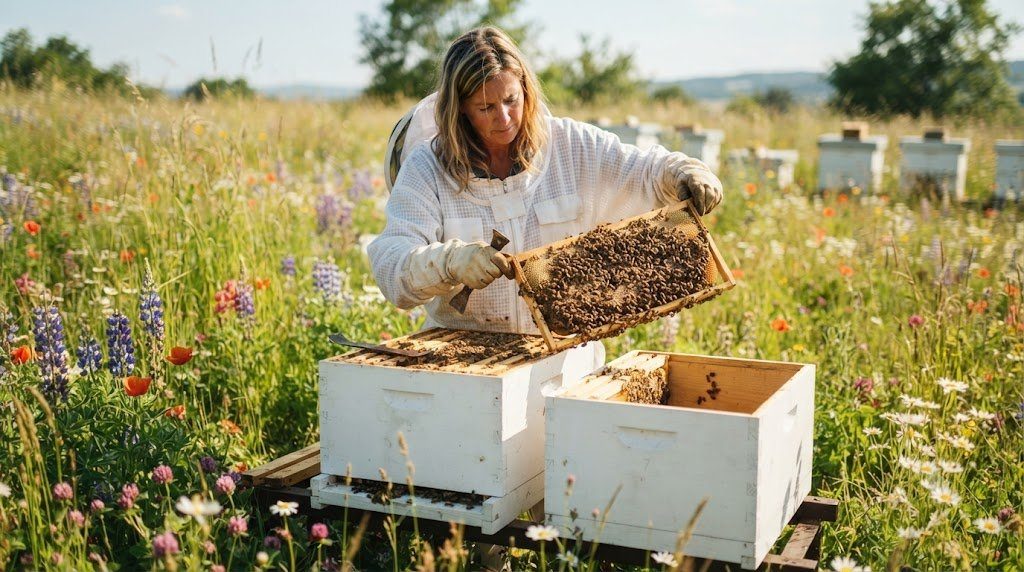
- Reconfigure the Bottom Brood Chamber: Place the single frame containing the queen in the center of the bottom hive body on the original bottom board. Fill the remaining 7 or 9 slots of this bottom box completely with empty drawn worker comb (or a mix of drawn comb and foundation frames on the edges). Ensure zero queen cells exist in this box.
- Install the Queen Excluder and Honey Supers: Place a precision metal wire queen excluder directly over the bottom brood box. Stack two or three honey supers (with drawn comb) directly above the excluder to create physical spatial separation.
- Place the Remaining Brood in the Top Box: Above the honey supers, place a second deep brood chamber containing all the remaining 7 to 9 frames of open and capped brood, pollen, and honey. Meticulously inspect every frame in this top box and pinch/destroy all existing queen cells.
- The 7-to-10-Day Follow-Up Inspection: Because the top brood box is separated from the queen below by two honey supers and an excluder, the young nurse bees who rush upstairs to keep the open larvae warm feel partially queenless and will often pull 2 to 5 emergency queen cells. Seven days after performing the Demaree, inspect ONLY the top brood box and destroy any emergency cells—or harvest a frame with a prime cell to start a mating nuc! Within 21 days, all brood in the top box emerges, and those cells are immediately backfilled with surplus honey while the queen lays an expansive new brood nest below.
Executing High-Success Walk-Away Splits and Nucleus Divisions
If upon opening a hive in late April or May you discover 10 charged queen cells filled with royal jelly and C-shaped larvae—or recently capped cells—merely pinching the cells will almost never stop the colony from swarming. Once the queen has been slimmed down and the physiological swarm switch is flipped, pinching cells simply forces the bees to build emergency replacements or swarm immediately on an empty stomach. At this stage, you must satisfy their instinct to divide.
The Classic Old-Queen Nucleus Split (Artificial Swarm)
The cleanest and fastest way to halt an active swarm preparation is to remove the mother queen from the parent hive:
- Find the mated mother queen and move her—along with 2 frames of capped/emerging brood (with all queen cells carefully removed), 1 frame of honey and bee bread, and 2 frames of empty drawn comb or foundation—into a 5-frame nucleus hive.
- Shake the adhering nurse bees from 2 additional brood frames into the nucleus box so that after older field bees fly back to the parent stand, a dense carpet of young nurse bees remains to keep the nuc warm. Move the nuc to an out-yard at least 2 miles away, or plug its entrance loosely with green grass for 48 hours on a separate stand in the same yard.
- In the original parent hive, select the single best frame containing 2 large, well-fed, unsealed or freshly capped swarm cells located close together on the comb. Destroy all other queen cells on the remaining frames so the colony does not cast secondary ‘afterswarms’ (cast swarms led by multiple emerging virgins), and insert 3 empty drawn combs into the center of the brood nest.
When allowing a split or parent colony to rear its own queen from a swarm cell or fresh egg, mark your apiary calendar and keep your hive tool out of the brood nest during the mating window! A queen takes 16 days from egg to emergence, 5–7 days to harden her cuticle and reach sexual maturity, 1–3 days of mating flights, and 3–4 days post-mating before her first eggs appear. Inspecting a hive during days 20–26 risks startling or balling the nervous newly mated queen.
Managing Afterswarms and Recombining Splits for the Main Flow
A prime swarm leaves with the old mated queen, but if a strong parent colony is left with 15 capped queen cells of staggered ages, the first virgin queen to emerge (pipping out on Day 16) will emit high-frequency substrate vibrations known as tooting (400–500 Hz), while her sister virgins still trapped inside their wax cells respond with lower-pitched quacking (300–350 Hz). Instead of fighting her sisters to the death, the first virgin may depart with a secondary ‘afterswarm’ (or cast swarm) of 5,000 to 8,000 bees. Reducing the parent hive to two prime cells of identical age on a single frame completely prevents afterswarming, ensuring a powerful, unified colony ready to harvest the summer nectar flow.
Acoustic Tomography and Nest-Cavity Scout Quorum Sensing
What happens after a prime swarm of 20,000 bees exits the parental hive and coalesces into a beard-like bivouac cluster on a nearby tree limb? Landmark behavioral research by Dr. Thomas Seeley on Appledore Island revealed one of the most democratic collective decision-making systems in nature: honey bee house-hunting quorum sensing.
Roughly 3% to 5% of the bees in the hanging swarm cluster—around 500 to 800 oldest foragers—act as nest-site scouts. Flying out in all directions across a 30-square-kilometer circle, these scouts inspect hollow trees, rock crevices, wall voids, and beekeeper bait hives against six strict architectural criteria:
- Internal Cavity Volume of 30 to 60 Liters (Ideally ~40 Liters / One Deep Langstroth Box): Cavities smaller than 15 liters cannot hold enough winter honey; cavities larger than 100 liters are too difficult to heat and propolize.
- Entrance Area of 12 to 30 $cm^2$ (2 to 5 sq. inches): Easily defended by a dozen guard bees against hornets, robber bees, and mice.
- Entrance Height 3 to 5 Meters Above Ground: Conceals the colony from terrestrial predators like bears and skunks.
- Entrance Positioned at the Floor of the Cavity Facing South/Southeast: Preserves the rising thermal heat dome at the top of the cavity while draining winter wall condensation out the bottom.
- Presence of Old Drawn Wax Comb or Propolis Scent: Signals that a previous honey bee colony successfully lived in the cavity.
The Piping Signal That Launches the Swarm into Flight
Scouts returning to the hanging bivouac perform waggle dances on the outer surface of the cluster, with the number of dance circuits directly proportional to the architectural quality of the cavity they discovered. Once 20 to 30 scouts accumulate simultaneously at a single superior cavity (the Quorum Threshold), they fly back to the swarm cluster and begin emitting high-pitched thoracic worker piping signals (350–450 Hz bursts lasting 0.8 seconds) while burrowing through the cluster. This piping instructs all 20,000 bees in the cold mantle to warm their flight muscles to 37°C; once the entire cluster reaches flight temperature, the swarm lifts off in a unified cloud and streak-flies scouts guide the mass straight to their new home.
Seasonal Colony Management Calendar for Swarm Biology and Reproductive Preventive Management
Successfully applying the principles of Swarm Biology and Reproductive Preventive Management in a working apiary requires synchronizing every human manipulation with the colony’s internal phenological clock and external botanical degree-day accumulation. A manipulation that builds booming populations during an ascending spring pollen flow can trigger robbing, queen rejection, or absconding if attempted during a late-summer nectar dearth.
Across temperate and continental zones, colony population dynamics follow a predictable four-phase annual curve: the Late-Winter Brood Initiation Phase (January–March), the Exponential Spring Turnover & Reproduction Phase (April–June), the Summer Peak Storage & Consolidation Phase (July–August), and the Autumn Diutinus Transition & Winter Contraction Phase (September–December). Use the operational field matrix below to align your hive inspections with the colony’s biological priorities at each stage.
| Phenological Season | Adult Colony Population | Primary Queen & Brood Activity | Critical Apiarist Field Protocol | Mistakes to Strictly Avoid |
|---|---|---|---|---|
| Early Spring (Willow/Maple Bloom) | 12,000 to 20,000 (Turnover phase) | Oviposition ramps to 600–1,000 eggs/day | Verify queenright worker brood; feed 1:1 syrup + pollen sub if weather turns cold | Breaking cluster seal below 13°C (55°F); over-expanding brood nest too early |
| Mid-to-Late Spring (Fruit/Dandelion) | 25,000 to 45,000 (Rapid buildup) | Peak laying (1,500–2,000 eggs/day); drone rearing | Reverse brood boxes; add drawn supers ahead of flow; execute splits/grafting | Waiting until swarm cells are capped to add comb space |
| Peak Summer (Clover/Basswood) | 50,000 to 65,000 (Maximum force) | Brood plateaus; heavy nectar backfilling | Maintain 2–3 supers of drawn surface area; provide afternoon shade & water | Letting honey-bound brood nests shut down queen laying |
| Late Summer / Early Autumn | 30,000 to 40,000 (Winter bee rearing) | Queen lays long-lived diutinus winter cohort | Complete Varroa IPM below 1% threshold; requeen failing colonies in August | Delaying Varroa treatment until October after winter bees are damaged |
| Winter Dormancy (Cluster Phase) | 15,000 to 25,000 (Tight sphere) | Broodless in Nov/Dec; restarts Jan solstice | Verify 60–85 lbs stores, mouse guards, R-20 top insulation, and windbreak | Opening frames in freezing weather or feeding liquid syrup below 10°C |
Field Record-Keeping and Quantitative Hive Evaluation Metrics
Professional queen breeders and Master Beekeepers never rely on memory when managing ten or fifty hives. Maintaining a standardized water-resistant Hive Inspection Card or Digital Telemetry Log attached beneath every outer telescoping cover allows you to track multi-generational performance across five objective scoring criteria (graded on a 1-to-5 scale during every 10-day inspection):
- Brood Viability & Contiguity Score: A score of 5 indicates >92% solid concentric rings of single fertilized eggs, plump C-shaped larvae swimming in royal jelly, and uniform tan cappings. A spotty ‘shotgun’ pattern (<75% solid) signals either inbred diploid drone production (matched sex alleles at the csd locus), failing queen spermatheca, or brood pathology.
- Comb Adherence & Temperament Score: Evaluate whether workers remain calmly walking across the comb face while the frame is held in bright sunlight (Carniolan/Buckfast hallmark) versus running nervously into hanging festoons off the bottom bar or bumping the operator’s veil.
- Foraging Launch Threshold & Weight Gain: Track morning flight initiation temperatures and net weekly weight gain on a reference platform scale hive to identify your top 15% honey-producing mothers for next spring’s grafting bar.
Whenever examining a brood frame for eggs, queen cups, or stock traits, ALWAYS hold the frame directly over the open center of the brood box—never swung out over the grass beside your boots! If the mated queen loses her tarsal grip on the comb edge and drops, she falls safely straight back into her own hive rather than vanishing into tall grass.
Frequently Asked Questions: Honey Bee Genetics, Swarming, and Queens
How often should a productive colony be requeened in a managed apiary?
While a queen honey bee can biologically live for 3 to 5 years, her daily egg-laying capacity and 9-ODA mandibular pheromone output peak during her first full production season and decline by roughly 20% to 30% in her third year. Colonies headed by two-year-old queens are approximately three times more likely to prepare to swarm in spring than colonies headed by vigorous young first-year queens. Therefore, commercial honey producers requeen on a 12-to-24-month cycle—ideally introducing young mated queens in late summer (August/September) when acceptance is high and young queens lay heavily into autumn to build a massive winter cluster.
Can I combine two weak colonies in autumn without finding both queens?
While performing a ‘Newspaper Combine’ (placing two sheets of slit black-and-white newspaper over the top bars of the stronger bottom colony and setting the weaker colony box on top so the bees chew through slowly over 48 hours and merge peacefully) works reliably, leaving both queens inside is a gamble—sometimes the older, inferior queen kills the younger queen, or both queens are injured in combat! Whenever possible, locate and remove the older or inferior queen 4 hours before setting the newspaper combine in place.
Why are my bees bearding heavily on the front of the hive on July evenings?
A dense ‘beard’ of 5,000 to 15,000 bees hanging calmly on the front landing board and lower hive wall on hot, humid summer evenings is completely normal thermoregulatory behavior—NOT a swarm! When all field foragers return home at dusk and internal brood nest temperatures threaten to rise above 35.5°C, older bees move outside onto the front porch so internal fanners have open air channels to cool the brood. In contrast, a true reproductive swarm departs between 10:00 AM and 2:00 PM in a swirling cloud and clusters on a nearby tree limb or fence post.