Selecting the right genetic stock of Western honey bee (Apis mellifera) is one of the most consequential management decisions an apiarist makes. While all managed honey bee lines share the same fundamental anatomy, pheromone communication channels, and eusocial caste hierarchy, thousands of years of geographic isolation across Europe, Western Asia, and North Africa—followed by modern selective breeding—have produced distinct ecotypes and commercial hybrids. Each stock exhibits dramatically different brood-rearing phenology, winter cluster consumption rates, foraging thresholds, propolis collection intensity, and hygienic resistance against Varroa destructor.
Placing a high-prolific southern stock that rears brood year-round into a harsh northern continental winter without supplemental feeding invites starvation by February. Conversely, running a frugal, swarm-prone mountain ecotype in an intensive commercial pollination or long-season southern honey operation without aggressive space management can trigger relentless spring swarming. In this comprehensive genetic reference, we analyze the major Apis mellifera subspecies and selected breeding lines—Italian (A. m. ligustica), Carniolan (A. m. carnica), Russian, Buckfast, Caucasian (A. m. caucasica), Cordovan, and Varroa Sensitive Hygiene (VSH)/Pol-line stocks—to help you match colony genetics to your regional nectar flow and management style.
Evolutionary Lineages and Quantitative Trait Loci in Apis mellifera
Entomological geneticists classify Apis mellifera into four primary evolutionary lineages based on mitochondrial DNA haplotypes, wing venation morphometrics (specifically the cubital index and discoidal shift), and microsatellite markers: Lineage A (African), Lineage M (Western and Northern European, including the dark bee A. m. mellifera), Lineage C (Eastern European and Mediterranean, including Italian and Carniolan bees), and Lineage O (Near and Middle Eastern). The vast majority of commercial beekeeping in North America, Europe, and Oceania relies heavily on Lineage C subspecies and their synthetic crossbreeds.
Because honey bee queens are polyandrous—mating in flight at Drone Congregation Areas (DCAs) with 12 to 24 drones—every colony is a superorganism composed of multiple patrilines (subfamilies sharing the same mother queen but different drone fathers). This intracolonial genetic diversity is critical for task allocation thresholds: some patrilines begin ventilating the brood nest at 34.8°C while others wait until 35.5°C, preventing chaotic thermal oscillation and enhancing disease resilience.
Italian Honey Bees (Apis mellifera ligustica): The Prolific Generalist
Originating from the continental peninsula of Italy south of the Alps, Apis mellifera ligustica has been the backbone of commercial beekeeping since Lorenzo Lorraine Langstroth and Moses Quinby imported them in the mid-19th century. Evolved in a warm Mediterranean climate with extended floral availability, Italian bees are characterized by their golden-yellow abdominal tergites, gentle temperament on the comb, low swarming propensity compared to northern dark bees, and extraordinary brood production capacity.
Italian queens begin expanding the brood nest early in late winter—often triggered by lengthening photoperiods rather than actual outside pollen availability—and maintain massive populations through late summer. This makes them unmatched for early spring almond pollination contracts and prolonged summer clover or alfalfa flows. However, their weakness lies in their optimism: Italian colonies continue rearing large sheets of brood during mid-summer nectar dearths and into autumn, consuming prodigious quantities of stored honey and providing continuous reproductive cycles for Varroa mites. Additionally, Italian foragers exhibit high drifting behavior between adjacent hives and notorious robbing tendencies during late-season dearths.
Carniolan Honey Bees (Apis mellifera carnica): The Rapid Spring Sprinter
Native to the Julian Alps of Slovenia, southern Austria, and the Danube valley, Apis mellifera carnica evolved under harsh alpine winters followed by explosive, short-duration spring mountain blooms. Visually darker than Italians—displaying dusky brown-to-black chitin bands accented by dense gray-silver tomentum hair on the abdominal segments—Carniolans are prized for their extreme gentleness, quiet comb adherence during inspections, and acute responsiveness to environmental resource signals.
Unlike Italians, Carniolan colonies overwinter as tight, small, remarkably frugal clusters that consume minimal winter stores. The moment the first natural willow and maple pollen enters the hive in early spring, Carniolan queens accelerate oviposition at an astonishing rate, rapidly building foraging populations in time for early fruit bloom and black locust flows. Conversely, if a sudden cold snap or summer pollen dearth strikes, Carniolan workers immediately curtail brood rearing—even cannibalizing young eggs and larvae to conserve protein reserves. Their primary management challenge is their explosive spring buildup: if an apiarist is even seven days late adding supers or reversing brood boxes during a heavy spring flow, Carniolans will rapidly construct swarm cells and cast prime swarms.
While abdomen color can be misleading due to open mating, true subspecies purity is measured via forewing venation—specifically the Cubital Index (the ratio of vein segment ‘a’ to segment ‘b’ in the third cubital cell). Pure Apis mellifera carnica averages a high cubital index of 2.4 to 3.0, Italian ligustica averages 2.0 to 2.5, while the European dark bee (A. m. mellifera) exhibits a low index below 1.9.
Comparative Performance Matrix of Managed Honey Bee Stocks
To assist apiarists in comparing behavioral, physiological, and seasonal performance traits across major commercial lines, the table below synthesizes field performance metrics gathered across temperate and continental apiary trials.
| Genetic Stock / Ecotype | Spring Buildup & Brood Curve | Winter Food Consumption | Swarming Propensity | Varroa Resistance Mechanism | Ideal Climate & Nectar Regime |
|---|---|---|---|---|---|
| Italian (A. m. ligustica) | Early, continuous, massive plateau all summer | High (60–90 lbs in northern zones) | Low to Moderate | Low baseline; requires active IPM | Mild winters; long, continuous summer flows |
| Carniolan (A. m. carnica) | Explosive on natural pollen; curtails in dearth | Low / Frugal (40–60 lbs); tight cluster | High if congested in spring | Moderate (brood breaks slow mite growth) | Cold winters; short, intense spring/mountain flows |
| Russian Primorsky Stock | Delayed until natural pollen strictly present | Very Low; small winter cluster | High (maintains queen cups year-round) | High (grooming + brood curtailment) | Cold continental climates; variable forage |
| Buckfast Hybrid | Moderate-fast, steady sustainable population | Low to Moderate; strong winter hardiness | Very Low (bred against swarming) | Moderate + high tracheal mite resistance | Cool, damp maritime and northern climates |
| Caucasian (A. m. caucasica) | Slowest spring ramp; peaks mid-summer | Moderate; excellent cold survival | Low | Low-Moderate; heavy propolis envelope | Short-summer northern zones; deep-corolla flora |
| VSH / Pol-Line Selected | Matches base stock (usually Italian/Carniolan) | Moderate (depends on background stock) | Low to Moderate | Very High (uncapping/removing infested pupae) | All regions; essential for chemical-free/low-input yards |
Russian Primorsky Bees: Co-Evolution with Varroa destructor
In the mid-1990s, the USDA-ARS Honey Bee Breeding, Genetics, and Physiology Laboratory in Baton Rouge, Louisiana, imported germplasm from the Primorsky Krai region of far-eastern Russia along the Sea of Japan. Pioneer settlers had brought European honey bees to Vladivostok in the late 1800s, placing Apis mellifera directly into the native geographic range of the Asian honey bee (Apis cerana)—the original evolutionary host of Varroa destructor. Over more than a century of natural selection in harsh Siberian-maritime conditions, Primorsky honey bees developed innate behavioral defenses against the parasite.
Russian honey bees exhibit three distinct management peculiarities that every beekeeper must understand before introducing them to an apiary:
- Strict Pollen-Coupled Brood Rearing: Russian colonies refuse to rear brood on stored carbohydrate syrup alone. They remain in a tight winter cluster until genuine environmental pollen flows begin, and they shut down brood rearing abruptly when nectar ceases. This natural shortening of the brood season deprives Varroa mites of the capped pupal cells required for reproduction.
- Perpetual Queen Cups (Supercedure/Swarm Readiness): Unlike Italian colonies that only build queen cups when preparing to swarm or supersede, Russian colonies routinely maintain polished queen cups on the bottom bars of frames throughout the active season. An inexperienced beekeeper inspecting a Russian hive may panic and destroy these cups, unaware that they are empty standby structures until an egg is actually deposited.
- Heightened Allo-Grooming and Hygienic Uncapping: Russian workers display elevated rates of auto-grooming and allo-grooming, physically biting and amputating the legs of phoretic Varroa mites riding on adult bees, alongside heightened sensitivity to mite-infested brood.
Brother Adam’s Buckfast Bee and Caucasian Propolis Architecture
When the Isle of Wight disease (caused by the tracheal mite Acarapis woodi and viral coinfections) devastated British native dark bees (Apis mellifera mellifera) in the early 20th century, Brother Adam (Karl Kehrle) at Buckfast Abbey in Devon, England, embarked on one of the most rigorous controlled-mating breeding programs in agricultural history. Utilizing an isolated moorland mating station on Dartmoor and traveling across Europe, the Middle East, and Africa to collect landrace germplasm, Brother Adam developed the Buckfast bee—a stabilized synthetic hybrid combining traits from Italian, French leather-colored, Anatolian, Cecropia (Greek), and Saharan stocks.
The Anatolian and Cecropia Influence in Buckfast Lines
True pedigree Buckfast bees are celebrated for their ability to forage in cool, overcast, drizzly weather that keeps pure Italian bees grounded inside the hive. They exhibit exceptional tracheal mite resistance, minimal propolis sticky bridge building (thanks to Cecropia heritage), remarkably low swarming inclination, and calm demeanor. However, when Buckfast queens open-mate over two or three generations with unselected local drones (F2 and F3 crosses), heterosis breaks down and colonies can occasionally exhibit defensive segregation—underscoring the importance of purchasing F1 production queens from breeders who maintain pure inbred mother lines via instrumental insemination.
Caucasian Bees (Apis mellifera caucasica) and the Propolis Envelope
Originating from the high valleys of the Central Caucasus Mountains in Georgia, Apis mellifera caucasica possesses the longest proboscis (tongue length reaching 7.0 to 7.2 mm) of any Western honey bee subspecies. This anatomical specialization allows Caucasian foragers to extract nectar from deep-corolla legumes such as red clover (Trifolium pratense) that short-tongued Italians (6.3–6.5 mm) cannot reach. Caucasian bees are also extreme propolizers, coating the interior walls of the hive and building elaborate resin curtains across the entrance in autumn. While 20th-century beekeepers bred against propolis because it glued frames together, modern immunology research by Dr. Marla Spivak has demonstrated that a rich antimicrobial propolis envelope significantly downregulates the colony’s chronic immune gene activation, suppressing chalkbrood (Ascosphaera apis) and American foulbrood spores.
Varroa Sensitive Hygiene (VSH), Pol-Line, and Minnesota Hygienic Breeding
Modern apicultural genetics has pivoted from geographical subspecies selection toward targeted functional trait selection—specifically neuro-olfactory hygiene directed against Varroa destructor. There are two distinct but complementary hygienic mechanisms currently bred into commercial North American and European queens:
- General Hygienic Behavior (Freeze-Killed Brood Assay): Pioneered by Dr. Marla Spivak at the University of Minnesota, colonies are screened using a liquid nitrogen cylinder poured onto a section of capped purple-eyed pupae. Colonies whose nurse bees uncap and completely remove >95% of the freeze-killed brood within 24 hours possess superior resistance to American foulbrood, chalkbrood, and moderate suppression of Varroa.
- Varroa Sensitive Hygiene (VSH) and Ankle-Biter/Groomer Lines: Developed at the USDA-ARS Baton Rouge laboratory (originally termed Suppression of Mite Reproduction or SMR), VSH bees possess heightened antennal olfactory receptor neurons sensitive to specific cuticular hydrocarbons and brood damage pheromones emitted by pupae parasitized by reproducing female Varroa mites. Nurse bees selectively uncap the cell around days 13–16 of development, disrupting the mite’s reproductive cycle, exposing the fragile immature male and daughter mites to desiccation, and frequently recapping the surviving bee pupa.
Never assume that a queen labeled ‘VSH’ or ‘Survivor Stock’ eliminates the need for monthly alcohol wash monitoring. True VSH is an additive polygenic trait; when a VSH breeder queen mates openly with local drones (producing ‘VSH-cross’ production queens), daughters express roughly 50% of the pure trait, which slows mite exponential growth but still requires autumn threshold verification.
Selecting and Introducing New Genetic Stock into Your Apiary
When transitioning an existing colony from one subspecies or genetic line to another—for example, requeening an overly defensive or high-consumption Italian hive with a gentle Carniolan or VSH queen in late summer—remember that complete worker population turnover takes exactly 42 to 49 days (21 days from the new queen’s first egg to emergence, plus 3 to 4 weeks for the previous queen’s last workers to age out as foragers). Furthermore, pheromone acceptance during introduction varies by subspecies: introducing a dark Carniolan or Russian queen into a strongly yellow Italian colony during a nectar dearth requires a slower release—such as a push-in comb cage over emerging brood—rather than a standard 3-day candy plug, ensuring nurse bees fully acclimate to her unique mandibular pheromone profile before she walks freely on the comb.
Instrumental Insemination vs. Isolated Mating Stations in Stock Preservation
Maintaining pure genetic lines of Apis mellifera in a landscape saturated with feral colonies and neighboring hobbyist hives presents a formidable reproductive challenge. Because virgin queens fly 1.5 to 5.0 kilometers from their hive to mate in mid-air at heights of 15 to 30 meters inside Drone Congregation Areas (DCAs) containing 10,000 to 30,000 drones from dozens of surrounding apiaries, simple open mating rapidly dilutes specialized traits within two generations. Professional breeder apiaries preserve genetic purity through three controlled mating architectures:
- Microsurgical Instrumental Insemination (II): Using a stereoscopic microscope, precision Harbo or Schley syringe apparatus, and carbon dioxide ($CO_2$) narcosis, breeders collect 8 to 12 microliters of semen from selected mature pedigree drones and inject it directly past the vaginal valve Fold into the median oviduct of a virgin queen. A second 10-minute $CO_2$ treatment 24 hours later stimulates the queen’s metabolic transition to oviposition without a mating flight.
- Geographic Island & High-Alpine Mating Stations: European Carniolan and Buckfast breeders utilize isolated North Sea barrier islands (such as Norderney or Wangerooge) or high alpine valleys surrounded by 2,500-meter mountain peaks devoid of feral trees, stocking the valley exclusively with 40 to 60 sister drone-mother colonies.
- Evening Sunset Mating (Moonlight Mating Offset): Pioneered for specialty breeding, virgin queens and selected drone colonies are kept in dark cold storage until 5:30 PM—after all local feral drones have returned to their hives for the day—and then stimulated with warm syrup to execute nuptial flights during the final 90 minutes of evening daylight in total genetic isolation.
Evaluating Heterosis (Hybrid Vigor) vs. F2 Outbreeding Depression
When two distinct, inbred homozygous breeder lines are crossed—such as an inbred Carniolan mother line crossed with an inbred Italian or VSH drone line—the resulting F1 hybrid workers frequently display heterosis (hybrid vigor), outperforming both parental lines in foraging speed, brood viability, and honey yield. However, if a beekeeper raises daughters (F2 queens) from that F1 hybrid queen via open mating, genetic recombination often produces unpredictable segregates: some colonies remain gentle and productive, while others exhibit heightened defensiveness and uneven brood patterns. Consequently, sideliner apiarists raising their own queens achieve the most consistent results by grafting from selected local survivor stock or pure line-bred breeder queens rather than unstable multi-way hybrids.
Seasonal Colony Management Calendar for Apis mellifera Subspecies Genetics
Successfully applying the principles of Apis mellifera Subspecies Genetics in a working apiary requires synchronizing every human manipulation with the colony’s internal phenological clock and external botanical degree-day accumulation. A manipulation that builds booming populations during an ascending spring pollen flow can trigger robbing, queen rejection, or absconding if attempted during a late-summer nectar dearth.
Across temperate and continental zones, colony population dynamics follow a predictable four-phase annual curve: the Late-Winter Brood Initiation Phase (January–March), the Exponential Spring Turnover & Reproduction Phase (April–June), the Summer Peak Storage & Consolidation Phase (July–August), and the Autumn Diutinus Transition & Winter Contraction Phase (September–December). Use the operational field matrix below to align your hive inspections with the colony’s biological priorities at each stage.
| Phenological Season | Adult Colony Population | Primary Queen & Brood Activity | Critical Apiarist Field Protocol | Mistakes to Strictly Avoid |
|---|---|---|---|---|
| Early Spring (Willow/Maple Bloom) | 12,000 to 20,000 (Turnover phase) | Oviposition ramps to 600–1,000 eggs/day | Verify queenright worker brood; feed 1:1 syrup + pollen sub if weather turns cold | Breaking cluster seal below 13°C (55°F); over-expanding brood nest too early |
| Mid-to-Late Spring (Fruit/Dandelion) | 25,000 to 45,000 (Rapid buildup) | Peak laying (1,500–2,000 eggs/day); drone rearing | Reverse brood boxes; add drawn supers ahead of flow; execute splits/grafting | Waiting until swarm cells are capped to add comb space |
| Peak Summer (Clover/Basswood) | 50,000 to 65,000 (Maximum force) | Brood plateaus; heavy nectar backfilling | Maintain 2–3 supers of drawn surface area; provide afternoon shade & water | Letting honey-bound brood nests shut down queen laying |
| Late Summer / Early Autumn | 30,000 to 40,000 (Winter bee rearing) | Queen lays long-lived diutinus winter cohort | Complete Varroa IPM below 1% threshold; requeen failing colonies in August | Delaying Varroa treatment until October after winter bees are damaged |
| Winter Dormancy (Cluster Phase) | 15,000 to 25,000 (Tight sphere) | Broodless in Nov/Dec; restarts Jan solstice | Verify 60–85 lbs stores, mouse guards, R-20 top insulation, and windbreak | Opening frames in freezing weather or feeding liquid syrup below 10°C |
Field Record-Keeping and Quantitative Hive Evaluation Metrics
Professional queen breeders and Master Beekeepers never rely on memory when managing ten or fifty hives. Maintaining a standardized water-resistant Hive Inspection Card or Digital Telemetry Log attached beneath every outer telescoping cover allows you to track multi-generational performance across five objective scoring criteria (graded on a 1-to-5 scale during every 10-day inspection):
- Brood Viability & Contiguity Score: A score of 5 indicates >92% solid concentric rings of single fertilized eggs, plump C-shaped larvae swimming in royal jelly, and uniform tan cappings. A spotty ‘shotgun’ pattern (<75% solid) signals either inbred diploid drone production (matched sex alleles at the csd locus), failing queen spermatheca, or brood pathology.
- Comb Adherence & Temperament Score: Evaluate whether workers remain calmly walking across the comb face while the frame is held in bright sunlight (Carniolan/Buckfast hallmark) versus running nervously into hanging festoons off the bottom bar or bumping the operator’s veil.
- Foraging Launch Threshold & Weight Gain: Track morning flight initiation temperatures and net weekly weight gain on a reference platform scale hive to identify your top 15% honey-producing mothers for next spring’s grafting bar.
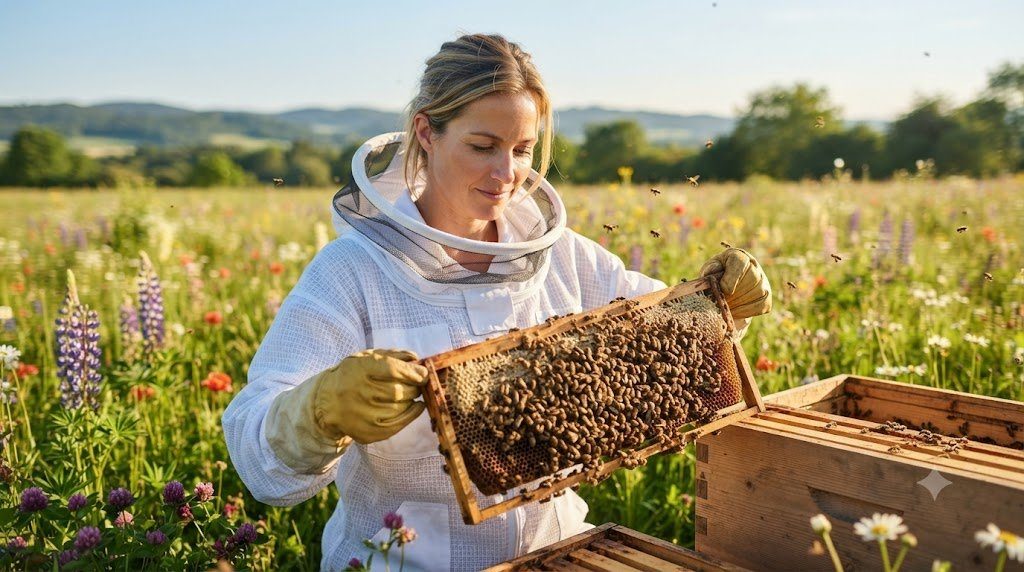
Whenever examining a brood frame for eggs, queen cups, or stock traits, ALWAYS hold the frame directly over the open center of the brood box—never swung out over the grass beside your boots! If the mated queen loses her tarsal grip on the comb edge and drops, she falls safely straight back into her own hive rather than vanishing into tall grass.
Frequently Asked Questions: Honey Bee Genetics, Swarming, and Queens
How often should a productive colony be requeened in a managed apiary?
While a queen honey bee can biologically live for 3 to 5 years, her daily egg-laying capacity and 9-ODA mandibular pheromone output peak during her first full production season and decline by roughly 20% to 30% in her third year. Colonies headed by two-year-old queens are approximately three times more likely to prepare to swarm in spring than colonies headed by vigorous young first-year queens. Therefore, commercial honey producers requeen on a 12-to-24-month cycle—ideally introducing young mated queens in late summer (August/September) when acceptance is high and young queens lay heavily into autumn to build a massive winter cluster.
Can I combine two weak colonies in autumn without finding both queens?
While performing a ‘Newspaper Combine’ (placing two sheets of slit black-and-white newspaper over the top bars of the stronger bottom colony and setting the weaker colony box on top so the bees chew through slowly over 48 hours and merge peacefully) works reliably, leaving both queens inside is a gamble—sometimes the older, inferior queen kills the younger queen, or both queens are injured in combat! Whenever possible, locate and remove the older or inferior queen 4 hours before setting the newspaper combine in place.
Why are my bees bearding heavily on the front of the hive on July evenings?
A dense ‘beard’ of 5,000 to 15,000 bees hanging calmly on the front landing board and lower hive wall on hot, humid summer evenings is completely normal thermoregulatory behavior—NOT a swarm! When all field foragers return home at dusk and internal brood nest temperatures threaten to rise above 35.5°C, older bees move outside onto the front porch so internal fanners have open air channels to cool the brood. In contrast, a true reproductive swarm departs between 10:00 AM and 2:00 PM in a swirling cloud and clusters on a nearby tree limb or fence post.